

The Roman monetary system was one of the most successful currencies ever created. It lasted, in recognizable form, for nearly seven hundred years. It circulated from the Atlantic coast of Spain to the deserts of Arabia. At its peak, it unified the economies of perhaps a hundred million people under a single, reliable set of coins.
And almost nobody today understands how it actually worked.
This is partly because the Romans used many denominations, and partly because they changed those denominations constantly. A coin called a “denarius” in 200 BC was not the same coin as a “denarius” in AD 200, even though both carried the same name. The Romans were pragmatic about their money — when economic conditions changed, they adjusted the system. When an emperor needed cash, he debased the silver. When inflation ran out of control, a new denomination was introduced. When the old name had lost meaning, the Romans kept using it anyway.
The result is a system that can seem impenetrably complex at first. But there is a simple underlying logic, and once you understand it, you can read Roman coinage across five centuries with confidence. This post will walk you through the essentials.
The Metals That Built an Empire
All Roman coins — from the earliest cast bronzes of the Republic to the late imperial folles — fall into three basic metal categories. You will see these abbreviated constantly in catalogs, dealer listings, and reference books:
| Abbreviation | Latin word | Meaning |
|---|---|---|
| AV | Aureum | Gold |
| AR | Argentum | Silver |
| AE | Aes | Bronze / Copper / Orichalcum (brass alloy) |
“An AR denarius” means a silver denarius. “An AV aureus” means a gold aureus. “An AE follis” means a bronze follis.
These abbreviations are universal. They appear in every serious numismatic reference — from David Sear’s Roman Coins and Their Values to the RIC (Roman Imperial Coinage) catalogs — and learning to read them is the first step into the hobby.
Each metal served a different economic purpose:
- Gold was the currency of the elite, of large transactions, and of long-distance trade. Most ordinary Romans would go their entire lives without handling a gold coin.
- Silver was the backbone of Roman commerce. Soldiers were paid in silver. Taxes were paid in silver. The empire ran on silver.
- Bronze and brass were the small change of daily life — the coins spent in markets, taverns, brothels, barbershops, and public baths.
Understanding this basic hierarchy — gold at the top, silver in the middle, bronze at the bottom — is the foundation of everything that follows.
The Collector’s Journey
Many newcomers begin their journey with the common fourth-century bronze pieces, such as the follis or the smaller AE grades. These are accessible and provide a tangible link to the late Empire. However, most collectors eventually find themselves drawn to the high-artistry of the early silver denarii or the massive, imposing copper sestertii from the first and second centuries AD.
Understanding Roman Coin Denominations is essential for any numismatic enthusiast.
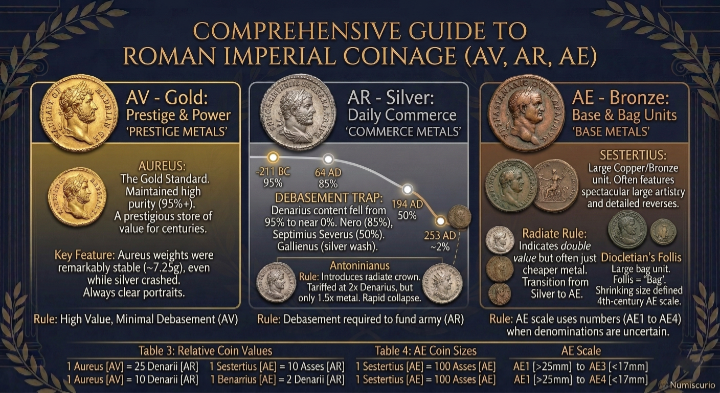
This overview of Roman Coin Denominations highlights their historical significance.
A Unified Value System
While the Empire’s lengthy history saw many shifts in weight and purity, the relationship between denominations remained the bedrock of the Mediterranean economy. The table below outlines how these coins related to one another from the start of the Empire through the early fourth century.
(Note: While the Republic saw different standards and fractional ‘As’ coins were occasionally used, this table represents the most widespread “unity” of the Imperial system.)
| Image | Denomination | Value |
|---|---|---|
 | Aureus | 25 silver denarii |
 | Denarius | 16 copper asses |
 | Antoninianus in Circulation c.300 AD | 2 Denari |
 | Quinarius | 8 copper asses1/2 Denarius |
 | Follis (Ae1-4), in Circulation c.400 AD | Bronze (silver wash) |
 | Sestertius | 4 copper asses |
 | Dupondius | 2 copper asses |
 | As | 1 |
 | Semis | 1/2 As |
 | Quadrans |
Roman Coin Size Comparison

Every coin in this system had a fixed relationship to every other coin. A wealthy Roman knew instinctively that 25 denarii equaled one aureus, that 16 asses equaled one denarius, that 4 asses equaled one sestertius. For nearly three centuries, this system held together with remarkable stability.
(If you want to know what these coins could actually buy in terms of real goods and services, see our post on the purchasing power of a Roman denarius.)
The Republican Origins
The Roman monetary system did not spring into being fully formed. It evolved through centuries of experimentation.
In the early Roman Republic (5th–3rd centuries BC), money was essentially raw bronze measured by weight — the aes rude, chunks of crude metal, and later the aes signatum, cast bronze bars stamped with simple designs. These were weighed out on balance scales in large transactions. They were not coins in the modern sense.
The silver denarius was introduced around 211 BC, during the Second Punic War — the existential struggle against Hannibal of Carthage. Rome needed a reliable, internationally recognized silver currency to pay mercenaries, supply armies, and do business with its allies. The denarius was designed to compete with the Greek silver coinage already dominating Mediterranean trade.
The earliest denarii were worth 10 asses — hence the name (denarius literally means “containing ten”). The “X” mark on the earliest denarii indicated this value. Around 141 BC, the denarius was revalued to 16 asses, but the old name stuck.
Republican denarii are distinguished by their unusual artistic freedom. Rather than featuring the emperor (there was no emperor yet), they showed a rotating cast of mythological figures, historical scenes, and ancestral references chosen by the moneyers — the young aristocrats appointed annually to oversee mint production. A moneyer who could afford to mint coins celebrating his own family history often used the opportunity to advertise his political ambitions.
In the collection, you can see this Republican tradition in coins like the C. Licinius L. F. Macer denarius with its complex Vejovis-and-quadriga design, or the L. Rubrius Dossenus denarius with its obscure religious imagery, or the L. Antestius Gragulus denarius with its “punning” jackdaw under Jupiter’s chariot. Each of these Republican denarii carries the personal stamp of a specific moneyer making a political statement in silver.
The Augustan Reform
The chaos of the late Republic — civil wars, military dictatorships, collapsing authority — demanded a new monetary framework. The man who built it was Augustus.
Around 23 BC, Augustus reorganized Roman coinage into the unified system shown in the table above. He fixed the relationship between gold and silver (25 denarii to one aureus). He standardized the weights and purities of each denomination. He established the sestertius, dupondius, and as as the brass-and-copper coins of daily life. He declared that gold and silver would be minted under imperial authority alone, while the Senate would oversee the production of bronze — a distinction marked on the coins themselves by the letters SC (Senatus Consulto, “By decree of the Senate”) that appear on most imperial sestertii and asses.
You can see this mark in the collection: the Augustus As with SC is one of the earliest examples of the reformed bronze coinage, struck under Augustus himself.
The Augustan system was so successful that it remained essentially unchanged for over two centuries. Emperor after emperor — Nero, Vespasian, Trajan, Hadrian, Marcus Aurelius — worked within its framework. Coin weights drifted slightly. Silver purity began a slow decline (which you can trace in our post on the debasement of the Roman denarius). But the basic architecture held.
The Sestertius: The Statue in Your Hand
Of all the denominations in the Roman system, the sestertius was arguably the most impressive as a physical object.
Large, heavy — around 25 to 27 grams of yellow-brass orichalcum, 32-35 mm in diameter — the sestertius was the Roman coin most like a small bronze medal. Its size gave engravers room to work. The portrait on a sestertius is often the most detailed surviving likeness of a given emperor, and the reverses can show elaborate architectural scenes, mythological tableaux, and allegorical figures with genuine sculptural presence.
The collection includes some magnificent examples: the Hadrian Sestertius of Diana the Huntress, a spirited hunting scene from the reign of the traveler-emperor; the Faustina I Sestertius of Aeternitas, struck to honor the deified empress after her death; the Severus Alexander Sestertius with Roma enthroned, one of the last great sestertii before the third-century crisis ended the denomination; and the Gordian III Sestertius with the emperor holding globe and spear, struck in the fragile years before the empire’s near-collapse.
These coins were not just money. They were propaganda, art, and physical anchors of imperial presence, distributed in staggering numbers to millions of hands across the Mediterranean.
The Antoninianus: Inflation in a Coin
The first major disruption to the Augustan system came in AD 215, under the emperor Caracalla. Facing the costs of his frontier wars and his famous citizenship edict (which extended Roman citizenship — and tax obligations — to nearly all free inhabitants of the empire), Caracalla introduced a new coin: the Antoninianus.
It was silver, like the denarius. It was larger. It showed the emperor with a distinctive radiate crown (rays extending from his head, rather than the laurel wreath of earlier emperors) to indicate its higher value. And it was officially worth two denarii.
The problem was that it only contained about one and a half denarii’s worth of silver.
This was Caracalla’s sleight of hand. The state received twice the face value from the same silver. Soldiers could be paid in antoniniani instead of denarii, stretching the imperial budget. In the short term, it worked. In the long term, it triggered a century of monetary collapse.
By the middle of the third century, the antoninianus itself had been debased into a silver-washed bronze coin with only traces of actual silver. The collection includes many examples from this era of decline: the Gallienus Antoninianus with Mars, struck in the darkest years of the Crisis of the Third Century; the Aurelian “Sol and Captives” Antoninianus, from the emperor who briefly restored order and attempted a monetary reform; the Probus Antoninianus with Quadriga, struck near the end of the denomination’s life.
These coins look silver at first glance. Most are thin surface washes over a base-metal core. They are the physical evidence of a currency eating itself alive.
Diocletian’s Reform and the Follis
By the late third century, the antoninianus had collapsed so completely that something had to replace it. The emperor Diocletian, as part of his broad restructuring of the Roman state, launched a sweeping monetary reform around AD 294.
The antoninianus was discontinued. A new silver coin, the Argenteus, was introduced — large, high-purity, rare enough to be mostly ceremonial rather than transactional. A new gold coin, the solidus (introduced in fuller form under Constantine), would eventually replace the aureus as the gold coin of the Late Empire.
But the coin that actually defined Late Roman commerce was the Follis — a large silvered-bronze coin with a thin wash of silver on a copper core. The follis was the day-to-day money of the fourth century. A Roman citizen in AD 320 would hold folles for small purchases the way earlier Romans had held asses and dupondii.
The collection shows the evolution of this coinage: the early heavy folles of the Tetrarchy, like the Maximianus Herculius Follis of Genius or the Constantius I Chlorus Follis, through the Constantinian-era issues like the Constantine I “Campgate” Follis, to later pieces like the Constantius II “Fallen Horseman” Follis, one of the most iconic reverses of late Roman coinage.
Folles grew steadily smaller and thinner over the fourth century. What began as a large, impressive coin under Diocletian had become a tiny, thin bronze flake by the time of Julian the Apostate. Inflation had simply restarted, and the cycle continued until the Western Empire itself collapsed in the fifth century.
The Eastern Continuation
Even after the fall of the Western Empire in AD 476, Roman coinage did not disappear. It simply moved east. The Eastern Roman Empire — what we now call the Byzantine Empire — continued striking recognizably Roman coins for another thousand years.
The collection includes examples from this long twilight: the Maurice Tiberius Half-Follis and the Tiberius II Constantine Follis with Large M, both showing the continued use of the Roman follis system in the late sixth century under emperors like Maurice Tiberius and Tiberius II Constantine. Further into the Byzantine centuries, new denominations appeared — the basilikon, for example, of which we have an example in the Andronicus II Basilikon struck in the early fourteenth century.
The final Roman coin was struck in Constantinople in 1453, on the very day the city fell to the Ottoman Turks. Seventeen centuries after the first denarius was struck during the Second Punic War, the direct line of Roman coinage finally ended.
The Logic of the System
If you take nothing else from this guide, take this: Roman coinage makes sense.
Yes, it changed over centuries. Yes, the same names applied to different coins at different times. Yes, there are exceptions and regional variations and complicated transitional periods. But the core logic is simple:
- Three metals, each for a specific economic role (gold for wealth, silver for commerce, bronze for daily life)
- A hierarchical system of denominations, each with a fixed value relative to the others
- The silver denarius as the spine of the system for over four centuries, surviving every reform until the antoninianus replaced it in the mid-third century
- The follis as the Late Roman workhorse once the denarius system collapsed
- Constant adjustment in response to inflation, war, and imperial need — but always preserving the basic architecture
Once you know that logic, every Roman coin you encounter becomes readable. The abbreviations make sense. The weights make sense. The relationships between denominations make sense. You can look at any imperial coin in a catalog or a dealer’s tray and say, within a reasonable range: this is gold / silver / bronze, struck during the High Empire / the Crisis / the Late Empire, worth X relative to Y.
That is the beginning of numismatic literacy. Everything else — the specific emperors, the specific mints, the specific design types — is details built on this foundation.
To see how these denominations played out across five centuries of Roman history, browse the collection or view the timeline. To understand what these coins were actually worth, read our post on the purchasing power of a Roman denarius. To trace the slow silver debasement that destroyed the Augustan monetary system, see our post on the debasement of the Roman denarius. To understand how these coins were physically produced, see how ancient Roman coins were made.

