
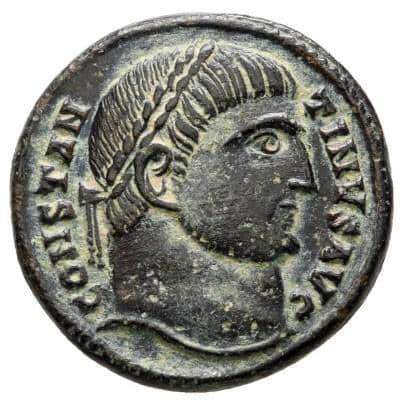

If you’re looking for a coin that represents the “Stone and Mortar” of the Roman Empire, the Constantine I “Campgate” Follis (RIC VII Alexandria 45) is a masterstroke of architectural propaganda. Struck between AD 326 and 327, this bronze coin was minted in the legendary city of Alexandria, Egypt, during a time when Constantine the Great was literally rebuilding the world in his own image.
1. The Historical Context: The Master of All
By AD 326, Constantine had done the impossible: he had reunited the fractured Roman Empire under a single ruler for the first time in decades. He had defeated his last rival, Licinius, and was now turning his eyes toward his greatest project—the founding of Constantinople.
However, the Empire was still a dangerous place. The borders were under constant threat from Germanic tribes and the Sassanid Persians. This coin was issued to reassure the public and the soldiers that the Roman world was a “Fortress of Peace.” It was minted in Alexandria, the intellectual and economic powerhouse of the East, ensuring that this message of strength reached the wealthiest corners of the Mediterranean.
2. The Reverse: The Gate That Never Sleeps
The reverse features a Campgate (or more accurately, a city gate or fortress) with two turrets and no doors. Above the gate sits a single star.
- The Symbol of Security: The gate represented the Providentia (Foresight) of the Emperor. It told the citizens that even in their sleep, the Roman military machine was awake, guarding the gates of civilization.
- The Missing Doors: You’ll notice the gate is wide open. This was intentional—it symbolized that under Constantine, the Empire was so secure that the gates didn’t even need to be closed. It was a “Golden Age” of open trade and movement.
- The Star: The star above the gate is often interpreted as a “Guiding Star” or a symbol of divine favor, reflecting Constantine’s move toward Christianity and his belief that his reign was blessed by the heavens.
- The Legend:
PROVIDENTIAE AVGG(To the Foresight of the Augusti).
3. The Obverse: The Imperial Diadem
The obverse features the laureate head of Constantine I facing right.
- The Classic Look: Unlike his later “eyes to heaven” portraits, this laureate head (wearing the traditional laurel wreath) links Constantine back to the “Good Emperors” of the past. It was a visual bridge between the old Roman virtues and the new Christian empire.
- The Legend:
CONSTANTINVS AVG(Constantine Augustus).
4. Technical Details: The Alexandria Mint
- RIC VII Alexandria 45: Cataloged in Roman Imperial Coinage, Volume VII.
- The Mint Mark: Look at the bottom (exergue) of the coin. You will see SMAL (Sacra Moneta Alexandria), followed by a Greek letter (like A, B, or Γ) indicating which specific workshop (officina) struck the coin.
- The Silver Wash: When this coin was new, it was coated in a thin layer of silver (“silvering”). It would have shimmered in the sunlight, looking far more valuable than a simple bronze coin.
