
f you’re looking for a coin that perfectly captures the “Secret Societies and Sacred Oaths” of the Roman Republic, the L. Rubrius Dossenus Denarius (Syd 705 / Crawford 348/1) is a hauntingly beautiful choice. Struck in 87 BC, this silver piece is a window into a Rome gripped by the Social War and the rising shadow of the first great Civil War.
At Numiscurio, we often say that a coin’s “soul” is found in its symbolism, and Dossenus gave us one of the most enigmatic and “occult” series in Republican history.
1. The Historical Context: The Year of the Cinna
The year 87 BC was a bloodbath. The great general Sulla had just marched on Rome and then left for the East, leaving a power vacuum that was violently filled by his rival, Cinna. The city was a tinderbox of proscriptions, street fighting, and religious anxiety.
Lucius Rubrius Dossenus, the moneyer, belonged to a family that claimed ancient priestly roots. During this time of national trauma, he issued a series of coins honoring the “Great Gods” of Rome. This denarius wasn’t just money; it was a religious plea for the gods to save the Republic from tearing itself apart.
2. The Obverse: The Mask of Jupiter
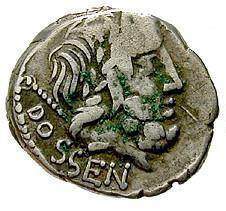
The obverse features the laureate head of Jupiter, the King of the Gods, facing right.
- The Scepter: Behind his head is a scepter, the symbol of his absolute authority over both gods and men.
- The “Dossenus” Mystery: Below the head is the legend
DOSSEN. Some scholars believe “Dossenus” refers to a hunchback or a masked character from the ancient Atellan Farce (early Roman improvisational theater). This gives the coin a strange, theatrical “mask-like” quality that is unique among Republican silver.
3. The Reverse: The Empty Chariot of the Gods
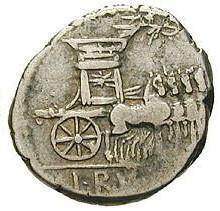
The reverse is where the mystery deepens. It depicts a triumphal quadriga (four-horse chariot) moving slowly to the right.
- The Empty Throne: The chariot is not carrying a general; it is carrying a thunderbolt, the weapon of Jupiter. The side of the chariot is decorated with a Victory figure.
- The Sacred Procession: This likely represents the Tensae—the sacred chariots used to carry the images of the gods during the Ludi Romani (Roman Games).
- The Message: In the chaos of 87 BC, Dossenus was reminding the warring factions that the ultimate power in Rome didn’t belong to Sulla or Cinna, but to the gods themselves. It was a call for a return to divine order.
- The Legend:
L·RVBRIin the exergue.
4. Technical Details: The “Syd 705” Reference
- Syd 705: This refers to the classic catalog by E.A. Sydenham, The Coinage of the Roman Republic. In the modern Crawford system, it is listed as 348/1.
- The Design Unity: Dossenus issued a famous “set” of coins featuring Jupiter, Juno, and Minerva (the Capitoline Triad). Finding a matching set is a goal for many advanced collectors.
- The Strike: These coins are often struck on slightly smaller, thicker “flans” than earlier Republican issues, giving them a satisfying weight in the hand.
