
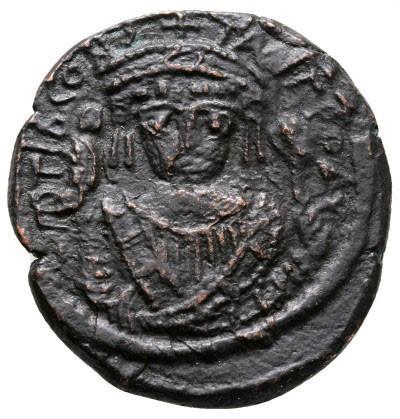
The Tiberius II Constantine Follis (Sear 430) is a heavy, majestic bronze from the heart of the Byzantine “Recovery.” Struck in AD 580–581, this coin represents a short but incredibly significant reign. Tiberius II was a man of the people—a charismatic commander who spent the imperial treasury to buy peace and popularity, earning him a reputation as one of the most generous (and perhaps fiscally reckless) emperors in the history of “New Rome.”
1. The Historical Context: The Popular Emperor
Tiberius II rose to power during the tragic mental decline of his predecessor, Justin II. He was a “Soldier-Emperor” who sought to consolidate the borders while winning over the citizens of Constantinople. His reign was defined by the removal of heavy taxes and the distribution of massive “donatives” to the army and the poor.
This coin was struck at the Constantinople mint during his seventh regnal year (ЧII). It is a physical reminder of the Emperor’s attempts to project a sense of “Roman-ness.” By assuming the ancient title of Consul, Tiberius was telling his subjects that the golden days of the old Republic were not gone, but merely transformed into the Christian glory of the East.
2. The Obverse: The Imperial Consul
The obverse features the Crowned Facing Bust of Tiberius II, wearing elaborate Consular Robes.
- The Mappa and Scepter: He holds the mappa (the cloth used to signal the start of the chariot races at the Hippodrome) in his right hand and a magnificent eagle-tipped scepter topped with a cross in his left. This imagery portrayed the Emperor as the “First Citizen” and the provider of public entertainment.
- The New Face of Rome: Tiberius was the first to consistently use this “Consular” type for his bronzes, moving away from the purely military portraits of the past.
- The Legend: d m TIb CONSTANT P P AV (Dominus Noster Tiberius Constantinus Perpetuus Augustus). He adopted the name “Constantinus” to link his legitimacy to the city’s founder.
3. The Reverse: The Mathematics of the City
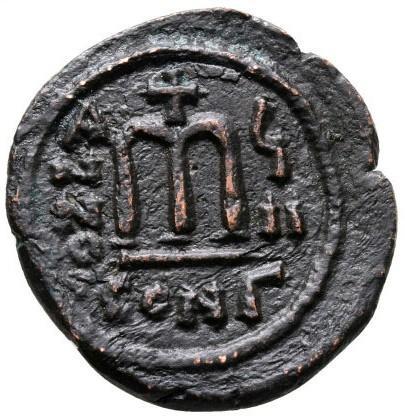
The reverse is dominated by the Large m, the Greek numeral for 40.
- The Denomination: This is a Follis (40 Nummi). It was the primary unit of copper currency. Notice the use of the cursive “m” instead of the blocky “M” used on earlier issues; this was a stylistic shift that became common in the late 6th century.
- The Date: To the left is ANNO (Year) and to the right is the numeral ЧII (Year 7). Because Tiberius counted his years from when he became “Caesar” (junior emperor), Year 7 corresponds to the middle of his actual reign as sole Augustus.
- The Cross: Positioned above the “m,” the cross is a reminder of the Empire’s divine mandate.
- The Mint Mark: Below the “m” is CONE. The CON stands for Constantinople, and the E (Epsilon) identifies the 5th Workshop of the Great Mint.
4. Technical Details: The Constantinople Standard
- Sear 430: Cataloged in David Sear’s Byzantine Coins and Their Values.
- The Size: These folles are known for their impressive size and weight, often reaching 30mm or more. They were designed to feel substantial, mirroring the “substantial” generosity of the Emperor himself.
- The Patina: Constantinople bronzes often develop a rich, dark “chocolate” or deep “river” green patina.
- The Collector’s “Tell”: Look for the detail in the eagle’s wings on the scepter. On sharp strikes, you can see the individual feathers. Finding a specimen where the “E” for the 5th workshop is crisp and the legends are not “doubled” is a sign of a premier Byzantine collection.
