
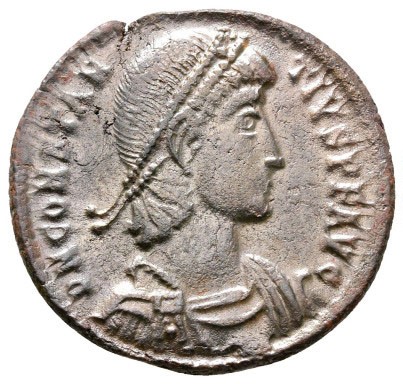
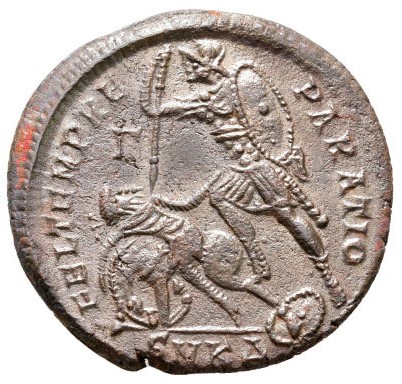
The Constantius II “Fallen Horseman” Follis (RIC VIII Cyzicus 92) is one of the most iconic and visually arresting bronze issues of the late Roman Empire. Struck between AD 351–354, this coin is a brutal piece of military propaganda designed to project an image of Roman invincibility during a century of constant civil war and barbarian incursions.
At Numiscurio, we often say that a “Fallen Horseman” is the essential entry point for any collector of the 4th century; it captures the raw, energetic shift from the classical portraits of the early Empire to the highly stylized, message-heavy coinage of the Constantinian dynasty.
1. The Historical Context: “Happy Times Restored”
The legend on the reverse, FEL TEMP REPARATIO (Felictium Temporum Reparatio), translates to “The Restoration of Happy Times.” It was a bold—and perhaps optimistic—slogan introduced by the sons of Constantine the Great.
This specific coin was minted at Cyzicus (on the coast of modern-day Turkey) during a period of intense conflict. Constantius II was locked in a struggle against the usurper Magnentius in the West and the Sassanid Persians in the East. By depicting a Roman soldier spearing a barbarian, the Emperor was sending a clear message to his subjects: the chaos of the past was being swept away by the iron tip of a Roman spear.
2. The Reverse: The Anatomy of a Kill
The “Fallen Horseman” type is celebrated for its dynamic, almost cinematic composition. It features a Roman soldier standing left, leaning into a thrust with his spear.
- The Barbarian’s Defeat: The horseman is depicted “bare-headed and bearded,” classic Roman shorthand for a “barbarian” (likely a Persian or a Germanic tribesman). He is shown falling from his horse, arm raised in a final, futile gesture of defense.
- The Gamma (Γ) Mark: In the middle of the reverse field, you’ll see the Greek letter Γ (Gamma). This was a series mark used by the mint to track the quality and volume of the strike during this massive military production run.
- The Legend: FEL TEMP REPARATIO.
3. The Obverse: The Christian Augustus
The obverse features the pearl-diademed, draped, and cuirassed bust of Constantius II, facing right.
- The Pearl Diadem: Notice the shift from the traditional laurel wreath to the pearl diadem. This was the new symbol of the Christian Roman monarch—less a “first citizen” and more a “sacred king.”
- The Profile: Constantius II was the longest-reigning son of Constantine, and his portraits reflect a transition toward a more “heavenward” and simplified style that would define the Byzantine era.
- The Legend: D N CONSTANTIVS P P AVG (Dominus Noster Constantius Perpetuus Augustus).
4. Technical Details: The Cyzicus Strike
- RIC VIII Cyzicus 92: Cataloged in the eighth volume of Roman Imperial Coinage, covering the complex family wars of the sons of Constantine.
- The Mint Mark: Look in the exergue (the bottom) for SMK followed by an office letter. SM stands for Sacra Moneta (Sacred Money) and K stands for Cyzicus.
- The Size: These coins were issued as “AE2” or “AE3” denominations. Finding a specimen where the reins of the horse or the individual links of the soldier’s mail are still visible is a major highlight for any collector of the 4th-century “Soldier-Emperors.”
