
For a collector of the early Roman Empire, the copper As of Augustus, cataloged as RIC 376, represents one of the most significant administrative reforms in numismatic history. Minted in Rome around 16 BC. It stands as a metallic testament to the “Pax Romana”—the period of relative peace and stability that Augustus established after decades of bloody civil war.
If you were a Roman citizen walking the streets of the Subura 2,000 years ago, this copper As was the heartbeat of your daily life. It paid for your bread, your wine, and your entrance to the baths. But more importantly, it was the “social media” of the ancient world, delivering the image of the man who had finally ended a century of bloody civil war.
1. The Historical Context: The Master of the Veil
By 7 BC, Augustus had been the “First Citizen” (Princeps) for twenty years. He was an expert at the “Veil of the Republic”—the art of holding absolute power while pretending to be just another humble magistrate.
This coin was minted during the height of the Pax Romana. Augustus was reorganizing the Roman state from top to bottom, including the monetary system. He established a hierarchy of metals: Gold and Silver were the “Emperor’s coins,” used for military pay and big commerce, while the Bronze and Copper coins (like your As) were theoretically issued by the Senate.
2. The Obverse: The “Bare-Headed” Father
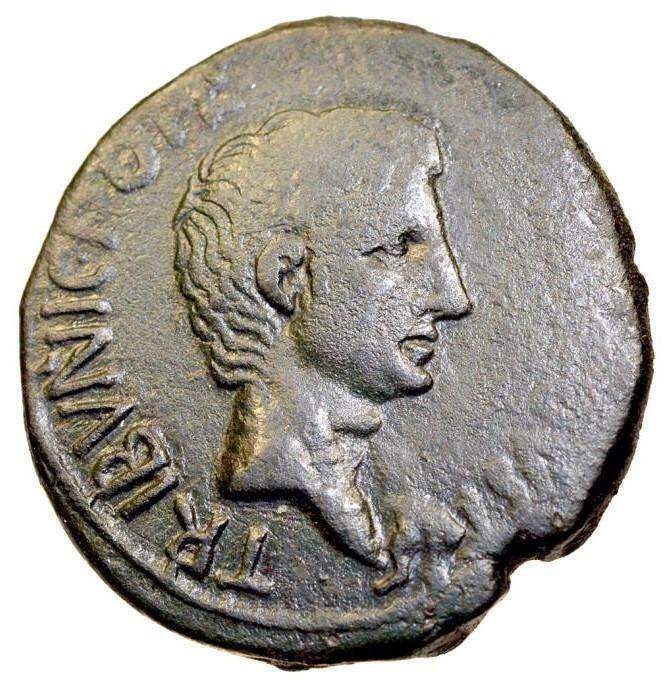
The obverse features the bare head of Augustus facing right, with the legend: CAESAR AVGVSTVS PONT MAX TRIB POT.
- The Legend: These aren’t just titles; they are the pillars of his power. PONT MAX (Pontifex Maximus) made him the High Priest of Rome, while TRIB POT (Tribunician Power) gave him the power of the people’s representative, making his body sacred and his word law.
- The “Bare Head”: Notice he isn’t wearing a crown or a laurel wreath. This was a calculated political move. By appearing “bare-headed,” Augustus was signaling to the Roman elite: “I am not a King; I am just like you.” It was the ultimate “Everyman” branding for the world’s most powerful man.
3. The Reverse: The Senate’s Seal (S C)
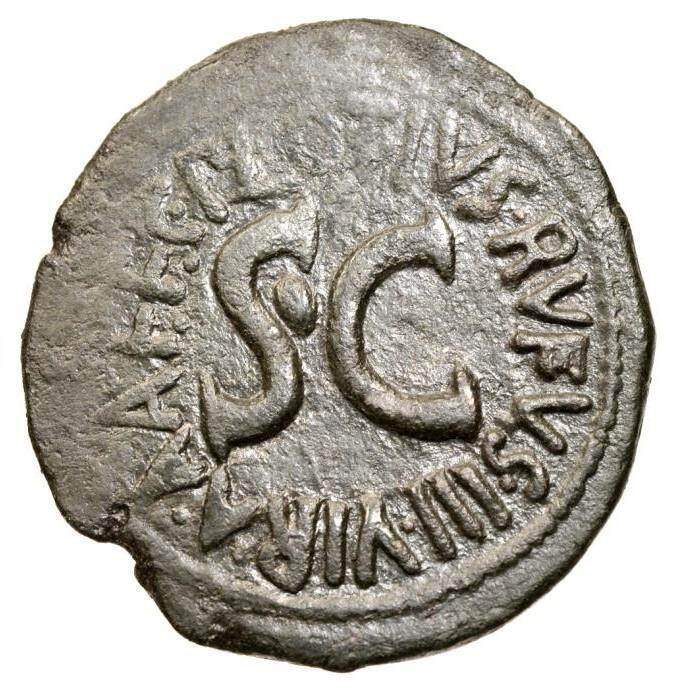
The reverse of RIC 376 is iconic for its massive S C in the center, surrounded by the name of a “Moneyer”—in this specific case, M. Maecilius Tullus.
- S C (Senatus Consulto): This stands for “By Decree of the Senate.” Even though Augustus pulled all the strings, he allowed the Senate to put their stamp on the copper coinage. It was a diplomatic “olive branch” to the old aristocracy, making them feel like they still had a role in the state’s economy.
- The Moneyers: M. Maecilius Tullus was one of the Tresviri Monetales (three men for striking gold, silver, and bronze). These were junior magistrates starting their political careers. For a collector, these names are “time stamps” that allow us to date the coin to the exact year.
4. Technical Details: The “Red” Coin
- Metal: Pure Copper (not bronze or brass). When this coin was fresh from the mint, it had a bright, reddish-orange glow.
- RIC 376: Cataloged in Roman Imperial Coinage, Volume I.
- The Strike: Augustus coins from the Rome mint are known for their high technical standards. The lettering is usually sharp, classical, and perfectly centered.
