
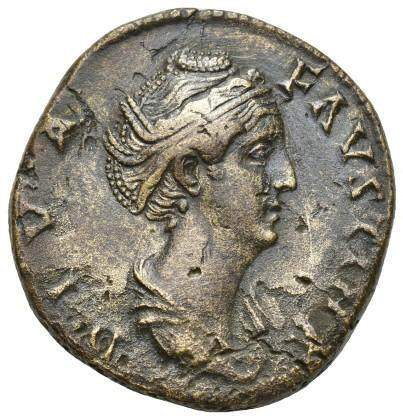
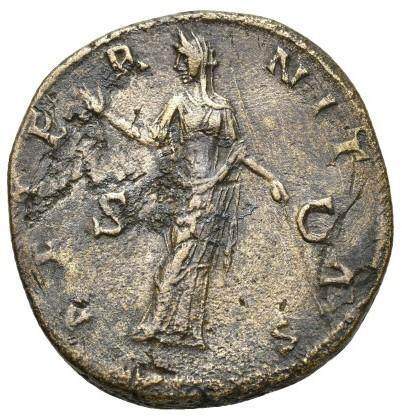
The Diva Faustina I “Eternity” Sestertius (RIC III 1102) is a magnificent, heavy-bronze monument to one of the greatest love stories of the Roman Empire. Struck shortly after AD 141, this coin was part of a massive commemorative issue following the death of the Empress Faustina the Elder. It represents the “Deification” of a woman so beloved by her husband, Antoninus Pius, that he transformed the city of Rome into a living memorial to her memory.
At Numiscurio, we often say that a sestertius is more than currency—it is a bronze canvas. To hold a “Diva Faustina” is to hold a literal piece of an Emperor’s grief and his promise of her immortality.
1. The Historical Context: The Deified Empress
Faustina I was the wife of Antoninus Pius and a woman of immense influence and charity. When she died young in AD 141, the Emperor was heartbroken. He famously remarked that he would rather live with her in a desert than without her in a palace.
He didn’t just mourn her; he elevated her to the stars. She was declared a DIVA (Divine), and a massive temple was built in her honor in the Roman Forum (which still stands today as part of a church). This sestertius was the primary tool used to spread the cult of the New Goddess across the provinces, ensuring that every citizen who spent this bronze would see her face and know she was now among the gods.
2. The Reverse: Juno and the Promise of Aeternitas
The reverse features Juno (the queen of the gods), veiled and draped, standing front with her head turned left. She raises her right hand in a gesture of protection and holds a transverse scepter in her left.
- The Divine Mirror: By depicting Juno on the reverse of a Faustina coin, the mint was drawing a direct parallel. Just as Juno was the loyal wife of Jupiter, Faustina was the loyal wife of the Emperor.
- The Veil of Sanctuarity: Juno is shown veiled, a sign of her modesty and her status as a matronly goddess. It reinforces the Roman ideal of the Univira—a woman who was faithful to one husband.
- The Legend: AETERNITAS S C. “Eternity” was the central theme of this coinage. It promised that even though Faustina had left the physical world, her spirit and her influence on the Roman state would never fade.
3. The Obverse: The Iconic Coiffure
The obverse features the bust of Diva Faustina I, facing right.
- The Hair as Architecture: Faustina was the ultimate trendsetter of the 2nd century. Notice the elaborate waves and the round coil piled on top of her head. This hairstyle was incredibly difficult to achieve, requiring hours of work by specialized slave hairdressers (ornatrices). For centuries after, Roman women would mimic this “Faustina style” to signal their own status and piety.
- The “Diva” Title: The legend is simple and haunting: DIVA FAVSTINA. It lacks the usual list of political titles, focusing entirely on her new status as a goddess.
- The Portraiture: The artists of the Antonine period were masters of character. Even in her deified state, Faustina is depicted with a serene, dignified expression that radiates the “Golden Age” stability of her husband’s reign.
4. Technical Details: The Bronze Monument
- RIC III 1102: Cataloged in the third volume of Roman Imperial Coinage, representing the high-water mark of 2nd-century bronze casting.
- The Mint: Struck in Rome. The sestertii of the Diva Faustina series are famous for their large, heavy flans and exceptionally deep engraving.
- The S C Mark: The S C (Senatus Consulto) reminds us that the Senate officially sanctioned her deification.
- The Patina: These bronzes often develop a rich, “desert” orange or a deep, dark chocolate-brown patina. Finding a specimen where the individual bands of hair in the top coil are still distinct is a mandatory acquisition for any collector of the “Good Emperors.”
