
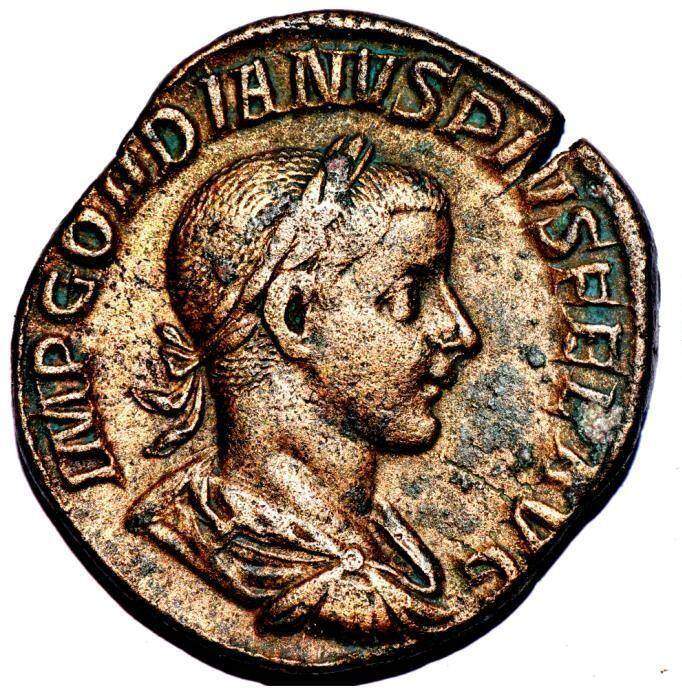
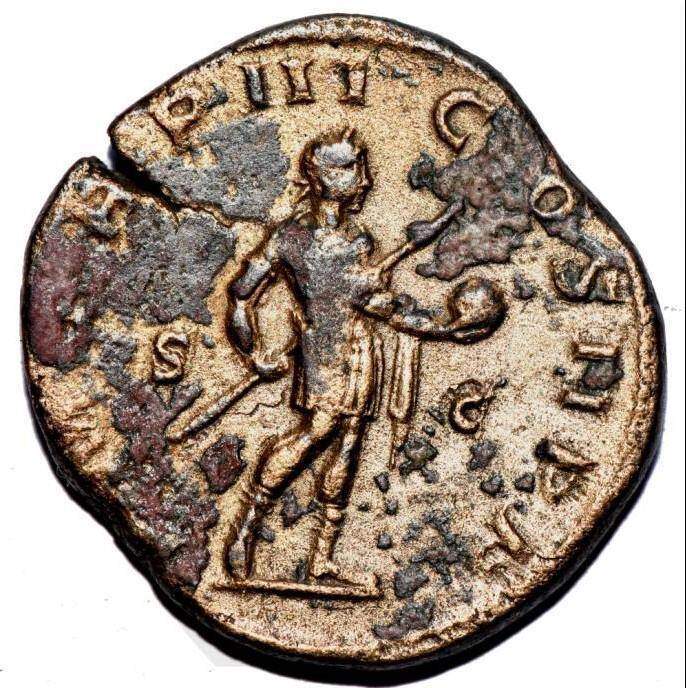
If you are looking for a coin that captures the heartbreaking fragility of the Roman Empire during the Crisis of the Third Century, the Gordian III Sestertius (RIC IV 305a) is a poignant masterpiece. Struck around AD 241–243, this heavy bronze piece depicts a “Boy King” trying to project the strength of a seasoned conqueror while the world around him began to fracture.
At Numiscurio, we often say that a coin’s “soul” is found in the gap between the image and the reality. This sestertius is the ultimate example of imperial “fake it ’til you make it.”
1. The Historical Context: The Puppet and the Protector
In AD 238, the Roman Empire was in chaos. After a series of bloody revolts and short-lived emperors, the 13-year-old Gordian III was raised to the throne by the Senate. He was the youngest sole legal Roman Emperor in history—a teenager suddenly tasked with holding back the Persians in the East and Germanic tribes in the West.+2
By the time this coin was struck, Gordian was no longer a child but a young man on the move. He had just married the daughter of his brilliant advisor, Timesitheus, and was preparing for a massive military expedition against the Sassanid Persian King Shapur I. This coin was minted to convince the Roman public, and the soldiers, that their young leader was a “World Ruler” ready for battle.
2. The Reverse: The Cosmic Soldier
The reverse of RIC 305a features a striking and symbolic image: the Emperor standing right, dressed in full military attire. He holds a transverse spear in his right hand and a globe in his left.
- The Globe: This was the ultimate symbol of Cosmocrator (Ruler of the Universe). By holding the world in his palm, Gordian was claiming divine right over all nations.
- The Spear: The spear pointed forward signaled readiness for war. It told the citizens: “The Emperor is on his horse, and he is coming to save the provinces.”
- The Legend:
P M TR P V COS II P P. These are his official titles (Pontifex Maximus, Tribune for the 5th time, Consul for the 2nd time), which allow us to date the coin precisely to AD 242, just before he set off for the East.
3. The Obverse: The Face of “Innocent” Power
The obverse features the laureate and draped bust of Gordian III.
- The Portrait: Unlike the grizzled, scowling soldier-emperors who came before him, Gordian’s portraits remain remarkably youthful. He has large, expressive eyes and a soft jawline, often depicted with a “dreamy” look. It was a visual reminder that he represented a new, “blessed” generation.
- The Legend:
IMP GORDIANVS PIVS FEL AVG.- PIVS FEL: The Pious and Blessed. This was the mandatory branding for an emperor who wanted the public to believe the gods were on his side.
4. Technical Details: The “Last of the Great Bronzes”
- Metal: Orichalcum (Golden-hued brass).
- RIC IV 305a: Cataloged in Roman Imperial Coinage, Volume IV, Part III.
- The Sestertius Weight: In Gordian’s time, the Sestertius was still a massive, impressive coin (often weighing 20–25 grams). However, this was the “sunset” of the denomination. Within a few decades, hyperinflation would make these large bronze coins too expensive to produce.
