
f you are looking for a coin that perfectly captures the “Puns and Politics” of the Roman Republic, the L. Antestius Gragulus Denarius (Syd 451 / Crawford 238/1) is a charming and clever piece of history. Struck in 136 BC, this silver denarius comes from a time when the Republic was at its territorial peak, but the internal social tensions that would eventually lead to its collapse were just beginning to simmer.
At Numiscurio, we often say that the “soul” of a Republican coin is found in its canting arms—the ancient practice of using a visual pun to represent the moneyer’s family name.
1. The Historical Context: The Rise of the “New Men”
In 136 BC, Rome was the undisputed master of the Mediterranean, having crushed Carthage and Corinth decades earlier. However, the old aristocratic families were facing new competition from rising political stars.
Lucius Antestius Gragulus, the moneyer, belonged to the Antestia gens. To make his mark on the Roman public (and the voters), he used this coin as a business card. This was the era of the Gracchi brothers, a time when a recognizable name and a clever image on a coin could mean the difference between a failed political career and a seat in the Senate.
2. The Obverse: Roma and the “Gragulus” Pun
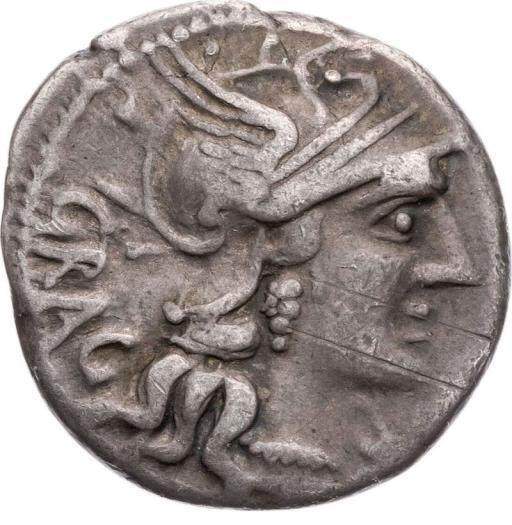
The obverse features the classic head of Roma wearing a winged helmet. But look closely at the details:
- The Legend: Behind her head, you’ll see the word
GRAG. - The Visual Pun: Under her chin is a small six-pointed star (the denomination mark for 16 Asses) and, most importantly, a tiny crow or jackdaw. In Latin, a jackdaw is a graculus. By placing this bird on the coin, Antestius was literally “signing” his name in a way that even an illiterate Roman citizen could understand. It’s one of the earliest and most literal examples of “branding” in human history.
3. The Reverse: Jupiter in Full Command
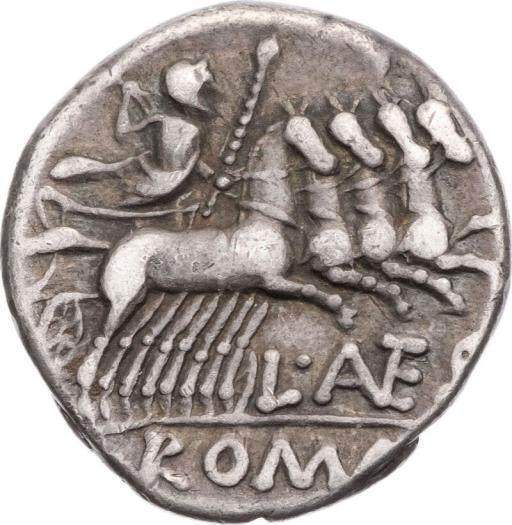
The reverse features a powerful and high-relief Jupiter driving a quadriga (four-horse chariot) at full gallop to the right.
- The Thunderbolt: Jupiter holds a scepter and a thunderbolt, the ultimate symbol of Roman law and divine authority.
- The Message: While the obverse was about the moneyer’s family, the reverse was about the state. It reminded every Roman that Jupiter Optimus Maximus was the protector of the Republic, and as long as the coins kept flowing, the gods were on Rome’s side.
- The Legend:
L·ANTESin the exergue, withROMAinscribed above.
4. Technical Details: The “Syd 451” Standard
- Syd 451: This refers to the Sydenham catalog, the traditional “gold standard” for Republican collectors. In the modern Crawford system, it is 238/1.
- The Silver Purity: During this period, the Roman denarius was nearly pure silver. These coins were so trusted that they circulated for centuries; it’s not uncommon to find a “Gragulus” that stayed in a merchant’s pouch until the time of Julius Caesar.
- The Strike: Coins from 136 BC are known for their “muscular” style. The horses on the reverse often have a sense of real movement and energy that was lost in later, more mass-produced periods.
