
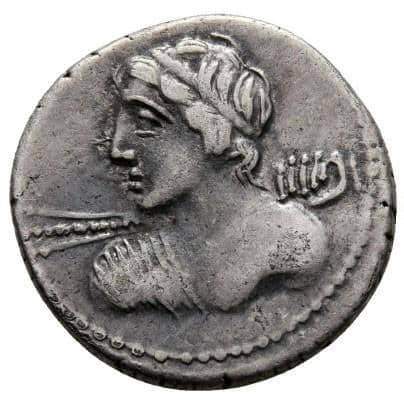
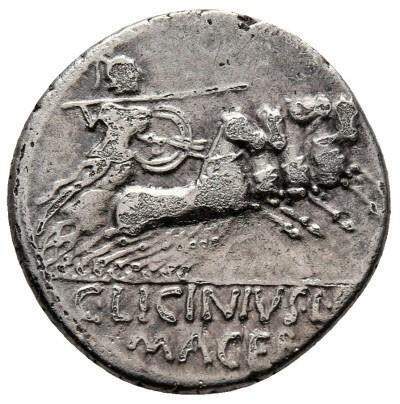
The C. Licinius L. F. Macer “Vejovis” Denarius (Crawford 354/1) is one of the most artistically sophisticated and politically charged silver coins of the late Roman Republic. Struck in 84 BC, this coin was minted at a time of absolute chaos, during the civil wars between the factions of Marius and Sulla. It is the silver signature of a man who was not only a master of the mint but one of Rome’s most radical and controversial historians.
At Numiscurio, we often say that a coin’s “soul” is found in its perspective; the rare “back-view” of the god on the obverse marks this as a masterpiece of Hellenistic-inspired Roman engraving.
1. The Historical Context: The Historian in the Mint
Gaius Licinius Macer, who eventually died in 66 BC, was a man of the “Populares”—the political faction that championed the rights of the common people. He was a famous orator and historian who claimed to have discovered ancient “Linen Books” that proved the early Republic was defined by plebeian liberty.
When Macer struck this coin in 84 BC, he was operating under the regime of Cinna and Carbo, while the formidable Sulla was still campaigning in the East. This denarius was a piece of high-stakes propaganda, using ancient, “authentic” Italian imagery to signal that the true spirit of Rome resided with the people’s party, not the aristocratic generals.
2. The Obverse: The Thunder of Vejovis
The obverse features a youthful, laureate bust of a god—traditionally identified as Apollo or the archaic Italian deity Vejovis—seen from behind, with his head turned left and a thunderbolt in his right hand.
- The Artistic “Back-View”: This is one of the few instances in Roman numismatics where a deity is shown from behind. This perspective adds a dramatic, three-dimensional depth to the coin, suggesting the god is mid-action, ready to hurl his bolt.
- Vejovis the Avenger: Vejovis was often seen as a “Young Jupiter” or a darker, vengeful version of Apollo. For Macer, this god likely represented the raw, primal power of the Roman state being unleashed against its internal enemies.
3. Reverse: Minerva’s Galloping Quadriga
The reverse features Minerva in a quadriga (four-horse chariot) galloping right, holding a shield, reins, and a spear.
- The Goddess of Strategy: By choosing Minerva over Mars, Macer was emphasizing Consilium (wisdom and strategy) over brute force. It was a reminder that the “Populares” cause was led by intellectual weight, not just military might.
- The Legend: C LICINIVS L F MACER. The “L F” stands for Lucius Filius (Son of Lucius), anchoring the mint master’s individual legitimacy in his family line.
- The Movement: Notice the “staggered” legs of the four horses. This was a hallmark of the high-quality engraving of the 80s BC, attempting to show the frantic speed and energy of a chariot at full tilt.
4. Technical Details: The High-Relief Strike
- Crawford 354/1: Cataloged in Michael Crawford’s Roman Republican Coinage.
- The Mint: Struck in Rome. Despite the political instability of 84 BC, the Rome mint maintained an incredibly high standard for this issue.
- The Collector’s “Tell”: Because of the high relief, particularly on the shoulder of Apollo/Vejovis and the wheels of the quadriga, these coins often show “flat” spots of wear. Finding a specimen where the individual fingers holding the thunderbolt are still visible is a major win for a Republican specialist.
