
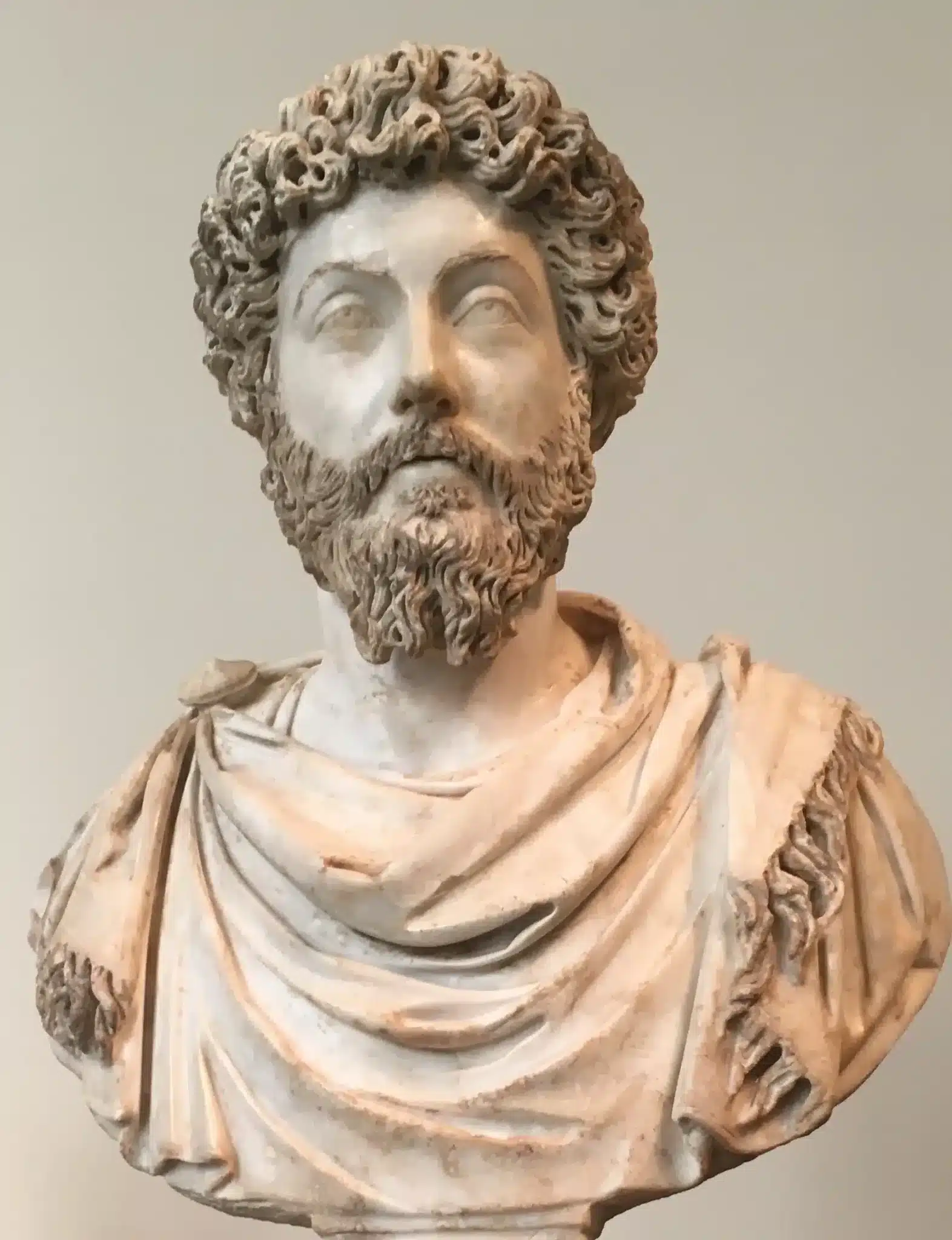
For a collector of the “Five Good Emperors,” holding a denarius of Marcus Aurelius feels fundamentally different from holding the coins of his predecessors. While Trajan’s coins shout of conquest and Hadrian’s sing of travel, the coinage of Marcus Aurelius (161–180 CE) carries the weight of a man trying to hold the world together through sheer force of will. To look at his silver is to see the face of the Stoic “Philosopher-King”—a man who spent his life longing for the quiet of a library but was forced by fate into the mud of the Danubian frontiers and the darkness of a global plague.
From Annius Verus to the Purple: 121–161 CE
Born in Rome in 121 CE as Marcus Annius Verus, he was a child of the high aristocracy. His serious nature caught the eye of the Emperor Hadrian, who jokingly called him Verissimus (“Most Truthful”). As part of a complex succession plan, Marcus was adopted by Antoninus Pius in 138 CE.
For the numismatist, the “Caesar” issues of Marcus Aurelius—struck during the long, peaceful reign of his adoptive father—are some of the most serene in the Roman series. They show a youthful, clean-shaven prince with curly hair and an idealistic expression. But as he matures into his own reign, the “Imperial” portraits change. The beard grows longer, reflecting his commitment to Stoicism, and the brow becomes furrowed. These coins aren’t just currency; they are a visual biography of a man aging under the pressure of the Roman state.
The Experiment of Dual Rule: 161 CE
When Antoninus Pius died in 161 CE, Marcus Aurelius made a radical move. He insisted that his adoptive brother, Lucius Verus, be elevated as his equal. This was the first time in Roman history that two men shared the title of Augustus simultaneously.
The early coins of their joint reign frequently feature the legend CONCORDIA AVGVSTORVM (The Harmony of the Emperors). For a collector, these “handshake” coins are symbolic of the peak of Roman political maturity. While Lucius went East to lead the war against the Parthian Empire, Marcus stayed in Rome to manage the bureaucracy and the law, a partnership that provided a brief moment of stability before the storm broke.
The Meditations and the Marcomannic Wars
Marcus Aurelius is perhaps best known today for his Meditations, a collection of personal Stoic reflections written in his tent at night during the Marcomannic Wars. While he was fighting Germanic tribes like the Quadi and Marcomanni along the Danube, he was reminding himself that “the best revenge is to be unlike him who performed the injury.”
This military struggle is vividly captured in his coinage. We see the introduction of the VIC GERM (Victory over the Germans) and PROPAGO IMPERI (Extension of the Empire) types. The reverse images move away from the peaceful agricultural themes of Antoninus Pius and toward scenes of the Emperor addressing his troops (Adlocutio) or crossing the Danube on a bridge of boats. To hold a “Germanic Victory” sestertius is to hold a relic from the very campaigns where the Meditations were composed.
The Antonine Plague: A Thinning of the Silver
The return of the troops from the East in 166 CE brought back the Antonine Plague, a pandemic that killed millions and devastated the Roman economy. This was a turning point for the Empire. The labor shortage led to a decline in mine production, and for the first time in decades, we see a subtle but noticeable “thinning” of the Roman denarius.
As a collector, you may notice that the silver of Marcus’s later years can sometimes have a slightly “grainy” texture compared to the lustrous issues of the early 160s. This was the Stoic Emperor doing what was necessary—managing a crumbling economy while fighting a two-front war and a biological catastrophe. He sold off the imperial jewelry and furniture to pay for the wars rather than overtaxing the citizens, an act of “Stoic Generosity” that was commemorated on his Liberalitas coinage.
The End of the Golden Age: 180 CE
Marcus Aurelius died of illness in 180 CE in Vindobona (modern Vienna). He was the last of the “Five Good Emperors,” and many historians—most notably Edward Gibbon—view his death as the moment the Roman Empire began its long “decline and fall.”
Following his death, his son Commodus struck beautiful CONSECRATIO issues to honor his father. These coins show Marcus Aurelius being carried to the heavens by an eagle or sitting atop a funeral pyre. For the collector, these “Divine Marcus” coins are the final, tragic exclamation point of the Antonine dynasty.
A Legacy in Luster
Marcus Aurelius was the philosopher who never wanted to be a king, yet he became one of the greatest rulers the world has ever known. His coins are the physical echoes of his philosophy. They show a man who viewed his power not as a prize, but as a duty to be performed with justice, clemency, and detachment.
When you add a Marcus Aurelius denarius to your tray, you aren’t just adding a portrait of an emperor; you are adding a piece of the man who believed that “the soul is dyed by the color of its thoughts.” His thoughts were of duty and virtue, and 1,800 years later, that “color” still shines through the silver.

