Imagine you are a day laborer in Rome in the year AD 75.
The sun is just up. You have worked since before dawn hauling stones for a new construction site on the Viminal Hill. Your back aches. Your hands are raw. At the end of the day, the foreman drops a single silver coin into your palm.
It is heavier than you expect. About four grams. The bust of the Emperor Vespasian stares out from one side — solid, bearded, looking determinedly past you toward something more important. On the back, an eagle, or a temple, or a personification of Peace holding a cornucopia.
This is a denarius. You have just earned a day’s wages. Now you have to make it feed your family, pay the rent on your one-room apartment, and leave something behind for tomorrow.
How far would that denarius actually go?
The Coin That Ran an Empire

For five centuries, the silver denarius was the backbone of the Roman economy. It was introduced during the Second Punic War around 211 BC, when Rome needed a reliable silver currency to pay the armies fighting Hannibal. It remained the standard coin of the Roman world until the mid-third century AD, when runaway inflation and relentless debasement finally replaced it with the antoninianus — a supposedly higher-value coin that was in reality just silver-washed bronze.
The word itself tells you something about Roman mathematics. Denarius is a Latin adjective meaning “containing ten” — originally, one denarius was worth ten copper asses. Later it was revalued to sixteen asses, but the name stuck. The Romans liked traditional names even when the underlying arithmetic had changed.
At its introduction, the denarius contained about 4.5 grams of nearly pure silver. One hundred denarii weighed roughly one Roman pound. By the reign of Julius Caesar, it was slightly lighter but still high-purity. By the time of Nero, the silver content had dropped to around 80%. By Septimius Severus, 50%. By Caracalla, 40%. And by the 260s AD, what the state still called a “denarius” was a small disc of bronze with a whisper of silver on its surface. You can trace that entire decline, emperor by emperor, in our post on the debasement of the Roman denarius.
But in its heyday — from the late Republic through the Antonine Golden Age — the denarius was solid, trusted money. And if you want to understand what Roman life actually cost, there is no better way to tell the story than through what a single one could buy.
The Denarius in the Roman Monetary System
Before we spend one, it helps to know where the denarius sat in the larger Roman currency.
At the top was the aureus, a pure gold coin worth 25 denarii. Aurei were the money of senators, large estates, and international trade. An ordinary Roman could live a whole year without ever touching one.
Below the denarius came the bronze and brass denominations — the small change of daily life. One denarius equaled 4 sestertii, the large orichalcum coin used for mid-sized purchases. A sestertius was worth 2 dupondii. A dupondius was worth 2 asses. Below the as came the semis and the quadrans — tiny copper pieces for buying a loaf of bread or a handful of olives.
A single denarius, then, was worth 16 asses — sixteen separate transactions at the level of a street vendor. For a Roman laborer, it represented a full day of buying power, from morning bread to evening wine.
(For more on how all these denominations fit together, see our guide to the history of Roman coin denominations.)
Aureus [gold] | 25 silver denarii |
Antoninianus [silver] | 2 silver denarii |
Denarius [silver] | 16 copper asses |
Quinarius [silver] | 8 copper asses |
Follis, AE1-4 | Bronze (silver wash) |
Sestertius [orichalcum] | 4 copper asses |
Dupondius [orichalcum] | 2 copper asses |
As [copper] | 1 |
Semis [brass] | 1/2 as |
Quadrans [copper] | 1/4 copper as |

What One Denarius Would Actually Buy
Historians reconstruct Roman prices from a scattered but vivid body of evidence — graffiti preserved in the ruins of Pompeii, military pay records, edicts that tried to cap wartime inflation, passing mentions in Cicero’s letters, receipts etched on papyrus fragments. The picture that emerges is not exact, but it is surprisingly detailed.
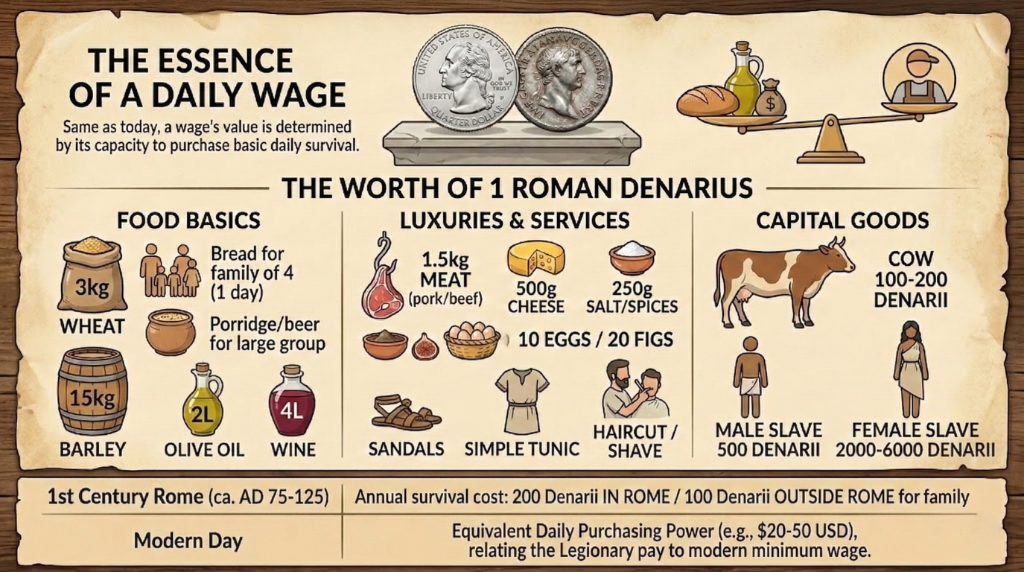
In the early empire, one denarius could buy roughly enough food to feed a small family for a day. Here is what a single silver coin would put on a Roman table — or in a Roman bath, inn, or temple.
One denarius could buy
| Category | What you’d get |
|---|---|
| Grain | About 3 kg of wheat — enough bread for a small family for a day |
| Wine | About 4 liters of cheap table wine |
| Olive oil | About 2 liters — used for cooking and household lamps |
| Salt & spices | A few hundred grams (soldiers were sometimes paid in salt directly — the origin of the word salary, from sal) |
| Clothing | A simple tunic or a pair of workman’s sandals |
| Lodging | A night at a modest inn |
| Entertainment | A seat at the public theater or circus |
| Personal care | A visit to the baths, or a shave and haircut at the forum barber |
| Religious service | A small animal sacrifice at a neighborhood temple |
It was not enough for anything much larger. A cow cost somewhere between 100 and 200 denarii — the work of several months. A modest house in an Italian town might cost several thousand. Luxury goods — imported silk, Indian spices, fine pottery — were priced in gold aurei, not silver denarii. The denarius was the currency of ordinary life, not of wealth.
What more denarii would buy
| Item | Cost |
|---|---|
| A cow | 100–200 denarii |
| A healthy adult sold into slavery | ~500 denarii |
| A modest Italian town house | Several thousand denarii |
| An educated or specialized slave | Many thousands of denarii |
| Luxury goods (silk, spices, fine pottery) | Priced in gold aurei, not denarii |
It is worth naming plainly the grim reality shown in that second table: human beings in the Roman slave market were also priced in this currency. Slavery was woven into the Roman economy at every level, from farm labor to domestic service to mining. When we admire the buying power of a denarius, we are also looking at a monetary system that assigned numbers to human lives.
The Worker, the Soldier, and the Emperor
The most useful way to measure what a denarius was “worth” is not in silver weight but in the time it took to earn one.
An unskilled laborer in first-century Rome earned roughly one denarius per working day. After the six-day Roman work week and allowing for festival days, this came to perhaps 250-300 denarii per year. That’s the annual income of the man hauling stones on the Viminal.
A legionary soldier under Julius Caesar earned about 225 denarii per year — later raised to 300 under Augustus, and higher still under Domitian. That seems close to the laborer’s wage, but with an enormous difference: the soldier also received food, clothing, weapons, and a substantial bonus upon retirement. In real terms, serving in the legions was a far better deal than breaking stones for a living.
A centurion — an officer commanding eighty men — earned between 3,750 and 15,000 denarii per year, depending on rank. The highest-ranking centurion in a legion, the primus pilus, could retire wealthy enough to enter the equestrian order and buy his way into Roman high society.
A Roman senator needed a minimum of one million sesterces in property (250,000 denarii) just to qualify for the office. These were the men who governed provinces, who owned vast estates in Italy, who treated an aureus the way a laborer treated an as.
When the Christian Gospels were written, the authors chose the denarius deliberately. In the Parable of the Laborers in the Vineyard (Matthew 20), the landowner hires workers for one denarius per day — immediately identifiable to first-century readers as a day’s honest wage for ordinary work. In the Book of Revelation, the Four Horsemen ride and the Third Horseman proclaims that a quart of wheat will cost one denarius, meaning food that should feed a family will take a full day’s labor to afford. Every ancient reader understood: famine was coming.
This is why the denarius matters historically. It was not just money. It was the metric by which ordinary Roman life was measured.

What Would It Be Worth Today?
This is the question every visitor asks, and the answer is frustratingly imprecise.
If you melted down a Roman denarius at today’s silver prices, you would recover less than a dollar’s worth of metal. That is obviously not a useful way to value the coin.
More interesting is purchasing-power comparison. Since one denarius bought roughly a day’s unskilled labor, we can compare it to the daily wage of an unskilled worker today. Depending on the country and era, that gives you somewhere between $75 and $150 in modern value — which sounds low until you remember that a Roman laborer was also not paying for housing the way a modern worker does (most urban Romans rented rooms in multi-family insulae for a pittance), and that bread, wine, and oil were proportionally much cheaper in an agrarian economy.
A safer way to think about it: one denarius in ancient Rome bought what perhaps $80-$120 might buy an American today in essential groceries and small services. But the comparison breaks down quickly — there was no such thing as a Roman cell phone bill or electricity meter. The economies were too different to map onto each other cleanly.
What you can say with certainty is this: a denarius was the coin of the ordinary person’s daily survival. Not luxurious. Not meager. Enough.
The Most Famous Denarius Ever Struck
One specific denarius has broken every auction record in ancient numismatics: the Eid Mar denarius of Brutus.
Struck in late 42 BC by Marcus Junius Brutus — one of the senators who had assassinated Julius Caesar two years earlier on the Ides of March — the coin is a masterpiece of republican propaganda. On the obverse is Brutus’s own portrait, an act of extraordinary audacity. No Roman had ever put his own face on a silver coin while still alive except Caesar himself, who had been killed partly for that exact reason.
On the reverse are two daggers flanking a pileus — the cap of liberty worn by freed slaves — and the Latin inscription EID MAR: “Ides of March.”
The meaning was unmistakable. Brutus was broadcasting his pride in the assassination. Yes, we killed him. Here are the weapons. Here is the freedom we won.
It is one of the most audacious political statements ever minted. And the coins were struck in tiny numbers, probably in a mobile military mint as Brutus marched toward his final defeat at the Battle of Philippi in 42 BC. Perhaps one hundred silver examples survive today. A gold Eid Mar aureus — even rarer, with only a handful known — sold at auction in 2020 for £2.7 million (roughly $3 million USD).
A single denarius that once paid a day’s bread is now among the most valuable coins in the world. Not because of its silver — its metal value is pennies. Because of what it said.
Below a picture of the beauty.

The Silent Testimony
Hold an ordinary Roman denarius in your hand today — a Trajan’s Felicitas, a Marcus Aurelius Eagle, a Hadrian silver issue — and you are holding what someone 1,800 years ago carried in a linen pouch to market. It bought their bread. It paid their rent. It was pressed into the hand of a physician, a barber, a prostitute, a temple priest, a grain merchant. It passed through a thousand hands before being lost in a burned house, buried in a wartime hoard, or dropped in a gutter and forgotten.
The faces on Roman coins were emperors, but the hands that held them were mostly ordinary people. The denarius was the currency of their daily life — the cost of their food, the measure of their labor, the limit of their dreams.
It is the most democratic object the Roman Empire ever produced. Everyone, from the slave to the senator, used the same coins. The only difference was how many they had.
To explore denarii across five centuries of Roman history, browse the Denarius denomination in the collection. To trace the slow decline of Roman silver, see our post on the debasement of the Roman denarius. To see the broader monetary system in context, read our guide to the history of Roman coin denominations.