
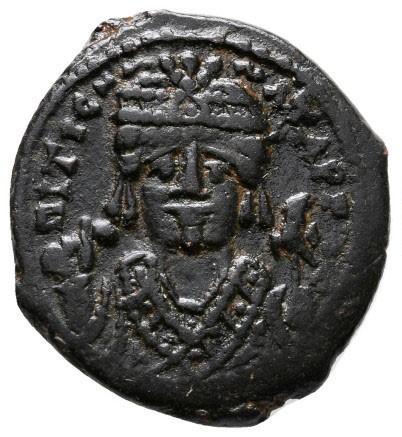
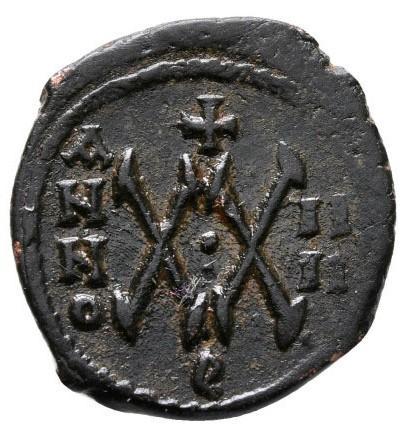
The Maurice Tiberius Half Follis (Sear 534) is a captivating bronze relic from a turning point in Byzantine history. Struck in AD 585–586, this coin is a product of Theoupolis (the “City of God”), the name given to the great metropolis of Antioch after it was rebuilt following a devastating earthquake.
At Numiscurio, we often say that a Byzantine bronze is a “time capsule of a changing world”; while the legends are still in Latin, the soul of the Empire was rapidly shifting toward the Greek East and the defensive struggles of the Middle Ages.
1. The Historical Context: The Fortress of the East
Maurice Tiberius was one of the most capable and hardworking emperors of the late 6th century. He inherited an empire under siege, particularly from the Sassanid Persians in the East. Antioch (Theoupolis) was the strategic linchpin of the Syrian frontier—the staging ground for the Roman legions and the primary mint for the eastern campaigns.
When this coin was struck in his fourth regnal year (II II), Maurice was deep in a “Cold War” with Persia, funding the fortifications and the soldiers who held the line. The name “Theoupolis” on the coin was a deliberate piece of religious propaganda, signaling that despite the earthquakes and Persian raids, the city remained under the direct protection of the Christian God.
2. The Obverse: The Imperial Consul
The obverse features the Crowned Bust of Maurice, facing forward. Unlike the military portraits seen on his gold coins, here he is shown in his Consular Robes.
- The Mappa and Scepter: He holds the mappa (the cloth used to start the races) and an eagle-tipped scepter. This imagery is a ghost of the Roman Republic; by assuming the Consulship, Maurice was connecting himself to the ancient traditions of Caesar and Augustus, proving he was the “First Citizen” and the provider of the public games.
- The Facing Portrait: This “facing-forward” style was designed to project an air of unmoving, divine authority. It was meant to be seen as an icon of the Emperor’s presence in every marketplace.
- The Legend: D N mAVRI TIBER P P AVI (or variations like yours). It reflects the Latin roots of the Byzantine administration: Dominus Noster Mauricius Tiberius Perpetuus Augustus.
3. The Reverse: The Mathematics of the Market
The reverse is dominated by a Large XX, the Greek numeral for 20.
- The Denomination: This is a Half Follis (20 Nummi). In the daily life of a citizen in Antioch, this was the “workhorse” coin—the currency used for buying bread, wine, or oil.
- The Date: To the left is ANNO (Year) and to the right are the numerals II II (Year 4 of his reign).
- The Cross: Positioned above the XX, it marks the transition of the Roman Empire into the Byzantine “Holy Empire.”
- The Mint Mark: Below the XX is the abbreviation THEUP’ (Theoupolis). This is a rare and highly localized mark that makes this coin a specific piece of Syrian history.
4. Technical Details: The Antioch Strike
- Sear 534: Cataloged in David Sear’s Byzantine Coins and Their Values.
- The Style: Antioch (Theoupolis) strikes are known for their “rugged” and sometimes slightly crude engraving compared to the refined mint of Constantinople. This “provincial” charm is exactly what collectors of the Eastern frontier love.
- The Patina: Eastern bronzes often develop a “desert” or sandy patina, or a deep, chocolatey brown. Finding a specimen where the eagle on the scepter or the cross above the XX is still sharp is a major highlight for any Byzantine collection.
