
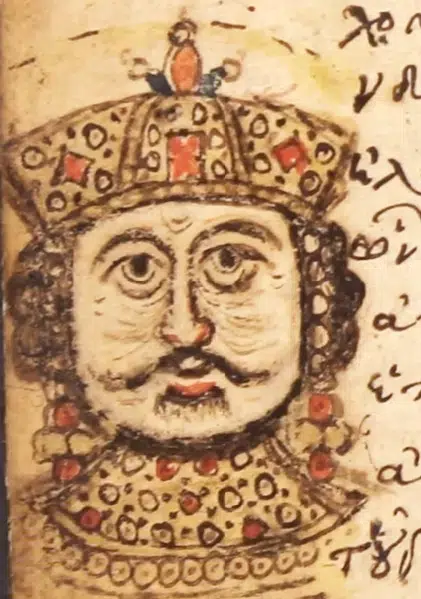
For a collector of Byzantine coinage, the reign of Flavius Mauricius Tiberius Augustus represents the final, disciplined breath of the world established by Justinian the Great. Maurice (582–602) was a “Soldier-Emperor” in the truest sense—a man of Roman roots born in Cappadocia who climbed the ranks not through palace intrigue, but through the grit of the Eastern frontier. To hold a gold solidus of Maurice is to hold a relic of the last emperor who truly managed to balance the staggering costs of a global empire with the tactical brilliance required to defend its borders.
From Commander to Caesar: 582
Maurice’s rise was the result of pure military competence. Under Tiberius II, he served as the Magister Militum per Orientem, the supreme commander of the forces facing the Sassanid Persians. His success in the East was so absolute that a dying Tiberius II chose Maurice as his successor, marrying him to his daughter, Constantina.
The coinage of Maurice is a study in transition. On his early issues, we see a clean-shaven, traditional Roman face, but as his reign progresses, the “Byzantine” style begins to solidify. He is often depicted wearing the plumed helmet or the consular mappa, symbols of a ruler who was as much a bureaucrat as he was a general. For the numismatist, his gold Solidi and Tremisses are prized for their high-quality striking, produced in a series of mints—Constantinople, Antioch, and Carthage—that reflect the vast reach of his authority.
The Victor of the Persian War
The greatest triumph of Maurice’s reign was the conclusion of the long-running war with Sassanid Persia. In a move of brilliant diplomacy, he supported the exiled Persian King Khosrow II against a usurper. When Khosrow was restored to his throne in 591, he returned the favor by ceding strategic parts of Armenia and Mesopotamia to the Romans.
This victory was a massive relief for the imperial treasury. For the first time in generations, the annual tribute to the Persians ceased. This economic breathing room is visible in the copper Follis coinage of the 590s. While previous emperors had been forced to shrink the size of the bronze coins to save metal, Maurice’s folles remained large and robust, often featuring the “M” (for 40 nummi) on the reverse, a symbol of a stabilized economy.
The Exarchates: A Blueprint for the Future
Maurice understood that Italy and North Africa were too far away to be governed directly from Constantinople. He established the Exarchates of Italy and Africa, semi-autonomous provinces ruled by “Exarchs” who held both military and civil power.
This was a radical departure from Roman tradition, which usually separated the two. To a collector, coins from the Carthage and Ravenna mints during this period are highly distinct. They often have a “chunky,” local style that differs from the refined output of the capital, showing the growing independence of these Western outposts. This system would eventually evolve into the famous “Theme” system that saved the empire in later centuries.
The Strategikon: The Emperor’s Mind on Paper
Maurice’s legacy isn’t just in metal; it’s in ink. He is traditionally credited with the Strategikon, a comprehensive manual of war that influenced military tactics for over a thousand years. It covered everything from cavalry maneuvers to the psychology of different barbarian tribes. To read the Strategikon is to understand the mind behind the coins—a man who viewed the defense of the empire as a complex, scientific endeavor.
The Revolt of Phocas and the Tragic End: 602
The fall of Maurice was a tragedy of fiscal discipline. Years of constant warfare against the Avars and Slavs in the Balkans had drained the treasury. When Maurice ordered his troops to winter across the Danube to save money on supplies, the army—led by a junior officer named Phocas—revolted.
Maurice fled with his family but was captured. In a scene of horrific cruelty, he was forced to watch the execution of his six sons before he was beheaded himself. His death ended the Justinian dynasty and plunged the empire into a dark age of civil war and Persian invasion.
A Legacy of Resilience
For the numismatist, Maurice Tiberius is the “Last of the Great Romans.” His coins represent the final moment of the 6th-century peak before the total transformation of the 7th century. They are the artifacts of a man who fought for every inch of Roman territory and sought to organize the state with the same precision he used to organize a legion.
When you add a Maurice Tiberius solidus to your collection, you are holding the work of a philosopher-general who tried to bridge the gap between the ancient and the medieval. He was a ruler who saw the storm coming and spent his life building the walls and minting the gold to withstand it.
