

The Romans were one of the most technologically sophisticated civilizations of the ancient world. They built aqueducts that still carry water today. They engineered concrete that modern chemists are still trying to reverse-engineer. They developed surgical instruments so advanced that some designs were not improved upon until the nineteenth century.
And they made their money by hand, one coin at a time, with a hammer.
For seven hundred years, Roman coinage was produced using essentially the same process: a worker placed a metal blank between two engraved dies, another worker struck the assembly with a heavy hammer, and a coin emerged. No water mills. No screw presses. No automation at any stage. Just fire, metal, and muscle.
It sounds primitive. It wasn’t. It was a highly optimized industrial process adapted to the technology available — and it produced the most widely circulated currency the ancient world had ever seen.
The Raw Materials
Roman coins were made from three metals, each with its own economic role.
Gold — reserved for the highest denominations, most notably the aureus. Gold was the currency of the elite and of international trade. A single aureus was worth 25 silver denarii — more than a month’s wages for a common laborer. Only a small fraction of ordinary Romans would ever hold one.
Silver — the backbone of Roman commerce for seven hundred years. The denarius was the standard coin of daily life, the money in which soldiers were paid and taxes were collected. Silver came to Rome from the mines of Spain, Dacia (modern Romania), Macedonia, and Britain. When those supplies ran short — or when emperors wanted to save silver for other uses — they debased the coinage by mixing in copper. You can trace that long decline in our post on the debasement of the Roman denarius.
Bronze (and later orichalcum, a brass alloy) — for smaller denominations: the sestertius, the dupondius, the as, the half-as semis, and the quarter-as quadrans. These were the coins of ordinary commerce — buying bread at a market stall, paying for a visit to the baths, tossing into a beggar’s bowl. In the later empire, the bronze-based follis dominated everyday use.
Each metal required a slightly different process. Gold was softest and easiest to strike. Silver needed careful heating before striking, or the dies would crack the brittle metal. Bronze had to be cast in molds first, because its higher melting point made cold-striking impossible at scale.
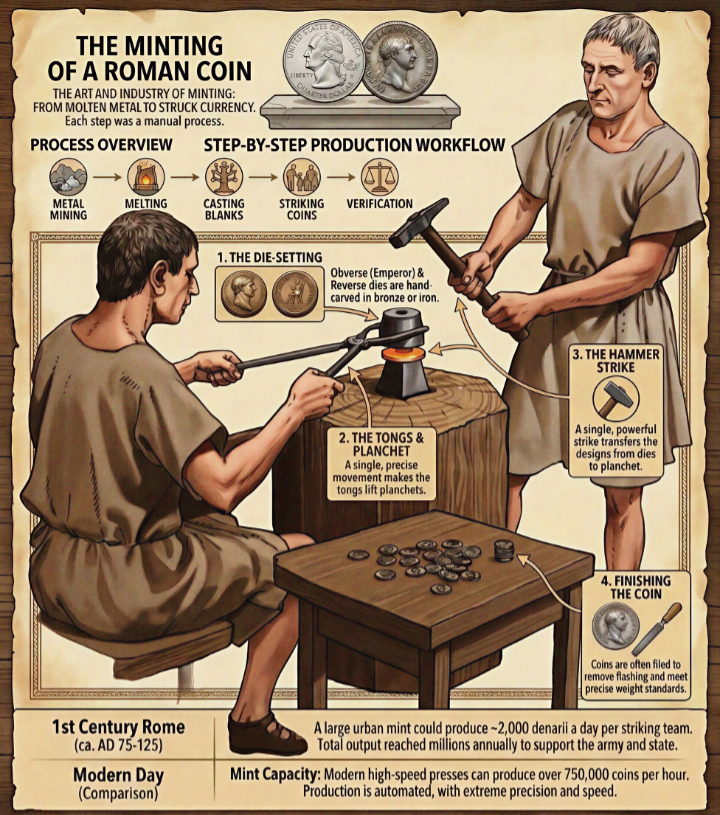
The Blank: Turning Metal Into a Coin-Shaped Disc
Before a coin could be struck, it had to be prepared as a blank — called a flan by numismatists.
There were two main methods. In the first, metal was melted in a crucible and poured into rows of small circular molds carved into a stone slab. Each little hollow produced one disc. When cooled and broken apart, these blanks were roughly coin-sized but uneven — often showing a small tab or “sprue” where the molten metal had flowed between molds. Workers filed these tabs off, though you can still see evidence on some ancient coins where the filing was hasty.
In the second method, metal was hammered or rolled into a thin sheet, and blanks were cut from the sheet using a punch or shears — much like cutting cookies from a rolled sheet of dough. This produced more uniform discs but wasted more material, since the space between discs had to be recycled.
Whichever method was used, the result was a rough disc — slightly uneven in thickness, sometimes slightly off-round. This imperfection is why no two ancient Roman coins are exactly identical. Even coins struck from the same dies, on the same day, in the same workshop, show small differences in centering, roundness, and surface texture. Each one is a handmade object.
Before striking, the blank was usually heated. A hot flan was soft and plastic, taking the die’s impression cleanly. A cold flan might crack or produce a shallow, weak strike. This is why Roman mints had furnaces going continuously during production runs — the metal had to be kept at working temperature.
The Dies: Where the Art Actually Happened
The real skill of Roman coin-making lay not in the striking itself but in the dies.
Dies were the negative engravings — usually of iron or hardened bronze — that pressed the image into the blank. Each coin required two: an obverse die (usually the one embedded in the anvil) and a reverse die (the one held on top and struck with the hammer). When the blank was pressed between them and the hammer fell, both sides received their design simultaneously.
The men who carved these dies were called celatores — skilled artisans who worked in miniature, engraving fine details into hardened metal using tiny chisels and gravers. A single die might take a master engraver days or weeks to complete, depending on the complexity of the portrait.
This is why the same emperor’s coins look so different across his reign. Every time a die wore out and had to be replaced, a new celator had to engrave a new die from scratch. Some celators were more talented than others. Some imperial portraits are sensitively rendered, capturing a specific likeness — the sad-eyed, long-nosed intensity of Augustus, the curly-bearded philosopher-king face of Marcus Aurelius, the brooding intensity of Caracalla. Others are crude, flat, generic — the work of a lesser engraver copying a master’s portrait at the outer edges of the empire.
Dies wore out fast. A well-made iron obverse die might strike 10,000-15,000 coins before cracks formed or the design became too worn to use. Reverse dies, which took the brunt of the hammer impact, wore out faster — often after just a few thousand strikes. When a die cracked and was still used anyway, it left visible flaws on subsequent coins. These die cracks are sometimes so distinctive that numismatists can identify the specific die that struck a given coin — and therefore the approximate week, month, or year the coin was made.
The Strike: Two Seconds That Made a Coin
With blank prepared and dies engraved, the actual striking was shockingly fast.
The obverse die was fixed into a heavy iron anvil. The heated blank was placed on top of it, centered by eye or by a small collar. The reverse die was positioned on top of the blank. A worker held this top die steady with tongs or with tongs-like handles, and a second worker — the strike man — swung a hammer down with enormous force.
One strike. Sometimes two, if the first hadn’t bitten deep enough. The finished coin was flipped into a pile. The next blank was placed. The hammer rose again.
A skilled team could strike perhaps 20-30 coins per minute in sustained production — over a thousand per hour. Multiplied across multiple teams in a single workshop, a single officina could produce tens of thousands of coins per day. Multiplied across all the mints of the empire, the total output was staggering.
And every single coin required a skilled human arm.
The Workshops: Officinae Across the Empire
Roman mints were called officinae — singular, officina — meaning “workshops.” Each large mint city might have multiple officinae operating simultaneously, each with its own team of workers and supervisors.
In the early Republic, Rome itself was the only official mint. Over time, as the empire expanded, this centralized system gave way to a network of regional mints producing coins for local circulation. By the late third century AD, the Tetrarchy under Diocletian had formalized this system — establishing major mints in cities scattered across the empire to serve the needs of regional armies and administrations.
Some of the most important Roman mints you can find represented in the collection:
- Rome — the original mint, still the symbolic center of Roman coinage even after provincial mints became more numerous
- Trier (Treveri) — the western imperial capital in Gaul, producing enormous quantities of late-empire coinage
- Siscia — a major Danubian mint serving the armies of the Balkans
- Antioch — the largest eastern mint, supplying the legions on the Parthian and Sasanian frontiers
- Alexandria — the great mint of Roman Egypt, known for distinctive billon tetradrachms struck for provincial use
- Constantinople — the new capital of the East, eventually the last major Roman mint to survive
- Londinium — the British mint, active from the late third century through the province’s fall
Each mint stamped its products with small identifying marks — letters, symbols, or combinations — that appear usually in the exergue (the lower portion of the reverse) or in the field beside the main design. These are the famous mint marks that numismatists use to identify where a coin was struck. An SMR tells you the coin came from Rome (Sacra Moneta Romae). SMAL marks Alexandria. SISC or SIS marks Siscia. The letters are usually followed by another letter indicating which specific officina within the mint produced the coin — A, B, Γ, and so on.
The mint-mark system was introduced gradually and became universal by the early fourth century. Before that, mint locations have to be inferred from style, weight, and fabric — which is partly why older coins are harder to attribute definitively.
The Imperfections That Prove They Were Handmade
Roman coins carry the fingerprints of their making. Look closely at any ancient coin and you’ll see signs of the human process that produced it:
- Off-center strikes — when the blank wasn’t perfectly aligned between the dies
- Double strikes — when the hammer came down twice and the second impact was slightly offset, creating ghosted details
- Flat spots — where the die was worn or the strike was too weak to fully impress the design
- Die cracks — thin raised lines where a worn die began to split
- Flan cracks — splits in the blank itself, usually caused by striking cold or too-thin metal
- Cuds and flow lines — small raised blobs and patterns where metal flowed unevenly during the strike
- Filing marks — tiny parallel scratches where workers filed the edge to remove casting sprues
Each of these marks would be unacceptable in a modern coin. In an ancient coin, they are the signature of an authentic handmade object — the evidence that a real human being, 1,800 years ago, held a hammer and brought it down.
If you hold a modern commemorative coin, you hold a machined object. Perfect roundness. Absolutely uniform strike. Identical to every other coin of its type. There is a precision to it, but no life.
If you hold a Roman coin, you hold the result of a specific moment in time when a specific worker placed a specific blank on a specific anvil and a specific celator’s carved die bit into silver or bronze in a specific workshop. The imperfections are the fingerprints of that moment.
Why the Craft Still Matters
The Roman coinage system lasted longer than almost any institution in human history. It outlived dozens of emperors, survived civil wars and invasions, and continued operating — with declining but unbroken continuity — from the late third century BC to the fall of Constantinople in 1453 AD.
That’s seventeen centuries of continuous production using essentially the same fundamental technology: hammer, die, blank, and the hands of skilled workers.
When you pick up a Roman coin today — a denarius of Marcus Aurelius, a follis of Constantine, an antoninianus of Aurelian — you are holding the end product of a process that began with raw silver ore from a Spanish or Dacian mine, passed through the hands of smelters, casters, celators, heat-men, strike-men, and quality checkers, and finally ended up in circulation across an empire that stretched from Scotland to Syria.
Every Roman coin is also, in a sense, a collaborative work. The celator who carved the die, the worker who heated the blank, the man who swung the hammer, the supervisor who checked the weight — dozens of people touched every coin before it ever reached the emperor’s treasury or a soldier’s purse.
When we admire Roman coins now, we are admiring their labor. The empire may be dust. The celators’ names are long forgotten. But their work is still here, carrying the faces of dead emperors across two thousand years.
To see coins from the many mints across the Roman Empire, browse the collection by mint location, or view the timeline to see how Roman coinage evolved over seven centuries. To understand why the quality of these coins changed over time, read our post on the debasement of the Roman denarius. To see one of the most remarkable preserved hoards from this long tradition of craft, read about the Rauceby Hoard.

