
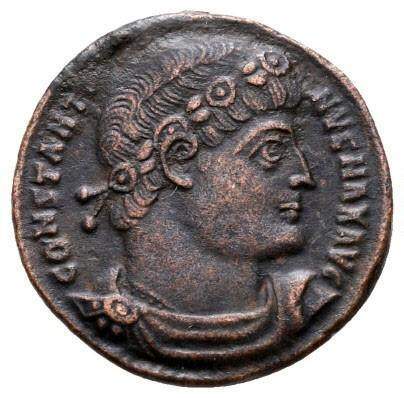
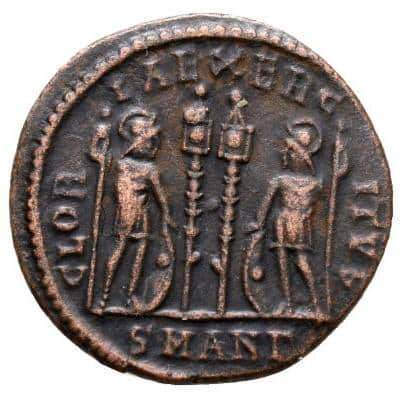
The Constantine I “Two Standards” Follis (RIC VII Antioch 86) serves as a striking bronze window into the final, militaristic chapter of the first Christian Emperor’s reign. Struck around AD 330–335, this coin represents a major shift in imperial messaging—moving away from complex mythological scenes and toward a direct, gritty tribute to the legions that kept the Constantinian dynasty on the throne.
1. The Historical Context: The Sunset of a Titan
By the early 330s, Constantine the Great had achieved everything a Roman could dream of: he had unified the Empire, inaugurated Constantinople, and fundamentally changed the course of Western religion. However, as he looked toward his succession, he knew that the only thing standing between his sons and total chaos was the Roman Army.
This coin was minted at the Antioch mint (in modern-day Turkey), a city that served as the strategic nerve center for the defense of the Eastern frontier. The “Two Soldiers” type was part of a massive, empire-wide reform of the small bronze coinage. It was designed to be easily understood by even the most illiterate recruit in a remote fort: The Emperor is Great, and the Army is Glorious.
2. The Reverse: The Dual Standards of the Legions
The reverse features two soldiers, helmeted and cuirassed, standing face-to-face. Each holds a spear in their outer hand and rests their inner hand on a grounded shield. Between them stand two military standards (signa).
- The Two Standards: This is a crucial diagnostic for collectors. This earlier version of the “Gloria Exercitus” type features two standards, representing the shared glory of the various legionary detachments. By AD 335, the design would be simplified to just one standard to save space as the coin size decreased.
- The Symbol of Unity: The soldiers aren’t fighting; they are standing guard. This imagery emphasized the internal peace of the Empire. It told the Roman public that as long as the soldiers stood together around their standards, the “Glory of the Army” (Gloria Exercitus) would remain intact.
- The Legend: GLOR – IA EXERC – ITVS. A blunt, powerful title that translates to “The Glory of the Army.”
3. The Obverse: The Diademed Autocrat
The obverse features the diademed, draped, and cuirassed bust of Constantine I, facing right.
- The Royal Diadem: Notice the absence of the traditional laurel wreath. By this stage in his reign, Constantine had adopted the gemstone-encrusted diadem—a symbol of absolute, divinely sanctioned monarchy that moved Rome away from its “first among equals” roots and closer to the Byzantine style of kingship.
- The “Maximus” Title: The legend CONSTANTI – NVS MAX AVG (Constantinus Maximus Augustus) proclaims him as “Constantine the Greatest.” It is the face of a man who knew he had reshaped history and wanted the world to remember him as the supreme architect of a new era.
- The Legend: CONSTANTI – NVS MAX AVG.
4. Technical Details: The Antioch Excellence
- RIC VII Antioch 86: Cataloged in the seventh volume of Roman Imperial Coinage, which covers the high-water mark of the Constantinian house.
- The Mint: Struck in Antioch (look for the SMANT mark in the exergue). The Antioch mint was famous for its high-quality engraving, often capturing incredible detail in the soldiers’ leather “pteryges” (skirt armor) and the individual “phalerae” (medallions) on the standards.
- The Patina: These 4th-century bronzes are beloved for their surfaces. Because they were minted in such high volume, we can still find specimens from Antioch with deep, “desert” patinas or rich, dark chocolate-brown finishes that make the silver-wash (billon) highlights pop.
