
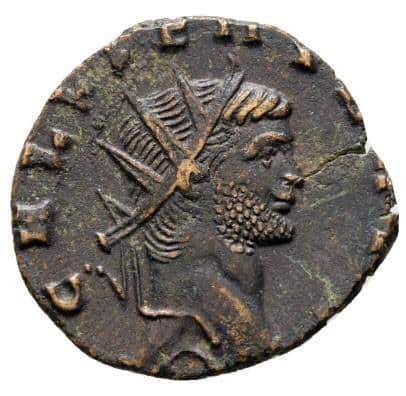
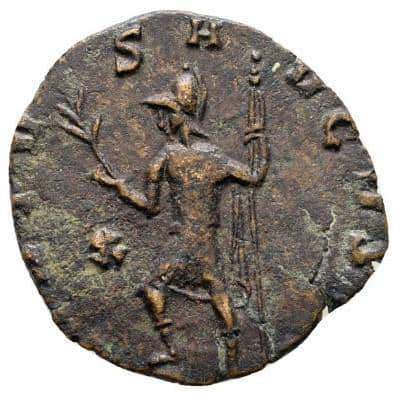
The Gallienus “Virtue of the Emperor” Antoninianus (RIC V 534) serves as a gritty silver-washed window into the “Age of Anxiety.” Struck around AD 260–268, this coin was minted in Mediolanum (modern Milan) at a time when the Roman world was literally tearing itself into three pieces, and Gallienus was fighting a desperate, multi-front war to keep the Italian heartland from falling to Germanic invaders.
1. The Historical Context: The Milanese Shield
By AD 260, Gallienus was perhaps the most stressed man in history. His father, Valerian, had been captured by the Persians, the Gallic Empire had broken away in the West, and the Palmyrene Empire was rising in the East. In response, Gallienus moved the center of his military operations to Mediolanum.
This coin was part of the “Milanese series,” struck specifically to pay the Comitatenses—the elite mobile cavalry units Gallienus created to intercept barbarian raids. By invoking Virtus Augusti, the Emperor was making a direct appeal to these soldiers. He wasn’t just their paymaster; he was their fellow commander, reminding them that the “virtue” of the Emperor was the only thing standing between Rome and total annihilation.
2. The Reverse: Mars the Peacemaker
The reverse features Mars, the god of war, standing left, holding a branch in his right hand and a spear in his left.
- The Olive Branch of Victory: This is a fascinating “hybrid” image. While Mars is traditionally a god of pure destruction, here he holds an olive branch—the symbol of peace. It tells the viewer that the Emperor’s war is a “Just War,” aimed at restoring peace through superior force.
- The Spear of Authority: The vertical spear reminds the legions that while peace is the goal, the military remains the backbone of the state.
- The Legend: VIRTVS AVGVSTI. In the 3rd century, “Virtus” didn’t just mean moral goodness; it meant “Manliness” and “Military Prowess.” It was a bold claim for an Emperor whose reign was plagued by constant rebellion.
3. The Obverse: The Intellectual Soldier
The obverse features the radiate head of Gallienus, facing right.
- The Realistic Transition: Notice the shift in style. Gallienus was a highly educated man, a poet, and a fan of Greek philosophy. His early portraits are quite classical, but by the time this Mediolanum issue was struck, the art had become “linear” and more stylized—a precursor to the blocky, simplified art of the later 4th century.
- The Radiate Crown: The spikes of the crown identify this as an Antoninianus (nominally a double-denarius). By this stage of the crisis, the “silver” was often just a thin wash over a copper core, a sign of the hyperinflation Gallienus was trying to manage.
- The Legend: GALLIENVS AVG.
4. Technical Details: The Mediolanum Workshop
- RIC V 534: Cataloged in the fifth volume of Roman Imperial Coinage, which covers the chaotic mid-to-late 3rd century.
- The Mint: Struck in Mediolanum. You can often distinguish Milanese strikes from Rome strikes by their slightly more “nervous,” energetic engraving style and the specific treatment of the radiate crown’s ties.
- The Silver Wash: These coins were originally issued with a bright, silvery coating to hide their low metal value. Finding a specimen from the Milan mint that still retains its original silvering (or “silver wash”) is a fantastic way to see how the coin would have looked to a soldier in Gallienus’s cavalry camps.
