
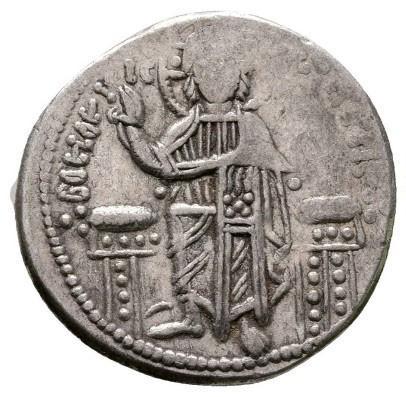
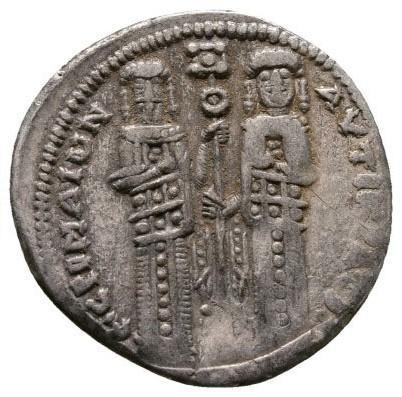
The Andronicus II Basilikon (Sear 2402) is a coin born of a desperate identity crisis. Struck between AD 1304 and 1320, it represents a moment when the Byzantine Empire—the last vestige of ancient Rome—decided to stop pretending it was the center of the world and started copying its neighbors just to survive.
The basilikon was introduced shortly before 1304 by Emperor Andronikos II Palaiologos (r. 1282–1328), in direct imitation of the Venetian silver ducat or grosso, chiefly to pay the mercenaries of the Catalan Company. The Byzantine coin closely followed the iconography of the Venetian model, with a seated Christ on the obverse and the two standing figures of Andronikos II and his son and co-emperor Michael IX Palaiologos (r. 1294–1320) replacing St. Mark and the Doge of Venice on the reverse. The similarity was reinforced by the name of the new coin: the ducato, the “coin of the doge”, became the basilikon, the “coin of the basileus”, although the contemporary Greek sources usually call both doukaton.
The basilikon was of high-grade silver (0.920), flat and not concave (scyphate) as other Byzantine coins, weighing 2.2 grams and officially traded at a rate of 1 to 12 with the gold hyperpyron or two keratia, the traditional rate for Byzantine silver coinage since the days of the hexagram and the miliaresion. The actual rate, however, was usually lower, and fluctuated depending on the changing price of silver: contemporary sources indicate actual rates of 12.5, 13, or 15 basilika to the hyperpyron. Examples of half-basilika are also known to have been minted.
In the 1330s and 1340s, however, the basilikon’s weight was much reduced, as a result of a silver shortage affecting all of Europe and the Mediterranean, falling to 1.25 grams by the late 1340s. It ceased to be struck in the 1350s, and was replaced circa 1367 with the new, heavier stavraton.
1. The Historical Context: A Shrunken Giant
By the reign of Andronicus II Palaeologus, the Byzantine Empire was a shadow of its former self. The Fourth Crusade had shattered Constantinople a century earlier, and though the Greeks had retaken their capital, the treasury was empty.
The traditional Byzantine gold coin, the Hyperpyron, was being debased into “fool’s gold.” Meanwhile, the Republic of Venice was dominating Mediterranean trade with its pure silver Grosso. In a move that was both practical and slightly humiliating, Andronicus II decided: “If you can’t beat them, join their currency.” The result was the Basilikon (the “Royal” coin), the first major pure silver Byzantine denomination in centuries.
2. The Obverse: Christ Enthroned
The obverse features a majestic image of Christ enthroned, facing forward, holding the Gospels.
- The Divine Authority: While the Empire was losing territory to the rising Ottoman Turks in the East, the coin reasserted that Constantinople was still the “Holy City.”
- The “Dot” Mystery: On many specimens of Sear 2402, you will see small dots or symbols on the throne. These are sigla (secret marks) used by the mint to track which workshop produced the coin. For a Numiscurio reader, these tiny dots are the “serial numbers” of the Middle Ages.
3. The Reverse: The Two Emperors
The reverse depicts Andronicus II on the left and his son/co-emperor Michael IX on the right. They are shown standing, holding a long cross or a labarum between them.
- A Fragile Dynasty: Michael IX was the “hope” of the Palaeologan dynasty, a brave general who spent his life fighting the Turks and the Catalans. Sadly, he died before his father, leading to a disastrous civil war.
- The Appearance: Notice their robes—the loros. These were incredibly heavy, jewel-encrusted silk scarves that symbolized the Emperor’s role as God’s representative on Earth. Even on a small silver coin, the die-sinkers managed to capture the “imperial weight” of these two men.
4. Technical Details: The “Venetian” Influence
- Sear 2402: This refers to David Sear’s Byzantine Coins and Their Values, the “bible” for collectors in this field.
- Silver Purity: The Basilikon was struck in high-quality silver (roughly .900 fine). It was designed to weigh exactly the same as the Venetian Grosso so merchants could swap them 1-for-1.
- The “Cup” Shape: Unlike the famous “cup-shaped” (scyphate) coins of earlier Byzantine history, the Basilikon was flat. This was another nod to Western European standards, making the coins easier to stack and trade in international markets.
