

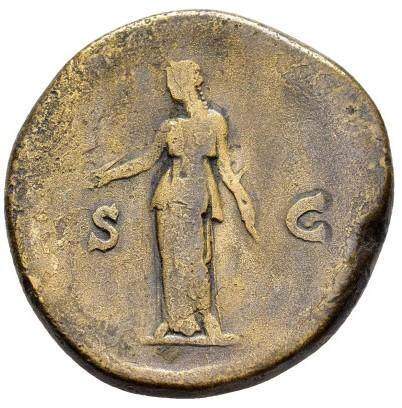
The Hadrian “Diana the Huntress” Sestertius (RIC II 2398) serves as a heavy, bronze testament to an Emperor who was as much a restless traveler and woodsman as he was a statesman. Struck between AD 134–138, during the twilight of Hadrian’s reign, this massive coin reflects the private passions of a man who spent more time in the rugged provinces than in the marble palaces of Rome.
At Numiscurio, we often say that a coin’s “soul” is found in those moments when the Emperor’s personal hobbies—like his legendary obsession with the hunt—become the official face of the Empire.
1. The Historical Context: The Restless Hunter
Hadrian was perhaps the most complex of the “Five Good Emperors.” He was a poet, an architect, and a scholar, but his true sanctuary was the wilderness. Ancient biographers note that he was an avid hunter, once famously killing a lion in Africa and nearly dying in a boar hunt in Asia Minor.
This sestertius was minted as Hadrian finally settled back in Italy after decades of traveling the Roman world. By choosing Diana, the goddess of the moon and the hunt, for his high-value bronze coinage, Hadrian was signaling a return to the “natural” virtues of the provinces. It was a subtle way of reminding the Roman elite that his strength came from the rugged frontiers he had so carefully fortified with his famous walls.
2. The Reverse: Diana, Mistress of the Wild
The reverse features Diana, the virgin huntress, standing left, holding an arrow in her right hand and a bow in her left.
- The Goddess of Transitions: Diana was the protector of the “in-between” places—the forests and mountains that lay outside the city walls. For an Emperor who spent his life crossing borders, she was a natural patroness.
- The Symbol of Readiness: Unlike the heavy, armored depictions of Mars, Diana represents a lean, agile readiness. She is shown in her short hunting tunic (chiton), ready for the chase. This mirrored Hadrian’s own philosophy of a mobile, “ready-response” Roman military.
- The Legend: S – C. These large letters (Senatus Consulto) remind the holder that this massive bronze was struck by the authority of the Senate, even though the Emperor’s hand guided the design.
3. The Obverse: The Mature Traveler
The obverse features the laureate head of Hadrian, facing right.
- The Greek Beard: Hadrian famously broke with Roman tradition by wearing a full beard, a style he adopted out of his love for Greek culture. By the time this coin was struck (COS III P P), his beard had become the standard for every Emperor who followed him for the next century and a half.
- The “Father of the Country”: The legend includes P P (Pater Patriae), a title Hadrian accepted only later in his reign. It marks the final, “Golden Age” phase of his rule, where he was seen as the seasoned, wise guardian of the Roman family.
- The Legend: HADRIANVS AVG COS III P P.
4. Technical Details: The “Canvas” of the Sestertius
- RIC II.3 2348: Cataloged in the newly revised third part of the second volume of Roman Imperial Coinage.
- The Mint: Struck in Rome. The sestertius was the largest bronze coin in circulation, and because of its size, it allowed die-engravers to create incredibly high-relief, artistic portraits that are often considered the “fine art” of the Roman numismatic world.
- The Patina: Collectors prize Hadrianic sestertii for their surfaces. Because of their high copper content, they often develop rich, deep green or chocolate-brown patinas over two millennia. Finding a Diana reverse where the bowstring or the individual feathers of the arrow are still visible is a significant find for any specialist of the 2nd century.
