

For most of human history, kings passed their power to their sons. It almost never worked.
A great father might have a foolish son. A wise ruler might be followed by a tyrant. The Roman Empire had already lived through this pattern — Tiberius, Caligula, Nero, and finally Domitian, whose paranoid brutality ended only when his own servants stabbed him in the imperial palace on a September afternoon in AD 96.
After Domitian’s assassination, the Senate had a choice. They could pick another ambitious young general and pray. Or they could try something different.
They tried something different.
For the next eighty years, the throne of Rome was not won by blood. It was earned.
This is the story of the Five Good Emperors — Nerva, Trajan, Hadrian, Antoninus Pius, and Marcus Aurelius — and of the one mistake at the end that brought the whole thing crashing down.
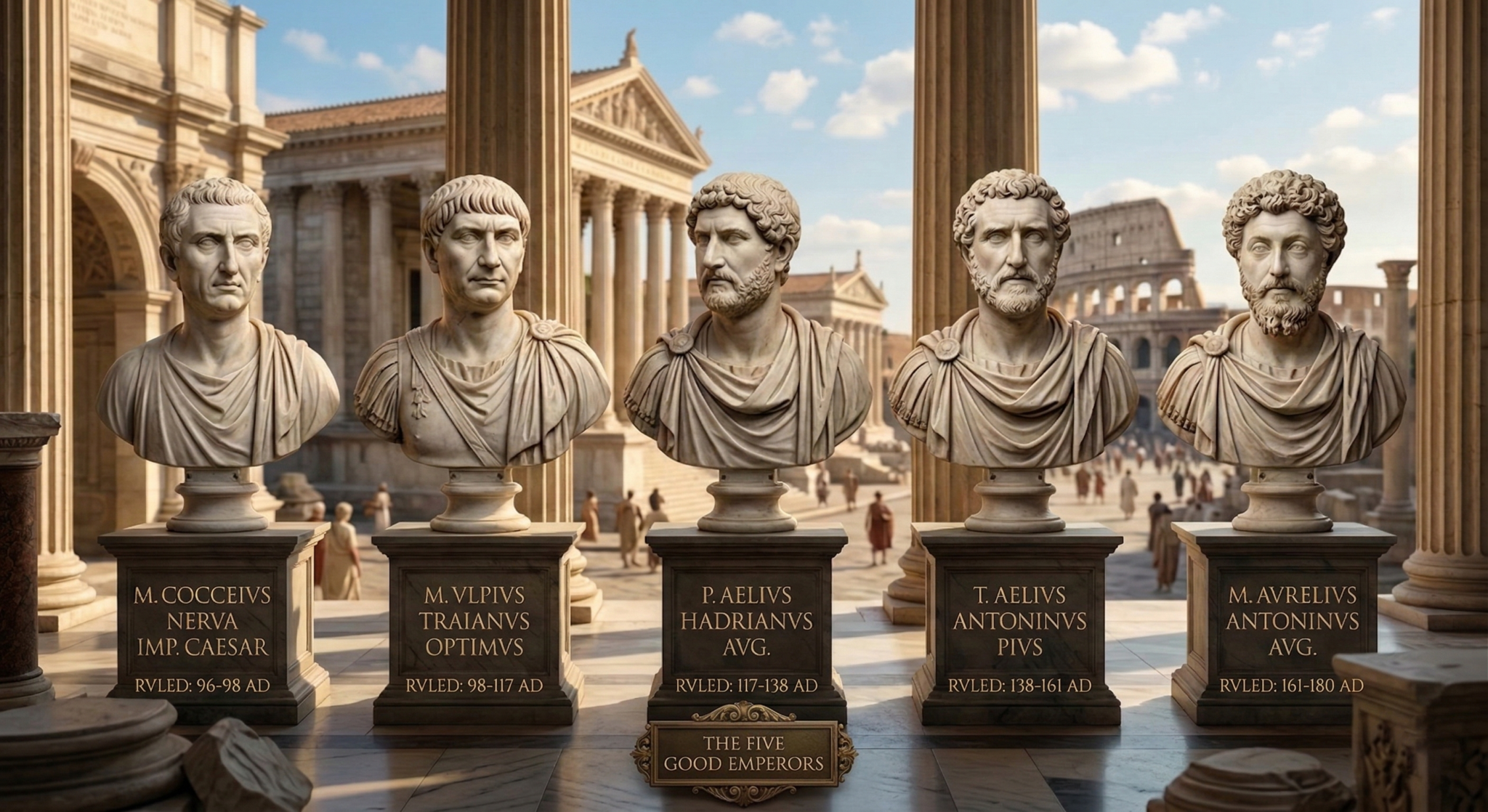
The Idea That Changed an Empire
The Senate’s choice after Domitian was a sixty-six-year-old lawyer named Marcus Cocceius Nerva. He was not a general. He had no sons. He had no dynastic ambition. What he had was wisdom — and a willingness to do something no Roman emperor had ever done.
Instead of naming a relative as his heir, Nerva searched the empire for the single most capable military leader alive. He found him commanding the Rhine frontier: a Spanish-born general named Trajan. Nerva adopted him publicly, made him co-emperor, and died four months later.
This was the moment Rome changed.
For the next eighty years, each emperor — nearing the end of his life — would select the most talented successor he could find, adopt him as a son, and train him to rule. Power passed from hand to hand not through accident of birth, but through deliberate choice. The result was an unbroken chain of five extraordinary men who governed Rome through its most peaceful, prosperous, and well-organized era.
Nerva: The Old Man Who Saved Rome

Nerva’s reign lasted fifteen months. It was one of the shortest in Roman history. It was also one of the most important.
He had survived Domitian’s reign by keeping his head down. A cautious senator, a respected lawyer, a careful man who knew how not to be noticed. When the Senate called on him in the chaos of September AD 96, he accepted — not out of ambition, but out of duty. He was old. He knew he was running out of time.
What Rome needed, Nerva decided, was not another emperor. It was a plan.
His plan was the adoption system. Rather than leave the throne to whoever could seize it when he died, he would name a successor in advance, publicly, while his armies and Senate could bear witness. And he would choose that successor for ability, not family.
On his coins, Nerva’s portrait shows a thin-nosed, contemplative man. Look closely at his silver denarius depicting the clasped hands of Concord, and you can read the political message in miniature: the armies are united, the Senate is reconciled, and the empire stands on solid ground. Another of his denarii shows the priestly implements of the Pontifex Maximus — a reminder that the old lawyer now held supreme religious authority over Rome.
Fifteen months. That’s all he got.
But in those fifteen months, he chose Trajan. And that choice changed everything.
Trajan: The Last Great Conqueror
Trajan was not Roman. He was Spanish, a provincial, the first emperor born outside Italy. And under his rule, the Roman Empire reached its greatest size in history.
From AD 98 to 117, Trajan pushed Rome’s borders to places they had never been. He conquered Dacia — modern Romania — and emptied its gold mines into the imperial treasury. He marched east into Mesopotamia, briefly reaching the Persian Gulf. At its peak, the empire stretched from the rainy hills of Britain to the hot deserts of Iraq. Five million square kilometers. From Scotland to Sudan.

But Trajan wasn’t just a conqueror. He was a builder. He constructed the largest forum Rome had ever seen. He built Trajan’s Column — ninety-eight feet of marble spiral carved with three thousand figures narrating his Dacian wars, still standing today in the middle of Rome. He funded the alimenta, a welfare system that fed Italian orphans from the interest on imperial loans to farmers.
He was so admired that for the next three centuries, every new Roman emperor was blessed by the Senate with the same formula: “May you be more fortunate than Augustus and better than Trajan.”
His coins reflect the ambition. The silver denarius showing Felicitas — the personification of Good Fortune — was struck at the height of Trajan’s reign, when the Dacian gold was fresh and Rome believed itself invincible. Another denarius shows Victory standing on a ship’s prow, commemorating Roman dominance of the Mediterranean — a sea the Romans now called, with entirely justified pride, Mare Nostrum: “Our Sea.”
Holding a Trajan denarius is holding a fragment of the Roman Empire at the exact moment it stopped growing.
Hadrian: The Emperor Who Walked Away

Trajan died suddenly in AD 117. His chosen successor Hadrian did something that horrified the Senate: he gave back the conquests.
Mesopotamia, Armenia, the eastern frontier — all abandoned. The Senate was appalled. But Hadrian wasn’t a coward. He was a realist. He understood what Trajan had not: the empire was already too big to defend. Every new province needed legions, forts, roads, administrators. Expansion had become a losing bet.
So Hadrian chose a different game. Consolidate. Fortify. Unify.
He spent more than half his twenty-one-year reign on the road — Britain, Egypt, Spain, Syria, Greece — personally inspecting every frontier and every province. No emperor before him had ever done this. He was the first to see his own empire with his own eyes.
His monuments are still standing. In northern Britain he built Hadrian’s Wall, seventy-three miles of fortified stone garrisoned by ten thousand soldiers, marking the edge of the Roman world for three centuries. In Rome he rebuilt the Pantheon, concrete dome and open oculus and all, almost exactly as it stands today — still the largest unreinforced concrete dome ever built, nineteen hundred years later. Near Tivoli he built a villa so large it covered a square mile, with replicas of Greek, Egyptian, and Roman architecture woven together into a single meditation on the empire he had explored.
On his coinage you can still feel the travel. The bronze As showing a Roman galley commemorates his own voyages across the Mediterranean. The heavy bronze Sestertius of Diana the Huntress captures another side of him — the woodsman, the outdoorsman, the emperor who would rather walk mountain trails than sit on a golden throne.
Hadrian took a machine of war and turned it into a culture of law, architecture, and shared identity.
Antoninus Pius: The Boring Emperor
Here’s the strange truth about Antoninus Pius: almost nothing happened during his reign.
No conquests. No crises. No dramatic scandals. No great buildings named after himself. For twenty-three years, from AD 138 to 161, the Roman Empire just… worked.
This is almost unheard of in ancient history. And it is exactly why Antoninus matters.
He was a wealthy senator from southern Gaul, selected by Hadrian for one specific quality: his total lack of political ambition. He earned his nickname “Pius” for his famous devotion to his adoptive father — when the Senate refused to deify Hadrian after his death, Antoninus argued for days, refusing to accept their decision, until they finally relented. That same steady conscientiousness defined his reign.

He didn’t wage wars of expansion. He rarely left Italy. He ran the empire like a careful accountant running a well-managed estate. The silver in the denarii was pure. The granaries were full. The borders were quiet. The economy grew.
The portraits on his coins match the man — serene, thoughtful, unhurried. His silver denarius showing the eagle and altar of his deification was struck after his death by his adopted son Marcus Aurelius, a final act of devotion that mirrors the one Antoninus had shown his own predecessor. His bronze As depicting Minerva the Defender — Minerva being the goddess of wisdom — feels like a fitting self-portrait for an emperor whose greatest strength was restraint.
Antoninus Pius proved something we rarely let ourselves believe: that the highest form of leadership is not conquest or reform or spectacle. Sometimes it’s just steadiness. Sometimes it’s just keeping the lights on for twenty-three years while the world doesn’t burn.
Marcus Aurelius: The Emperor Who Didn’t Want the Job

The last of the five was Marcus Aurelius — and he was the one who didn’t want to be emperor.
Marcus had been raised from boyhood to be a philosopher. He was a devoted student of Stoicism, the Greek school of thought that emphasized duty, restraint, and acceptance of what cannot be changed. When Antoninus Pius adopted him and marked him as heir, Marcus accepted the throne not with ambition but with obligation.
Then everything went wrong.
Germanic tribes poured across the Danube. The Parthians attacked in the east. A devastating plague — almost certainly smallpox, brought back by returning legions — swept through the empire and killed perhaps five million people. For much of his reign, Marcus Aurelius governed from a military tent on the frozen northern frontier, far from Rome, writing in the small hours by lamplight.
What he wrote became one of the most influential books ever written: the Meditations, a private journal of philosophical reflections on duty, mortality, and the examined life. It was never meant to be published. It was never meant for anyone’s eyes but his own. Nineteen hundred years later, it has never gone out of print.
His coins capture both the man and the moment. The silver denarius showing an eagle — struck to honor the death of Antoninus Pius — is a somber, transcendental tribute, the eagle carrying the deified emperor’s soul to the heavens. His heavy bronze Dupondius depicting Victory commemorates a hard-won triumph over the Germans — a reminder that Marcus, however reluctantly, was also a soldier on horseback.
He was a philosopher ruling an empire in collapse. He did it for nineteen years. And then, at the end, he made one mistake — the mistake that undid everything.
The One Son Who Broke the System
For eighty years, five emperors had chosen their successors on merit.
Then Marcus Aurelius did something none of his predecessors had done. He had a biological son. And rather than follow the tradition of his four predecessors — rather than adopting the most capable man in the empire — he left the throne to his own child.
The child’s name was Commodus.
Commodus was not Nerva’s lawyerly wisdom. He was not Trajan’s bronze discipline, or Hadrian’s restless curiosity, or Antoninus’s careful restraint, or Marcus’s reluctant duty. He was vain, unstable, and obsessed with his own divinity. He renamed Rome after himself. He fought in the gladiatorial arena, slaughtering wounded soldiers and exotic animals for the cheering crowd. He declared himself the reincarnation of Hercules. He bankrupted the treasury, devalued the silver coinage, and was finally strangled in his bath by his own wrestling partner on New Year’s Eve, AD 192.
His denarius showing Roma enthroned was struck while he was still trying to project imperial dignity — one of the last artifacts of a dying era. Within months of his death, Rome plunged into the Year of the Five Emperors, then civil war, and eventually the Crisis of the Third Century that nearly destroyed the empire entirely.
The Golden Age was over. It had lasted eighty-four years.
What the Coins Remember
The Five Good Emperors did not build the largest empire in history — Trajan alone did that. They did not found the greatest religious tradition — that came later, under Constantine. They did not create the most enduring laws — those came from Justinian four centuries after them.
What they did was rarer and more fragile. They proved that good government was possible. That an empire could be run without tyranny. That power could transfer without civil war. That leaders could choose their successors based on who could actually do the job.
They did this for eighty years. And when one of them failed — when Marcus Aurelius let love override wisdom and handed the throne to his own son — the entire structure collapsed within a single generation.
That is the lesson carried in their coins. Hold a Trajan denarius, a Hadrian As, a Marcus Aurelius Dupondius in your palm, and you are holding evidence of something almost miraculous: humans, on their best days, governing themselves wisely.
The coins outlasted the empire.
The lesson is still here.
To see the coins of the Golden Age in person, browse the collection or explore the timeline to see how these eighty years fit into the wider sweep of Roman history. To meet the rulers who came before and after, visit Rulers & Authorities.

