
The Nerva “Priestly Implements” Denarius (RIC II 24) serves as a striking silver window into a moment of extreme political delicacy. Struck in AD 97, this coin represents the “Great Reset” of the Roman Empire—the brief, two-year bridge between the tyranny of Domitian and the golden age of Trajan.
1. The Historical Context: The Senate’s Emperor
When the despised Domitian was assassinated in AD 96, the Senate acted with lightning speed to appoint one of their own: Marcus Cocceius Nerva. He was elderly, childless, and a career lawyer—the literal opposite of the paranoid “Lord and God” who preceded him.
This denarius was minted during his third consulship (COS III), a year defined by Nerva’s struggle to appease the Praetorian Guard, who were still loyal to the murdered Domitian. By choosing ancient religious tools for his coinage, Nerva was making a profound statement: The age of the ego is over; the age of the Law and the Gods has returned. It was a visual promise of a return to the “Good Old Days” of the Republic.
2. The Reverse: The Instruments of the Gods
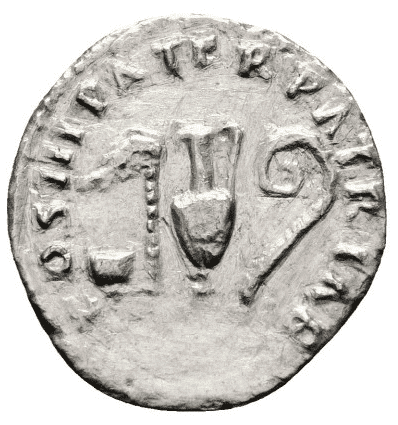
The reverse features a collection of priestly implements: the Simpulum (ladle), Sprinkler (aspergillum), Ewer (jug), and Lituus (augur’s staff).
- The Sacred Tools: Each of these items was used by the high-ranking priestly colleges of Rome. The simpulum was for libations, the sprinkler for purification, and the lituus for interpreting the will of the gods through the flight of birds.
- The Pontifex Maximus: Together, they represent Nerva’s role as the High Priest of Rome. In a time of political transition, these symbols told the Roman people that the Emperor was performing his sacred duties to maintain the Pax Deorum (the Peace of the Gods).
- The Legend: COS III PATER PATRIAE. This highlights his third consulship and his title as “Father of the Country,” a role he took very seriously as he worked to provide grain for the poor and land for the veterans.
3. The Obverse: The Stoic Senator
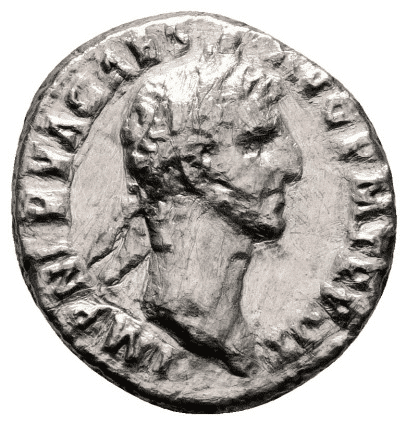
The obverse features the laureate head of Nerva, facing right.
- The Realistic Portrait: Nerva’s portraits are famous for their unflinching realism. Notice the prominent, “aquiline” nose, the thin lips, and the wrinkled neck of an older man. He didn’t ask the engravers to make him look like a young hero; he wanted to look like a wise, seasoned statesman who had seen it all.
- The Legal Authority: The legend IMP NERVA CAES AVG P M TR POT covers his full range of powers, from military commander (Imperator) to the holder of Tribunician Power (TR POT), which gave him the right to veto legislation and protect the citizens.
- The Legend: IMP NERVA CAES AVG P M TR POT.
4. Technical Details: The High-Quality Rome Mint
- RIC II 24: Cataloged in the second volume of Roman Imperial Coinage, which covers the era from Vespasian to Hadrian.
- The Mint: Struck in Rome. Nerva’s coinage is known for its high technical standard. Because his reign was so short (only 16 months), his coins were not heavily debased, and they often retain a very high silver purity.
- The Scarcity: Because Nerva reigned for such a brief window, his denarii are naturally scarcer than those of the emperors who surrounded him. Finding a specimen with a sharp lituus and simpulum—where you can see the handle of the ladle and the curve of the staff—is a mandatory acquisition for any collector of the “Five Good Emperors.”
