

Walk into any ancient coin auction, scroll any dealer’s online catalog, or search “Roman coin” on eBay, and you will see the same word everywhere.
RARE.
In all caps. Often followed by exclamation marks. Sometimes expanded into “EXTREMELY RARE” or “ONE OF THE FEW KNOWN.” The word does a lot of work. It catches attention. It justifies prices. It implies that the person selling the coin has specialist knowledge and the buyer should trust them.
But here is the uncomfortable truth about rarity in ancient numismatics: it often doesn’t mean what beginners think it means.
Modern coin collecting works on a simple mathematical principle. If 100 of a coin were minted, 50 survive, and 1,000 collectors want one, the price rises until 950 people drop out. Supply and demand meet, and the price settles. In modern numismatics, where mintage numbers are published and collection sets are standardized, rarity translates directly to value.
Ancient coins don’t work that way.
In the ancient world, no two coins are identical. Dies varied. Mints varied. Every striking session produced small variations that a diligent modern cataloger can treat as separate “types.” A coin with a tiny die crack — genuinely unique, genuinely “rare” — may have no collectors seeking it, because nobody has decided that specific die crack is a type worth pursuing. Meanwhile, a coin from a catastrophically mass-produced emperor — Constantine the Great, say — may sell for hundreds of dollars not because it’s scarce, but because so many people want to own one.
Rarity in the ancient world is a riddle. Learning to read it accurately is what separates experienced collectors from beginners — and what protects you from paying premium prices for things that aren’t actually premium.
Why “Rare” Means Less Than You Think
In modern numismatics, rarity is tied to numbered varieties. The 1909-S VDB Lincoln cent is rare because the mint produced only 484,000 of them in a specific year at a specific mint facility. The number is known. The collectors are numerous. The math is simple.
Ancient coinage had none of this structure.
Every ancient Roman emperor of any longevity produced a bewildering variety of coin types — portrait variations, reverse designs, mint marks, workshop letters, legend variations, field symbols, control marks. For any given emperor, a serious cataloger might identify hundreds of distinct “types.” Some types are common, with thousands of surviving examples. Others are extraordinarily rare, sometimes unique.
The problem is that rarity at the type level rarely translates to market demand.
A collector of Roman coinage typically focuses on big categories: a complete set of emperors (one coin of each), a thematic set (coins showing animals, or military scenes, or architectural reverses), or coins from a specific period or mint. The collector wants one representative Constantine — any Constantine — not necessarily this specific die variation of Constantine.
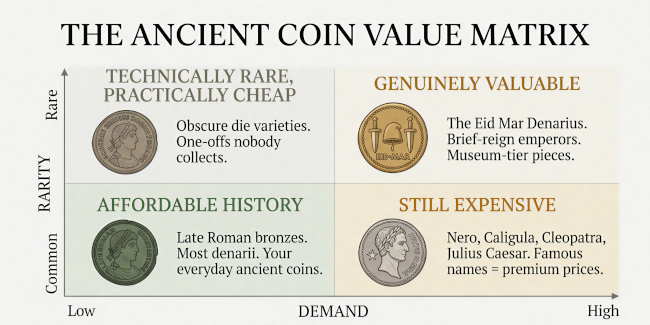
If a variant is technically rare but nobody is building a collection of that specific variant, the rarity generates no upward pressure on price. A one-of-a-kind die variation of a common emperor might sell for the same price as a common die, or even less if the variant is poorly preserved.
Rarity without demand is just a footnote.
When Ancient Rarity Genuinely Matters
True rarity does exist in the ancient world, and when it intersects with demand, prices can go very high. There are a few recognizable patterns where rarity is both real and meaningful.
The Brief Reign
Some emperors simply didn’t live long enough for their coinage to be produced in quantity. The classic example is Didius Julianus, who reigned for just nine weeks in AD 193 after buying the throne at auction from the Praetorian Guard. His coinage is genuinely rare — there was barely time for the mints to strike any before he was killed and replaced.
Other short-reigned emperors with rare coinage include Pertinax (86 days in 193 AD), Clodius Albinus (brief usurper, 196-197 AD), and various third-century claimants whose coins are almost never encountered in the market. For collectors building a chronological set of every emperor, these short-reign rulers become the “key dates” — the coins that hold up the whole set.
Demand for short-reign emperors is high and supply is genuinely limited. This is rarity that matters.
The Politically Suppressed
Some coinage was explicitly destroyed after a regime change. When an emperor was overthrown and declared damnatio memoriae — official condemnation of memory — his coins were sometimes recalled and melted. Coins of Elagabalus, Commodus (after his death), Geta (following his murder by his brother Caracalla), and others saw such recall campaigns, making their coinage rarer than it would otherwise have been.
This rarity is real and often translates to strong demand, since these are historically famous emperors.
Major Hoard Discoveries
The rarest hoard finds can include coins previously unknown to exist. The discovery of a new mint, a previously unknown emperor’s coinage, or an unrecorded variation can temporarily shake market assumptions. The Rauceby Hoard, for example, added 3,099 coins of the Tetrarchy to the corpus in 2017 — mostly known types, but the sheer freshness of the find and the detailed provenance gave each coin meaningful additional value.
The Rare Type with Large Collector Interest
Some specific coin designs became iconic, and their rarity intersects with intense modern demand. The Eid Mar denarius of Brutus — struck in 42 BC to commemorate the assassination of Julius Caesar — is a perfect example. The coin is genuinely scarce (maybe 100 silver examples known), but it’s also historically iconic. When demand meets genuine rarity, prices can reach $500,000 or more. The gold Eid Mar sold for £2.7 million in 2020.
The Dark Side: “Rare” as Marketing
None of this prepares you for the reality of browsing actual coin listings online.
In real-world marketplaces — especially eBay, but also mid-tier auction sites and some dealers — the word “RARE” is deployed aggressively as a marketing tool. The pattern is predictable:
- A coin that is genuinely common gets listed as “Rare”
- A coin that is scarce-but-low-demand gets listed as “Extremely Rare”
- A coin that has no business being described as rare gets listed as “Museum Quality Rare Roman Imperial Coin”
The seller isn’t always lying. Sometimes they genuinely believe it. More often, they’re using the word to pull in inexperienced buyers who see “RARE” and assume “VALUABLE.” The mismatch between the claim and the reality is where beginners lose money.
Common warning signs that a “rare” listing is hype:
- No reference number provided. A truly rare coin should have a specific citation in a reference work like RIC (Roman Imperial Coinage), BMC (British Museum Catalogue), Sear (Roman Coins and Their Values), or similar. If the seller can’t cite the variant, they probably can’t justify the rarity claim.
- The price doesn’t match the claim. A genuinely rare and in-demand ancient coin rarely sells for $10. If a seller claims rarity but is pricing like a common coin, one of the two statements is wrong.
- The same seller (or others) has similar coins listed. If you scroll through a seller’s other listings and find three other “extremely rare” examples of the same type, it’s not extremely rare.
- The language is emotional, not technical. A specialist describes a coin by its specific attributes: “RIC Rome 456, late issue, small variant with field star” — not “AMAZING RARE ROMAN TREASURE!”
- The seller resists direct questions. Ask what makes the coin rare. Ask for the reference number. Ask how many are known. A legitimate seller will answer; a hype-based seller will deflect.
The Production Scale You Should Know About
To calibrate your expectations about ancient coin rarity, it helps to understand the sheer scale of Roman minting.
Scholarly estimates based on die studies suggest that the mint of Rome alone was producing hundreds of thousands of silver denarii per month during much of the early Imperial period. Some estimates for peak production under the Flavian dynasty reach into the millions of coins per month. Across the entire empire, across six centuries, the total number of Roman coins produced is measured in billions.
Even after two thousand years of attrition — melting for the metal, loss in war, destruction through corrosion, burial in inaccessible places — millions of ancient Roman coins still exist in modern collections. The supply of common material is effectively inexhaustible at current demand levels. There are also, simply, far fewer collectors of ancient coins than of modern ones, which keeps prices for common coins remarkably low.
This is why a decent common denarius of Trajan or Hadrian or Marcus Aurelius can often be bought for under $50. You can see examples in the collection: the Trajan Felicitas denarius, the Marcus Aurelius Eagle denarius, the Hadrian Sestertius of Diana — each one is a beautiful object, a piece of direct history, and not particularly rare.
None of these coins are “rare” in the marketing sense. They are simply ancient coins that millions of people have held before you. That’s worth something different, something the marketing copy doesn’t capture.
The Demand Side: Why Common Can Still Be Expensive
If rarity alone doesn’t drive price, what does? Demand.
The classic example is the emperor Nero. Ruling from AD 54 to 68, Nero’s reign was long enough to produce coinage in very substantial quantities. His coins are not rare in absolute terms — plenty of examples exist across museum collections, auction catalogs, and private holdings.
And yet Nero’s coinage is consistently expensive — often two to five times the price of similar-grade coins from emperors with comparable or smaller outputs. Why?
Because everyone wants to own a piece of Nero. The emperor is historically infamous — tied to the burning of Rome, the persecution of Christians, the death of his own mother, the artistic pretensions and operatic performances that scandalized Roman society. He is one of a handful of Roman emperors whose name is still widely recognized two thousand years later. That recognition creates demand. Demand raises prices.
The same principle applies to Caligula, Julius Caesar, Cleopatra VII, Constantine the Great, Hadrian, and a few other historically famous figures. These emperors issued plenty of coins — but because so many people want a coin from these specific rulers, even common types sell for significantly more than equivalent coins from less-famous contemporaries.
Demand, not rarity, is the real price driver for most of the ancient coin market.
The Right Question to Ask
So what should a collector actually do with this information?
The answer is simple: forget rarity as a primary criterion. Buy coins you genuinely want.
When you consider a purchase, the useful questions aren’t about market rarity. They are about your personal relationship to the coin:
- Does this coin represent a period or a person I find genuinely interesting?
- Does its design, portrait, or reverse image appeal to me aesthetically?
- Is it in a condition I enjoy looking at?
- Is the price fair for what it is, regardless of marketing labels?
If you can answer yes to these questions, the coin is valuable to you — which is the only value that matters in a private collection. You’re not buying for resale (most collectors never sell during their lifetimes). You’re buying for the long, quiet relationship between you and the object.
A $40 common denarius of Vespasian that you love is worth more to you than a $400 technically-rare variant that bores you. The hype market pushes collectors toward the second kind of purchase. The thoughtful collector resists that pressure.
What Rarity Really Means
Here is the nuanced truth about rarity in ancient coins:
- Real rarity exists — in short-reign emperors, in suppressed rulers, in specific iconic types, and in occasional genuinely unique discoveries. When identified and paired with demand, real rarity commands real premiums.
- Marketed rarity is mostly noise — “RARE” as a marketing label is almost always less meaningful than it appears, and frequently used to extract premium prices from inexperienced buyers.
- Demand, not rarity, is the real driver for most of the ancient coin market — famous emperors command premiums regardless of supply, and less-famous emperors remain affordable regardless of scarcity.
The collector’s job is to build enough knowledge to separate genuine rarity from manufactured hype. That knowledge comes with time — tracking auction results, reading reference works, spending time with the coins themselves.
When you finally buy a coin that is genuinely rare and genuinely wanted by other knowledgeable collectors, you’ll know. The documentation will be real. The price will reflect honest scarcity. And the pleasure of owning something truly uncommon will be based on knowledge, not marketing.
Everything else — every breathless “RARE!” listing, every shouted sales pitch — is just noise.
To understand the broader Roman coinage you’ll encounter in the market, see our guides to Roman coin denominations and Roman mint marks. To protect yourself from the other great buyer’s trap — modern forgeries sold as authentic — read our guide to spotting cast vs. struck fakes. And to understand the one thing that can genuinely add meaningful value to an ancient coin beyond its physical features, see our post on provenance.

