

Every ancient coin you will ever hold is either 1,700 years old or a few months old.
There is no middle ground. Nobody struck Roman denarii in 1842, and nobody has been legitimately reproducing ancient coin designs as “collectibles” the way they do for Civil War buttons or Victorian medals. If a coin looks Roman but isn’t, it is a forgery — and its purpose is to deceive.
This is the quiet anxiety at the heart of ancient numismatics. You pick up a coin at a market stall in Rome, or bid on a lot online, or inherit a small collection from a relative, and the question immediately appears: is this real?
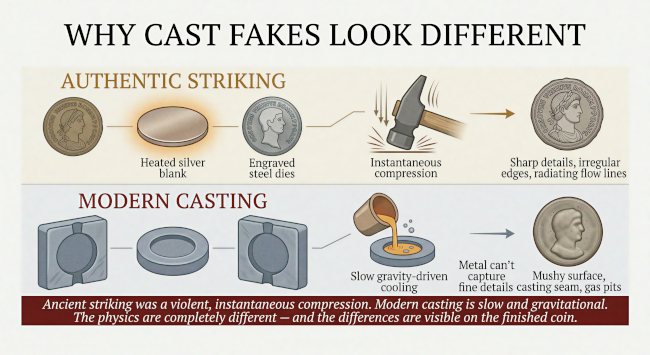
The good news is that authentic ancient coins and modern forgeries are made in fundamentally different ways. The Romans struck their coins — pressing a heated blank between two engraved dies under the force of a hammer. Modern forgers almost always cast their fakes — pouring molten metal into a mold made from a real coin. These two processes leave completely different fingerprints in the finished metal.
Once you understand those fingerprints, spotting most cast forgeries becomes almost embarrassingly easy. Not all fakes — there are sophisticated modern struck forgeries that are genuinely hard to detect — but the cast fakes that flood online marketplaces can be caught with nothing more than a magnifying glass, a digital scale, and a few minutes of careful observation.
This post is your introduction to that detective work.
The Fundamental Difference: Cast vs. Struck
Authentic Roman coins were produced by a very specific hand process. The full story is in our post on how ancient Roman coins were made, but the short version:
A worker heated a small disc of silver or bronze (called a flan) until it was soft enough to deform. He placed it on an anvil into which an obverse die — usually carrying the emperor’s portrait — had been fixed. A second die with the reverse design was positioned on top. A third worker brought a heavy iron hammer down on the whole assembly with enormous force. In the instant of that strike, the metal was compressed into the engraved recesses of both dies at once, emerging as a coin with sharp, high-relief details and characteristic flow lines where the metal had radiated outward from the point of impact.
Cast forgeries are made differently. A forger takes a genuine ancient coin (or sometimes just a photograph), makes a two-part mold from it, and pours molten metal into the mold. When the metal cools and the mold is opened, what comes out is a physical copy of the original.
It sounds like it should produce a convincing replica. But the physics are all wrong. Casting is a slow, gravity-driven process; striking is a violent, instantaneous compression. These two processes produce coins that look superficially similar but behave completely differently at the microscopic level — and the differences are visible to the naked eye, if you know what to look for.
Here are the three most reliable tests.
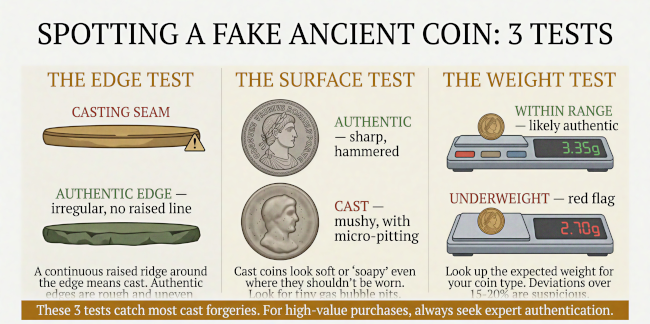
Clue #1: The Casting Seam
This is the number-one tell of a cast fake, and it’s visible on the edge of the coin.
When liquid metal is poured into a two-part mold, it inevitably tries to squeeze into the joint where the two mold halves meet. That tiny film of escaping metal leaves behind a thin raised line running around the entire circumference of the coin — a continuous ridge where the mold halves joined.
Authentic struck coins never have this raised line. Their edges can be rough, irregular, sometimes split from the force of the hammer blow, sometimes irregular from filing away casting tabs on the flan, but they are never neatly encircled by a single raised seam. There is no physical process in ancient striking that could create such a line.
If you see a raised line running around the entire edge of a coin — particularly a line that looks consistent in height and thickness all the way around — you are almost certainly holding a cast forgery.
The Forger’s Fix
Experienced forgers know about casting seams. They hide them by filing. After the cast is removed from the mold, they take a small file and grind the seam down until it’s no longer raised.
The problem is that filing leaves its own evidence. Look at the edge under magnification. If you see tiny parallel scratches running perpendicular to the coin’s faces — what looks almost like a brushed or machined surface — that edge has been filed. An authentic ancient coin edge should look like an edge: irregular, slightly rough, with evidence of natural wear and patina, not the uniform sheen of metal that’s been ground with a modern abrasive tool.
A flat, smooth, suspiciously clean edge on a coin whose faces look worn and ancient is almost always a filed-down casting seam.
Clue #2: The Surface Tells You Everything
Pour molten metal into a mold and the physics of that moment dictate what you get. Sand and clay molds cannot capture the finest microscopic details of an original coin. Gas bubbles trapped in the cooling metal leave voids. The cooling process itself makes the surface grainy and porous at a level that wouldn’t exist in struck metal.
The result is that cast coins almost always look soft, mushy, or soapy — even when no specific feature shows obvious wear.
On an authentic struck coin:
- High points are sharp — the emperor’s hair has individual strands, his drapery has crisp folds, the reverse figure has sharply defined musculature
- Fields are flat and bright — with microscopic flow-lines visible under magnification, radiating outward from the high-relief features
- Wear pattern makes historical sense — the highest points show the most wear (because those are the parts that touched other coins in a purse), while the recesses are protected
On a cast fake:
- All details look rounded and indistinct — not because of wear, but because the casting process couldn’t capture them
- Surfaces may show “pitting” — microscopic pinholes where gas bubbles were trapped as the metal cooled
- Wear patterns don’t make sense — the coin looks uniformly softened, as if viewed through a slight blur
Look at an authentic silver denarius of Trajan or a Marcus Aurelius denarius under a loupe. You should be able to see individual strands in the emperor’s hair, distinct letter serifs, the fine texture of engraving that survived nearly two thousand years. If your coin’s details look blurred and molten even in fresh areas, that is a strong sign of casting.
The Problem of Fake Silvering
A particularly common target for forgers is the late Roman antoninianus — the silver-washed billon coin that dominated third-century Roman commerce. Our post on the debasement of the Roman denarius explains why these coins had only a thin silver surface layer over a base metal core: by the mid-third century, the Roman state was issuing coins that were essentially silvered bronze.
Genuine antoniniani of Aurelian, Probus, Gallienus, and others have a characteristic silvered or billon surface — sometimes still bright, more often worn down to reveal patches of bronze beneath. You can see examples in the collection: an Aurelian Sol and Captives antoninianus, a Probus Quadriga antoninianus, a Gallienus Valerian and Gallienus antoninianus.
Forgers mimic this silver wash by electroplating a cast bronze core with modern silver. The result can be convincing at first glance — but there are tells:
- Modern plating looks too bright, like new jewelry. Ancient silvering is muted, gray, often darkened by patina and centuries of handling
- Plating wears differently. On a genuine coin, the silver wash wears off first at the highest points (the cheek, the nose of the portrait) because those are what touched other coins. Modern plating, applied to an already-cast surface, tends to flake off in patches — including in the recesses where it should have been protected. If you see bronze peeking through in the low areas but still-shiny “silver” on the high points, be suspicious.
- Ultrasonic cleaning will damage modern plating but not ancient silvering. (Don’t try this on a coin you think is genuine — it’s for diagnostic purposes only on known fakes.)
Clue #3: The Scale Doesn’t Lie
Ancient mints were obsessively careful about weight. Coins were the state’s guarantee of value, and underweight coins would have been detected immediately in commerce. The Roman Republic struck denarii to a standard of about 4.5 grams in its early years, dropping through known increments over the centuries as debasement progressed. Imperial coins of each denomination, at each period, have known weight standards that are well-documented in reference works.
Forgers almost always get the weight wrong.
This is because cast fakes are usually produced from cheap base metals — often a low-quality bronze or lead alloy — rather than the proper silver or carefully-alloyed metals of the authentic coins. These substitutes have different densities. A cast copy of a silver denarius made from cheap bronze will be noticeably lighter. A cast copy made from lead-heavy alloys may be abnormally heavy.
How to do the test
- Get a digital scale accurate to 0.01 grams. Jewelry scales work fine; they cost under $30.
- Weigh your coin carefully, ideally multiple times, and note the weight to two decimal places.
- Look up the expected weight for that specific coin. Standard references include David Sear’s Roman Coins and Their Values series (five volumes covering the full Roman imperial period), or the RIC (Roman Imperial Coinage) catalog volumes for more detailed attribution.
- Compare. A silver denarius of Hadrian, for example, should weigh approximately 3.2 to 3.5 grams. A coin that looks Fine grade but weighs only 2.7 grams is a serious red flag. A coin that weighs 4.8 grams (heavier than the standard) is equally suspicious — authentic coins don’t gain mass.
Some variation is normal. Ancient striking was not perfectly uniform, and genuine coins often weigh slightly above or below the “official” standard. But variations of more than 15-20% from the expected weight should make you cautious.
What About Sophisticated Forgeries?
The techniques above will catch most cast fakes — the kind that fills online marketplaces and appears at flea markets in Mediterranean tourist towns. Unfortunately, they will not catch everything.
Modern struck forgeries — where a forger carves new dies and actually strikes fakes using hammer and die the way the Romans did — can be much harder to detect. These are the work of sophisticated criminals, and they fool even experienced collectors. The most famous example is the “Carson City” fakes produced in the 1960s-80s, many of which still circulate in the market.
Tooled coins — authentic ancient coins that have been “enhanced” by modern engravers, with weak details sharpened or missing features added — are another category of deception that’s not quite a forgery but not quite authentic either.
Ancient forgeries themselves are a known category. The Romans had counterfeit problems too, and some cast or struck ancient fakes were so well-made that we now collect them as historical artifacts in their own right.
For most collectors, the three-clue test covers 90% of the fakes you’re likely to encounter. For high-value purchases, always seek expert authentication.
Protect Yourself Before You Buy
The best fake-detection technique is still the one every collector should internalize before they ever touch a scale: buy from reputable sellers.
A reliable dealer will have a return policy, will guarantee authenticity in writing, will be willing to describe exactly where and how they acquired a coin, and will welcome independent authentication if you ask. Avoid “unbelievable deals” on eBay from sellers based in countries with known forgery problems. Avoid any seller who won’t provide clear, high-resolution photographs of the coin edge. Avoid situations where you feel pressured to buy quickly.
When in doubt, walk away. There is always another coin.
The Slow Art of Knowing
Ancient coin authentication is not about running sophisticated tests in a laboratory. It is about slow, careful, methodical observation — the same patient attention that the celators who carved the original dies brought to their craft, applied now to the question of whether what you’re holding is genuinely two thousand years old or two months old.
Take your time. Use a loupe. Check the edge. Compare the details. Weigh the coin. Look up the expected weight. Compare to photographs of authenticated specimens. Be patient.
Every authentic Roman coin carries the fingerprints of the workers who made it — the off-center strikes, the die cracks, the flow lines, the genuine patina of centuries. Those fingerprints are what a cast fake cannot replicate. Learn to recognize them, and you will spend the rest of your collecting life separating the true witnesses of history from the cheap copies pretending to be them.
To see how authentic Roman coins were produced, read our post on how ancient Roman coins were made. To understand why later Roman coins had a silver wash over a base-metal core, see our post on the debasement of the Roman denarius. To compare authentic coins across eras, browse the collection or view the timeline.

