
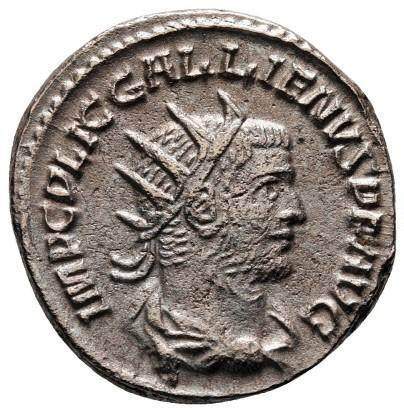
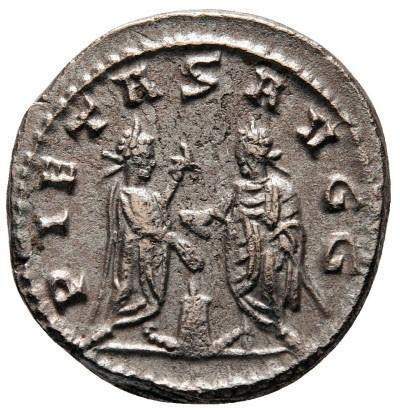
he Gallienus and Valerian “Joint Piety” Antoninianus (RIC V 447) is a haunting silver-washed relic from one of the most precarious moments in Roman history. Struck between AD 255–260 at the fortress-mint of Samosata (on the Euphrates River in modern-day Turkey), this coin captures the “Joint Reign” of father and son just before the Empire shattered under the weight of the Third Century Crisis.
1. The Historical Context: The Last Stand of the East
By the mid-250s, the Roman Empire was being torn apart from every side. To manage the chaos, Valerian took command of the East to face the Sassanid Persian King Shapur I, while his son, Gallienus, held the Rhine and Danube frontiers in the West.
Samosata was a vital military hub, the headquarters of the Legio VI Ferrata. This coin was likely struck to pay the legions massing for Valerian’s ill-fated Persian campaign. The imagery was a bold piece of psychological warfare, designed to prove that the “Joint Augusti” were divinely favored and perfectly synchronized—a claim that would be shattered in AD 260 when Valerian became the only Roman Emperor ever to be captured alive by a foreign enemy.
2. The Reverse: The Sacred Bond of the Augusti
The reverse features a powerful scene of religious solidarity: Gallienus and Valerian standing face-to-face, sacrificing at a central altar.
- The Ritual of Piety: The legend PIETAS AVGG (The Piety of the Augusti) refers to the emperors’ devotion to the gods and their duty to the state. In a time of plague and war, the emperors were showing the public that they were performing the necessary rites to bring back divine favor.
- The Tools of Power: * The figure on the right (Gallienus) holds a patera (sacrificial bowl) over the altar and a parazonium (a ceremonial dagger) in his left hand, symbolizing his military command.
- The figure on the left (Valerian) holds a patera and an eagle-tipped scepter, the traditional staff of a senior Augustus.
- The Visual Union: By standing face-to-face, the two emperors project a sense of equality and mutual support that was rarely seen during the “Soldier-Emperor” era.
3. The Obverse: The Intellectual General
The obverse features the radiate, draped, and cuirassed bust of Gallienus, facing right.
- The Radiate Crown: The spiked crown indicates that this is an Antoninianus, theoretically worth two denarii. It also identifies the Emperor with Sol, the Sun God, casting him as the “Light of the World” during a dark age.
- The Samosata Style: The engraving at the Samosata mint is distinctively “Eastern”—the portraits often have a sharper, more angular profile and a different treatment of the drapery compared to the coins of the central Rome mint.
- The Full Imperial Title: IMP C P LIC GALLIENVS P F AVG (Imperator Caesar Publius Licinius Gallienus Pius Felix Augustus).
4. Technical Details: The Billon Crisis
- RIC V 447: Cataloged in the fifth volume of Roman Imperial Coinage, the primary reference for the mid-3rd-century collapse.
- The Metal: This is a billon coin—mostly copper with a tiny percentage of silver (usually less than 10-15% at this stage).
- The Silver Wash: When this coin left the Samosata mint, it was covered in a bright, thin silver coating to make it look like pure metal. Over time, this “silvering” wears away. Finding a specimen from the Eastern mints where the original silver luster still clings to the altar or the folds of the emperors’ robes is a major prize for any 3rd-century specialist.
