

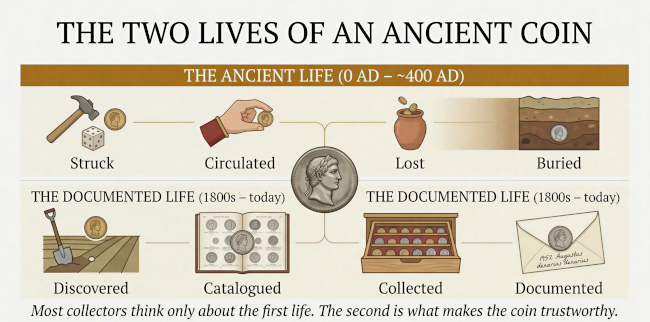
Every ancient coin has two histories.
The first is the one most collectors think about — the centuries before the coin was lost. The Roman legionary who carried it in a leather pouch. The merchant who made change with it at a market stall in Antioch. The emperor whose face was stamped on it two thousand years ago.
The second history is the one almost nobody thinks about — the centuries after the coin was found again. Who dug it up, and where? Who owned it next? What collectors held it before you? What auctions carried its image through the generations of printed catalogs? What dealer’s envelope did it sit in before it arrived on your desk?
Both histories matter. The first is why we collect; the second is what makes the coin trustworthy. Numismatists call the second history provenance — the documented chain of ownership from the moment the coin was unearthed to the moment you acquired it.
For most inexpensive coins, provenance is irrelevant. A modestly priced late Roman bronze doesn’t need a paper trail; the economics don’t support the research. But once you move into rarer, more valuable, or historically significant coins, provenance stops being an optional curiosity and becomes the most important feature of the object — often more important than grade, more important than rarity, and occasionally more important than the coin itself.
Here is why.
Why Provenance Actually Matters
There are four reasons documented ownership history matters for an ancient coin. Understanding each of them will change how you approach any future purchase above the entry-level tier.
1. Authentication
Modern forgery of ancient coins is a serious and well-funded criminal enterprise. The best modern fakes use genuine ancient dies (recovered from archaeological sites), properly aged metal, and carefully replicated surface chemistry. They fool experienced dealers and sometimes even experts. Our post on spotting cast vs. struck forgeries covers some of the ways these fakes are made and detected.
Provenance provides a powerful defense against modern forgery, because a forger cannot go back in time.
If a coin was illustrated in a printed auction catalog from 1905, or appeared in a published collection inventory from 1962, or has a dealer’s handwritten envelope dated 1978, then whatever it is, it is at least that old. A coin documented in a 1930s auction catalog cannot have been made in a modern forger’s workshop. The paper trail is its own certification of authenticity, independent of anything a modern expert might say about the metal.
This is why the highest-end numismatic market treats pre-1970 provenance as nearly gold-standard authentication. If a coin has a continuous documented history extending back before the era of sophisticated modern forgery, the question “is it real?” is largely answered.
2. Legal and Ethical Clarity
In 1970, UNESCO adopted the Convention on the Means of Prohibiting and Preventing the Illicit Import, Export, and Transfer of Ownership of Cultural Property — the document that has shaped international antiquities law ever since. Many source countries (Italy, Greece, Turkey, Egypt, and others) have since enacted their own export restrictions that effectively treat ancient coins as cultural heritage that should not leave the country of origin without specific permits.
This has created a legal divide in the ancient coin market. Coins that can be shown to have been outside their country of origin before 1970 — or that come from documented early-20th-century collections — are generally considered safe for international trade. Coins with no documented history before 1970 exist in a more ambiguous space, sometimes subject to seizure at borders or by auction houses, sometimes requiring export permits that can be impossible to obtain.
A provenance that predates 1970 isn’t just evidence of authenticity; it’s evidence of lawful ownership. For collectors who care about building a collection that can be passed to heirs, sold at major auction, or donated to an institution without legal complications, documented pre-1970 provenance is meaningful.
For more modest coins — the bulk of what most collectors handle — this is less critical. But for significant pieces, it matters.
3. Resale Liquidity
Whether you think of your collection as an investment or simply as a group of objects that will eventually be sold or inherited, provenance affects what happens when the coin changes hands again.
A coin with a strong paper trail is easier to sell. Major auction houses — Classical Numismatic Group, Nomos, Leu Numismatik, Künker, and the others that dominate the ancient coin market — prefer pieces with documented history. Some high-profile auction houses will not accept ancient coins without demonstrable pre-1970 provenance. A coin with documentation sells faster, to more buyers, at better prices.
Sources vary on the exact magnitude, but pedigreed coins in the high-end market typically command premiums ranging from 10% to 50% over equivalent pieces with no provenance — and for coins from the most celebrated collections (Nelson Bunker Hunt, the Prospero sale, the Numismatic Fine Arts cataloged pieces, the Garrett Collection, the Athos D. Moretti Collection), the premiums can be much larger.
This isn’t just snobbery. Pedigreed coins have been examined, cataloged, photographed, and vouched for by generations of experts. When you buy one, you’re buying their collective certification of the coin’s merits. When you sell one, future buyers will similarly trust that long verification chain.
4. The Collector’s Chain
The three reasons above are practical. The fourth is different — it’s about what owning an ancient coin actually means.
When you buy a coin with documented provenance, you are explicitly joining a chain of collectors that stretches back through time. The coin you hold may have passed through the hands of an Enlightenment-era scholar who studied it by candlelight, a Victorian aristocrat who built his cabinet in a London townhouse, a 20th-century American industrialist who collected as a serious hobby, and finally the modern dealer who sold it to you. Each of those previous owners added to the object’s history not by changing it, but by caring for it — by keeping it catalogued, protected, and moving intact through the generations.
Ancient coin collecting as an organized pursuit dates back to the Renaissance, when humanists like Petrarch and the Medici family began building cabinets of ancient objects as instruments of humanistic study. Some coins in the highest-tier collections today have continuous documented provenance stretching back four or five centuries — half their time above ground documented in successive collectors’ inventories.
Owning such a coin is less like buying an antique and more like being given a book that has been passed from hand to hand since before the invention of the printing press. You don’t really own it. You just hold it for a while.
What Pedigree Documentation Actually Looks Like
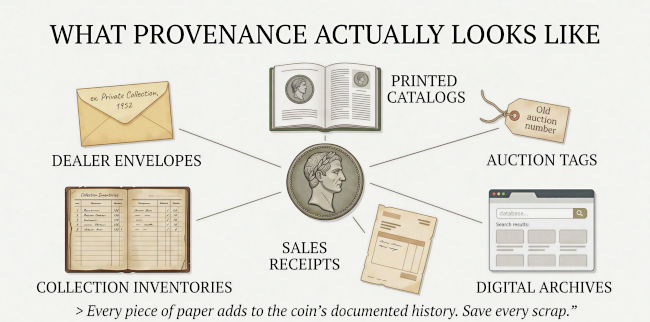
Provenance is documented through a mix of physical and written evidence. Here’s what collectors actually work with:
Auction tags — small paper or card tickets issued by auction houses when a coin is sold. Tags from major houses (CNG, Nomos, Heritage, Leu, Künker, Gorny & Mosch, NAC) are prized and should never be separated from the coin.
Dealer envelopes — small paper packets, often handwritten with the coin’s attribution, weight, and sometimes the previous collection name. Old dealer envelopes from renowned figures like B.A. Seaby, Spink & Son, or Edward Gans have their own collector value separate from the coin they once held.
Published catalogs — priced auction catalogs from the major ancient-coin firms, stretching back over a century. If your coin can be illustrated in a printed catalog, that’s powerful documentation. Digital archives like acsearch.info and CoinArchives have made this research far easier than it used to be.
Private collection references — mentions in scholarly works, museum publications, or collection inventories. A coin recorded in a 19th-century French academic journal can be tracked through subsequent collections if the same distinctive specimen resurfaces.
Photographic matching — sometimes the most reliable form of documentation is visual. Every ancient coin is slightly unique — a specific die crack, a particular centering, an individual strike pattern — and these “fingerprints” can be matched to photographs in old catalogs or archives. If your coin can be visually identified as the exact piece illustrated in a catalog from 1905, you have effectively perfect provenance back to that date.
How to Build Your Coins’ Histories
For most collectors, provenance is something you accumulate gradually rather than pursue aggressively. A few habits help:
Save every scrap of paper. Auction tags, envelopes, invoices, receipts — keep them with the coin. If they exist only digitally, archive them carefully. These documents establish the current-ownership portion of the paper trail and will be valuable to future owners.
Prefer sellers who document. When choosing between two similar coins, one with a known prior dealer or auction history and one without, choose the one with the history. The premium, if any, is usually worth paying.
Research what you already own. Many collectors discover that coins they bought casually years ago have more documented history than they realized, simply because they haven’t looked. Check acsearch.info or CoinArchives for matches to your coins. You may find that a coin you paid a modest sum for was once in a notable collection.
Be patient with high-value purchases. For significant coins, demanding clear provenance is not rudeness — it’s standard practice. Reputable dealers expect the question and will provide what they have.
The Limits of This Discussion
Let me be honest about where this post applies and where it doesn’t.
For most entry-level ancient coins — late Roman bronzes, common denarii, most folles — provenance is not a meaningful factor. The coins are plentiful, the research costs would exceed the coin’s value, and nobody expects documentation at the $20-$100 tier. Buy from reputable sellers who stand behind their coins. That’s enough.
Provenance becomes important at the mid-tier. Once you’re spending a few hundred dollars or more on a coin, especially a rarer issue or a well-known historical piece, documented history starts mattering — both as authentication insurance and as value protection.
At the high end, provenance is everything. For pieces priced in the thousands or tens of thousands — rare denarii, quality sestertii, important historical coins, anything gold — provenance is usually a decisive factor. Here the paper trail can matter as much as the coin itself.
Most of us will never buy at the high end. But understanding the role provenance plays in the market, even for coins we may never own, helps us read the broader numismatic world with more sophistication.
The Record the Coin Cannot Make Itself
An ancient coin cannot tell you where it has been for the past two thousand years. The Roman craftsman who made it, the merchant who used it, the soldier who lost it, the farmer who plowed over its burial ground for a thousand years afterward — none of them left written records that tie to this specific object.
The paper trail begins, in most cases, at the moment a coin resurfaces into the human world — whether that’s a Victorian detectorist, a 19th-century dealer’s shop, or a 20th-century auction room. From that moment forward, every well-documented coin accumulates an additional layer of history that the coin itself cannot generate.
When you participate in that tradition — when you save your dealer envelopes, when you add your own notes, when you buy from sellers who document — you’re adding to the record. The collector who owns this coin in the year 2150 will benefit from your care in 2026. You are part of a chain that stretches in both directions: back to the Roman Empire on one side, forward into a future you will not see on the other.
That is worth taking seriously, even for coins that don’t have famous pedigrees. Every act of documentation is a small investment in the long-term survival of the historical record.
To understand what you’re actually collecting, see our guide to Roman coin denominations and how ancient Roman coins were made. To protect coins you already own, read our posts on understanding ancient patina and bronze disease. To see an extraordinary example of a coin group with fully documented modern provenance, read about the Rauceby Hoard — one of the most thoroughly recorded hoard finds of the 21st century.

