

You found a Roman coin.
Maybe it was in a drawer your grandfather left behind. Maybe it came with an old estate you bought. Maybe you picked it up at a flea market in Italy, or dug it out of your garden in Britain, or noticed it in the change from a coin collector friend. Now you’re holding a small dark disc of metal with an ancient face on one side, and the question appears immediately:
How much is this worth?
The honest answer is: it depends, and probably less than you’re hoping, and that’s actually okay. Here is what you need to know.
The First Thing to Understand
The ancient Roman Empire produced coins at a staggering scale. Scholarly estimates suggest that during peak production in the first and second centuries AD, the mint of Rome alone was striking hundreds of thousands — sometimes millions — of silver denarii per month. Multiplied across every mint, across six centuries of continuous production, the total output runs into the billions of coins.
Even after two thousand years of attrition — melting for the metal, loss in war, destruction through corrosion, burial in places no one will ever find — millions of ancient Roman coins still exist in modern hands. They are regularly dug up by metal detectorists, found in archaeological excavations, passed down through family collections, and traded in an active international market.
This matters because it shapes expectations. Unlike a rare 1909 Lincoln cent with a known mintage of under 500,000, your typical Roman coin belongs to a category with a genuinely enormous surviving population. There are more ancient Roman denarii in the world today than there are serious collectors to want them.
That’s why most ancient Roman coins are surprisingly affordable. A decent common Roman bronze coin, in collectable condition, typically sells for somewhere between $10 and $50 — the price of a restaurant meal. A nicer example might reach $75 to $150. A high-grade silver denarius of a common emperor can usually be had for under $100.
Those numbers may disappoint you if you were hoping to fund a vacation. They should also reassure you if you were hoping to start collecting — the hobby is within reach of anyone with modest pocket money.
What Drives Value in an Ancient Coin
Once you understand that most Roman coins are not rare in the economic sense, you can start asking the right question: what makes some coins worth more than others?
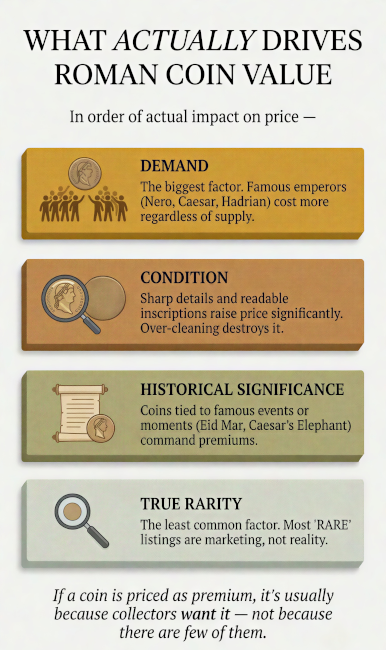
Four factors matter, roughly in order of importance:
1. Demand (usually the biggest factor)
Demand, not scarcity, is the single biggest driver of price in the ancient coin market. Some emperors are vastly more famous than others, and that fame translates directly into what their coins sell for.
Coins of Julius Caesar, Nero, Cleopatra VII, and Augustus command premium prices because they are globally famous historical figures. Anyone can own a coin with Nero’s face on it, and millions of people want to. The demand is enormous — and so even a common Nero denarius can sell for several hundred dollars.
Compare that to coins of Gallienus or Probus or Valens — emperors whose names mean very little to most modern readers. These emperors ruled real kingdoms, issued real coinage, and their coins survive in significant numbers. You can buy a decent one for $15-25 because demand is modest.
Same age. Same empire. Similar supply. Dramatically different prices — all driven by modern celebrity.
2. Condition
Condition (or “grade”) is the second major factor. A Roman coin that survived two thousand years with sharp details, readable inscriptions, and solid metal is worth substantially more than the same coin that’s been worn down to a smooth disc with a barely-visible portrait.
Numismatists describe condition with standardized terms:
- Fine (F) — all major details readable, but worn
- Very Fine (VF) — good detail, some wear on the highest points
- Extra Fine / Extremely Fine (EF or XF) — sharp detail, minor wear
- About Uncirculated / Mint State — essentially as-struck, rare for ancient coins
The same Trajan denarius might sell for $40 in Fine grade and $300 in Extra Fine. Condition matters enormously — but be careful: an overly clean coin that has had its patina stripped is generally worth less than one with its patina intact, not more. Aggressive cleaning is a destruction of value, not an improvement. (For why, see our post on understanding ancient coin patina.)
3. Historical Significance
Some coins carry stories that transcend their rarity or condition. The Eid Mar denarius — struck by Brutus to commemorate the assassination of Julius Caesar — has sold for millions of dollars at auction. The Julius Caesar “Elephant” denarius — struck on the eve of the civil war that ended the Republic — commands serious premiums. The “Fallen Horseman” coins of the fourth century are sought after because they’re one of the most dramatic propaganda images in history.
If your coin is connected to a specific famous event, a well-known historical figure, or a legendary design, its value can jump dramatically above what condition and grade would suggest.
4. Genuine Rarity
Genuine rarity — actual scarcity — is the least common of the four factors. Most coins sold as “RARE” are not actually rare; the word is the most overused marketing label in the ancient coin market. For a full explanation of why, see our post on rarity vs. value in ancient coins.
When rarity is genuine, it usually falls into one of these categories:
- Brief-reign emperors (Didius Julianus, Pertinax, Clodius Albinus — short rules mean small coin output)
- Suppressed emperors (those whose coinage was recalled after their overthrow)
- Unique varieties recognized in major reference works (RIC, BMC, Sear) and collected by specialists
If a dealer claims a coin is rare, ask for the specific reference number. A legitimate dealer will provide it immediately.
What Your Specific Coin Is Probably Worth
If you’ve arrived here with a specific coin in hand, the honest assessment usually looks like this:
If you have a small, worn, late Roman bronze coin (fourth century, roughly dime-sized, with a thin layer of corrosion): $5 to $25. These are the most common ancient coins in existence. They’re historically interesting, but individually they’re not valuable. You can buy one for the price of a coffee.
If you have a larger Roman coin (sestertius, roughly quarter-sized, with visible portrait and heavy patina): $30 to $200 depending on emperor and condition. Some sestertii of famous emperors can go much higher, but most common ones fall in this range.
If you have a silver Roman denarius: $30 to $200 for common emperors in typical condition, considerably more for famous emperors (Nero, Hadrian, Marcus Aurelius in good grade can reach $300-500+) or for coins in exceptional condition.
If you have a gold Roman aureus: congratulations, you have something genuinely valuable. Even common aurei start around $1,500-3,000, and famous examples can reach tens of thousands. These are rare enough that you should absolutely get a professional appraisal before doing anything.
If your coin looks too good — bright, shiny, perfectly round, with crisp modern-looking details — it may be a modern reproduction or forgery. Most genuine ancient coins show their age through irregular edges, off-center strikes, genuine patina, and signs of wear. Our guide to spotting cast vs. struck forgeries covers this in detail.
These ranges are rough. The only way to know what a specific coin is actually worth is to get it examined by someone who knows what they’re looking at.
How to Actually Figure Out Your Coin’s Value
Here are the practical steps, in order:
Step 1 — Identify the emperor (or attribution)
Look for the inscription around the portrait on the obverse. Most Roman coins name the emperor or authority that issued them, in abbreviated Latin. IMP CAES NERVA TRAIAN AVG tells you the coin is from Trajan. AVRELIAN AVG means Aurelian. Even partial legends can identify the emperor.
If you can’t read the inscription, photograph the coin (both sides, in good light) and search Google Images for “Roman coin portrait [description].” You can also ask for identification on Reddit’s r/AncientCoins community, which is remarkably helpful to beginners.
Step 2 — Check comparable sales on CoinArchives or acsearch.info
Once you’ve identified the emperor and the basic type, search for recent auction results on:
- acsearch.info — free searchable database of past auction sales
- CoinArchives.com — more detailed, some content requires subscription
- Vcoins — dealer listings that show current market prices
Filter for similar emperor, similar denomination, similar condition. The realized prices will give you a realistic picture of what the market pays.
Step 3 — If it looks significant, get an expert opinion
For a coin that might be worth several hundred dollars or more, it’s worth paying for a proper appraisal. You have several options:
- A specialized ancient coin dealer (the major US houses include Classical Numismatic Group, Heritage Auctions, Stack’s Bowers). Many offer free or low-cost appraisals for coins they might consign.
- A certified numismatist in your area, especially one who specializes in ancient coins rather than modern currency
- Reputable grading services like NGC Ancients — for coins worth potentially $500+, formal grading adds value and authentication
For a coin that’s probably worth $20, don’t bother with formal appraisal. Sell it through the normal channels or enjoy it as a souvenir.
How to Sell an Ancient Coin (If That’s Your Goal)
If you’ve decided to sell, the right channel depends on the coin’s value:
- Low-value coins ($10-100) — eBay works fine. Be aware of fees (~15%) and understand that selling genuinely ancient coins requires honesty about their condition and provenance.
- Mid-value coins ($100-1000) — consign to a specialized dealer or a smaller auction house. You’ll get 60-80% of the realized price after their commission, but you’ll access real collectors who know what the coin is worth.
- High-value coins ($1000+) — use a major auction house (CNG, Heritage, Leu Numismatik, Künker). Their commission is significant, but their reach and expertise produce the best final prices for important coins.
Be realistic about timing. Selling a coin quickly almost always means getting less for it. Collectors who patiently shop their coins through the right channels typically realize 30-50% more than those who dump them at the first available price.
How to Buy an Ancient Coin (If That’s Your Goal)
If you’ve found this post because you’re interested in starting an ancient coin collection, the good news is that it’s remarkably affordable.
A reasonable starting budget of $50-200 can acquire you:
- 2-3 collectible common Roman bronze coins with good patina
- A single decent silver denarius of a common emperor
- A small collection of late Roman folles (the late-empire bronze coins)
The best purchases for beginners tend to be well-attributed, properly photographed coins with honest descriptions rather than anything marketed as “rare” or “investment-grade.” A coin described as “Constantine I follis, Trier mint, VF grade, stable green patina, $35” gives you everything you need to understand what you’re buying. A coin described as “EXTREMELY RARE ROMAN IMPERIAL TREASURE!!!” tells you only that the seller hopes you don’t look too closely.
Where to buy:
- Reputable specialized dealers — the established names in the ancient coin trade (VCoins, MA-Shops, Classical Numismatic Group for higher-end pieces) have genuine ancient coin expertise and clear return policies
- Auction houses — for more serious purchases, but with buyer fees (typically 20%) to factor in
- Private collectors — often the best prices come from direct purchases from someone who is selling a portion of their own collection
Our marketplace falls in this last category. Numiscurio is a private collector’s gallery, not a commercial dealer — the coins we offer are pieces we’ve owned and studied, priced realistically, with honest descriptions and no “RARE!” inflation. If that kind of transparent private-collector sourcing interests you, it’s worth a browse.
Whichever channel you choose, avoid these warning signs in any seller:
- No clear photographs of both sides at proper resolution
- No weight, diameter, or reference number provided
- Language focused on emotion rather than specifics (“AMAZING,” “RARE,” “MUST SEE”)
- Prices dramatically below comparable market rates (almost always a fake)
- Sellers who won’t answer questions about provenance or authenticity
The Coin You Already Have
Let’s come back to where we started. You found an ancient Roman coin, and you wanted to know what it was worth.
The most likely answer is: it’s worth less than you might have hoped in dollar terms, but considerably more in other terms. You are holding a small object that was made by human hands 1,700-2,000 years ago, that passed through the pockets of Roman citizens who are long dead, that survived two thousand years of burial, oxidation, war, weather, and accident to end up in your hand. Even the commonest Roman coin is an extraordinary survivor.
If you want to sell it, you now know how to figure out what it’s worth and where to take it. If you want to keep it, know that you are the current custodian of a piece of genuine ancient history — and that protecting it well (see our post on storing ancient coins) is the most important thing you can do.
If this is your first encounter with an ancient coin and you feel the slight pull of wanting another one, there’s a community of collectors waiting. The hobby is affordable, endlessly deep, and connects you directly to two thousand years of human history.
That’s worth more than money.
To understand the types of coins you’ll encounter in the market, see our guides to Roman coin denominations and Roman mint marks. To avoid the most common buyer traps, read our posts on rarity vs. value and spotting cast vs. struck forgeries. And to see real ancient coins with honest descriptions and transparent pricing, browse our marketplace.

