

In 49 BC, Julius Caesar did something no Roman general had ever done. He crossed the Rubicon, marched on his own capital, and minted a coin.
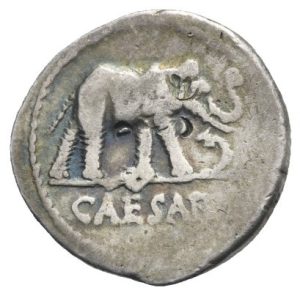
That coin — a small silver denarius, barely larger than a modern fingernail — showed an elephant trampling a serpent. No portrait. No emperor’s name. No gods. Just a tusked beast crushing something beneath its feet.
To modern eyes it looks like an odd design choice. To Romans in 49 BC, it was a declaration of war.
The coin itself
The Julius Caesar Elephant Denarius (Crawford 443/1 in the standard reference catalog) is one of the most famous ancient coins in existence. Millions were struck. They paid the soldiers of Caesar’s legions as he marched south from Gaul toward Rome, then east across the Adriatic to hunt down Pompey the Great. These coins financed the civil war that ended the Roman Republic.
The obverse shows the elephant in mid-stride, tusks raised, trampling a coiled serpent (or possibly a Gallic war trumpet — scholars still argue). Below the elephant, a single word: CAESAR.
The reverse is almost as striking. It displays the symbols of a Roman priest: a simpulum (ladle for pouring libations), an aspergillum (sprinkler for holy water), an axe for ritual slaughter, and a priestly hat. These were the tools of the Pontifex Maximus — the chief priest of Rome.
Caesar held that office. He wanted everyone to remember it.
View the Julius Caesar Elephant Denarius in the collection →
So why an elephant?
This is where the coin becomes fascinating, because historians have been arguing about the elephant for 2,000 years.
Theory 1: It’s a political attack on Pompey.
Caesar’s rival, Pompey the Great, had adopted the elephant as a personal symbol after his African victories. His family name, Metellus Scipio (his father-in-law), connected to the Scipio family who had famously defeated Hannibal’s war elephants at Zama in 202 BC. By showing an elephant trampling something, Caesar might have been saying: I am the one crushing Pompey, not the other way around.
Theory 2: It’s about Caesar’s own name.
Ancient sources recorded that “Caesar” meant “elephant” in the Punic language of Carthage. One of Caesar’s ancestors was said to have killed a war elephant in battle and taken the beast’s name as his own. On this theory, the elephant is literally a visual pun — the coin is saying CAESAR in both image and text.
Theory 3: It represents good crushing evil.
In the Roman visual vocabulary, the serpent under the elephant’s foot represented disorder, chaos, or treachery. Caesar was about to fight a civil war against the Senate and Pompey. He needed to frame himself as the hero bringing order to a corrupt Rome, not as a rebel general. The elephant as savior, the serpent as enemy.
Most historians now think all three are correct at once. Ancient propagandists were sophisticated. A single image could carry three different messages to three different audiences. The soldier spending the coin in a tavern saw a war elephant crushing an enemy. The senator examining it in Rome saw an attack on Pompey. The educated officer knew it was a visual pun on Caesar’s ancestry.
The propaganda weapon in your palm
What makes this coin extraordinary isn’t just the imagery. It’s what Caesar chose to leave off.
No portrait of himself. Roman coins had never shown living individuals — depicting yourself was something kings did, and Romans had executed their last king 460 years earlier. Caesar would eventually break that rule (and pay for it with his life), but not yet. Not on this coin.
No mention of the Senate. The standard “SPQR” — Senatus Populusque Romanus — was absent. Caesar was announcing that he no longer needed their authority.
No explanation. Just the elephant, the serpent, and his name. The coin demanded interpretation, which meant that wherever it went, people talked about it.
That’s sophisticated. That’s modern. That’s branding.
How ordinary Romans experienced it
Imagine receiving one of these coins in the winter of 49 BC. You’re a baker in Capua. Caesar’s army has just passed through. A soldier pays you for bread with a fresh silver denarius, struck weeks ago at a mobile military mint.
You hold it up to the light. The silver is bright — purer than anything you’ve seen in years, because Caesar had access to the Gallic gold and silver he’d seized during his nine years of conquest. The image is crisp. The message is unmistakable: Caesar is coming. Caesar is in charge. Caesar is Pontifex Maximus, blessed by the gods.
You put it in your purse. You spend it the next day. It passes through a hundred more hands before the war is over. By the time Caesar defeats Pompey at Pharsalus the following year, these coins are circulating from Britain to Syria.
Caesar understood something his rivals didn’t: the coin in your pocket is the most widely distributed piece of political communication in the ancient world. You can’t escape it. Every transaction is a small reminder of who holds power.
A coin that changed history
The Julius Caesar Elephant Denarius financed the end of the Roman Republic. The soldiers who received it crossed Italy, crossed the Mediterranean, and crossed swords with the legions of Pompey at the Battle of Pharsalus in 48 BC. Caesar won. The Republic, as a functioning political system, never recovered.
Within five years, Caesar would put his own face on a coin for the first time — the first living Roman to do so. Within a year of that, he would be dead, stabbed twenty-three times on the floor of the Senate house by men who couldn’t forgive what his coinage had already announced: Rome no longer has a Senate. Rome has a Caesar.
And the tradition stuck. Every Roman emperor who followed, from Augustus to the last Byzantine emperor fourteen centuries later, would issue coins bearing their portrait. Every single one. They all understood what Caesar understood first.
Why it still matters
Hold a Julius Caesar Elephant Denarius in your hand today, and you’re holding the oldest surviving example of something deeply modern: a mass-produced political message. Not a speech, not a statue, not a monument — all of those reach only those who come to see them. A coin reaches everyone, everywhere, whether they want it to or not.
Caesar figured that out 2,070 years ago. He put an elephant on a coin. The Republic fell.
Want to see coins from this turbulent moment in history? Browse the Roman Imperatorial period in the collection or explore the timeline to see how the fall of the Republic played out across the next century.

