
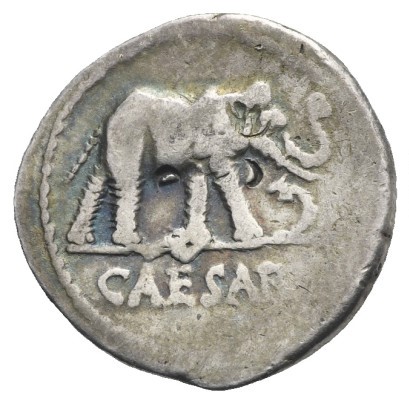
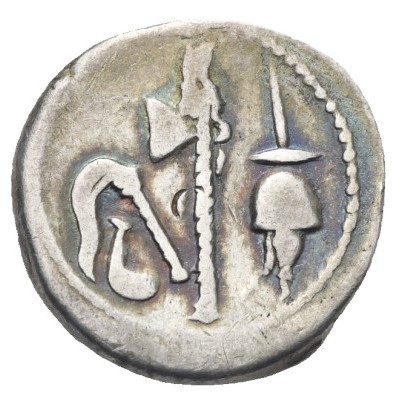
When you hold a Julius Caesar Elephant Denarius (Crawford 443/1), you aren’t just holding silver; you are holding the very spark that ignited the Roman Empire. Struck in 49–48 BC, this is arguably the most famous “military” coin ever minted, produced by a moving mint as Caesar’s legions marched toward a destiny that would change the Western world forever.
1. The Moment of Treason: Crossing the Rubicon
In early 49 BC, Julius Caesar stood at the banks of the Rubicon stream. By crossing it with his army, he committed an act of high treason against the Roman Senate. He famously muttered, “Alea iacta est” (The die is cast).+1
But an army cannot march on slogans alone, it needs silver. Because the Senate controlled the official mint in Rome, Caesar had to strike his own currency in moving military camps. This coin was the “paycheck” for the hardened veterans of the Gallic Wars as they prepared to fight their own countrymen in a bloody civil war.
2. The Obverse: The Elephant and the Dragon
The design is a masterpiece of psychological warfare. It depicts an elephant trampling a carnyx (a Gallic war trumpet shaped like a dragon or serpent).
- The Hidden Name: Why an elephant? In the Punic language (the tongue of Hannibal), the word for elephant was reportedly “caesai.” By using the animal, Caesar was “punning” on his own name without violating the Roman taboo against putting a living leader’s face on a coin.
- The Symbol of Good vs. Evil: The elephant represents the unstoppable strength of Caesar, while the serpent/carnyx represents the “barbarian” chaos he had conquered in Gaul. It told his soldiers: “You have followed me through the forests of Gaul; follow me now to Rome, and we shall trample our enemies.”
3. The Reverse: The Tools of the High Priest
The reverse features a collection of religious implements: a culullus (ritual cup), a pontifical axe, a sprinkler, and a priest’s hat (apex).
- The Pontifex Maximus: These symbols reminded the world that Caesar was not just a general; he was the Pontifex Maximus (High Priest of Rome).
- The Divine Shield: By emphasizing his religious office, Caesar was claiming that his cause was divinely sanctioned. It was a brilliant bit of branding: he wasn’t a rebel; he was the protector of Rome’s sacred traditions.
4. Technical Details & “The Caesar Strike”
- Crawford 443/1: This is the primary reference from Roman Republican Coinage.
- Mass Production: Because Caesar needed to pay tens of thousands of men quickly, these coins were struck in massive quantities. They are often found with “banker’s marks” (tiny test punches), proving they circulated heavily for decades after Caesar’s death.
- The High Purity: Despite being minted “on the run,” these coins are remarkably high-quality silver. Caesar wanted his men to know they were being paid in the best metal possible.
