
The Sun God’s Scandal: The Radiant and Ruinous Coinage of Elagabalus
For a collector of the Severan dynasty, opening a tray containing the coins of Varius Avitus Bassianus, known to history as Elagabalus, is like moving from a stoic gallery of Roman generals into a fever dream of Eastern mysticism. To hold a silver antoninianus of this teenage emperor is to touch the very moment when the traditional Roman world collided head-on with the exotic, solar cults of Syria. He was a boy-king who wore the purple not as a statesman, but as a high priest, and his four-year reign (218–222 AD) remains one of the most polarizing and visually distinct chapters in numismatic history.
The Syrian Rising: A Grandmother’s Ambition
Elagabalus was born around 203 AD in Emesa, Syria, a city famous for its Temple of the Sun. His lineage was a formidable web of powerful women: his grandmother, Julia Maesa, was the sister of the great Julia Domna. When the Emperor Caracalla was assassinated in 217 AD and the prefect Macrinus seized the throne, the “Severan Women” did not retreat.
Maesa, a master of propaganda, spread a calculated rumor that her grandson was actually the illegitimate son of the beloved (by the army, at least) Caracalla. To a soldier, the face of a young “Severus” was a more lucrative prospect than a bureaucratic usurper. Backed by Maesa’s gold and the religious fervor of the East, the fourteen-year-old Bassianus was proclaimed Emperor in 218 AD. In the early coins of his reign, we see a boy trying to look like a soldier, the portraits are often indistinguishable from the youthful Caracalla, a deliberate “minted” lie to establish legitimacy.
The Black Stone of Emesa
Once Elagabalus arrived in Rome, the mask of the traditional Roman Emperor slipped. He didn’t just bring his household, he brought his god, Elagabal, personified as a massive, conical black meteorite. He prioritized the Sun God over Jupiter Optimus Maximus, a religious insult that shocked the conservative Roman Senate.
As collectors, we see this theological revolution play out on the reverses of his coinage. The most striking type depicts the Sacred Stone of Emesa being carried on a lavishly decorated chariot drawn by four horses (Quadriga). The legend often reads SANCT DEO SOLI ELAGABAL (To the Holy Sun God Elagabal). Holding this coin is a visceral experience, it represents the exact moment the Palatine Hill was transformed into a Syrian sanctuary. Elagabalus himself is often depicted on the obverse wearing a “horn” over his forehead, a mysterious symbol of his priestly status that remains a topic of hot debate at every ancient coin convention.
The Priest-Emperor’s Transgressions
The histories, largely written by his enemies, describe a ruler who delighted in subverting every Roman norm. He married a Vestal Virgin, Aquilia Severa, claiming their union would produce “god-like” children, an act that traditionally carried the death penalty. He cross-dressed, wore silk and heavy makeup, and allegedly sought out surgeons to perform gender-reaffirming procedures.
While these personal exploits don’t always appear directly on the coins, the “scandalous” nature of his reign is reflected in the sheer variety of women featured on his currency. He had four wives in quick succession, and each—Julia Paula, Aquilia Severa, and Annia Faustina—received her own imperial coinage. For the numismatist, these “Empress” coins are highly sought after, as they represent the chaotic, revolving door of the imperial bedroom during these four frantic years.
The Fall: 222 AD
Julia Maesa was a pragmatist. She saw that her grandson’s religious fanaticism and sexual eccentricities were alienating the Praetorian Guard and the people of Rome. To save her dynasty, she forced Elagabalus to adopt his more moderate cousin, Severus Alexander, as Caesar.
The rivalry between the two youths was short-lived. In March 222 AD, when Elagabalus attempted to have his cousin murdered, the Praetorian Guard turned on the Emperor. He and his mother, Julia Soaemias, were cut down in the palace latrines, their bodies dragged through the streets and unceremoniously dumped into the Tiber.
A Legacy of Luster and Infamy
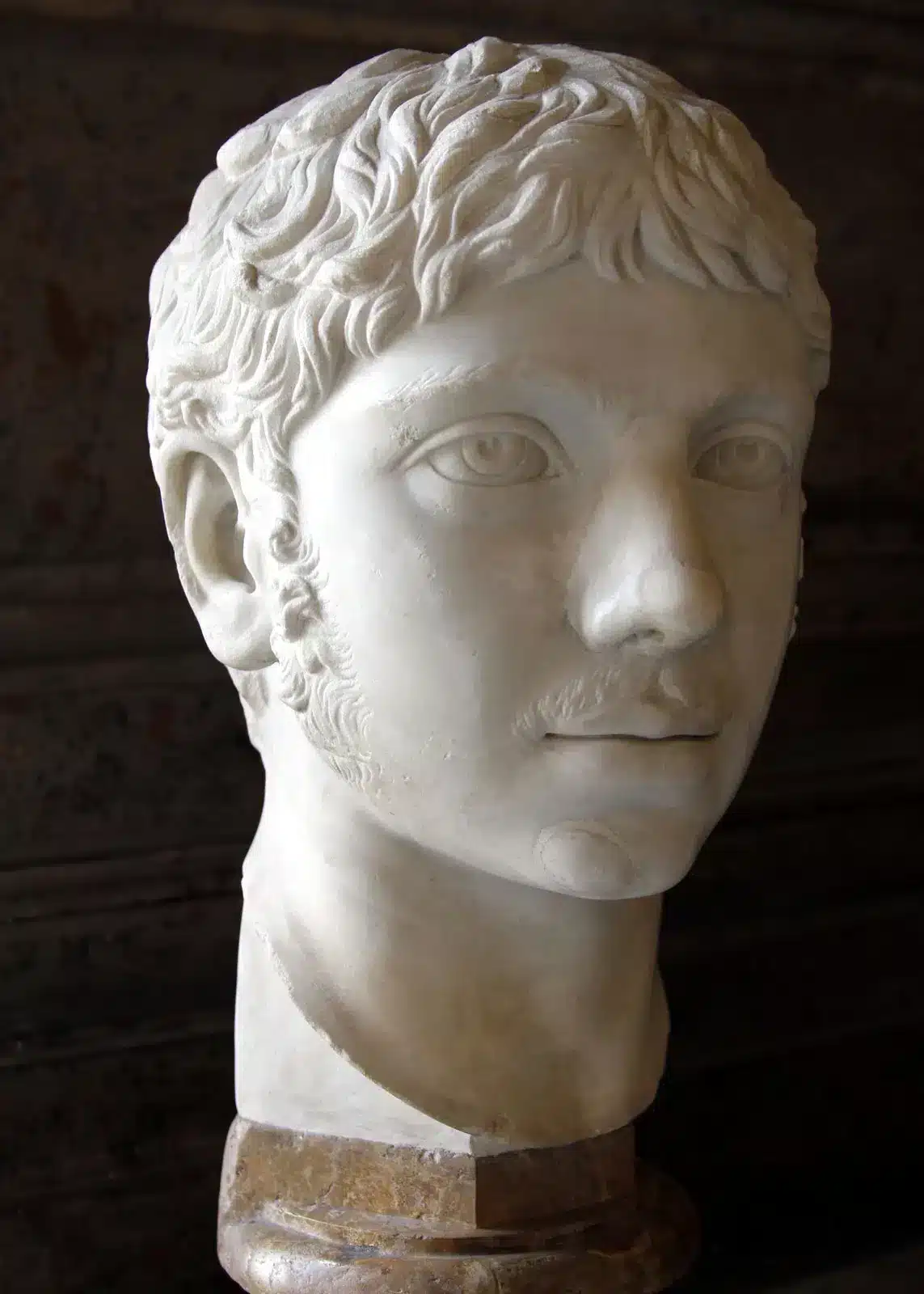
Following his death, Elagabalus was subjected to damnatio memoriae. His statues were smashed, and his name was chiseled out of inscriptions. However, the sheer volume of his coinage means that his image, the large eyes, the slight “horn,” and the priestly robes, remains perfectly preserved for us today.
Modern scholars have begun to look past the “madman” narrative of the ancient sources, suggesting he was a young man caught between two worlds, attempting to modernize Roman culture with Eastern light. Whether you view him as a degenerate tyrant or a misunderstood visionary, there is no denying the magnetic pull of his history. His coins are the only survivors of a sun-drenched, scandalous era that almost burned the Roman world to the ground.

