
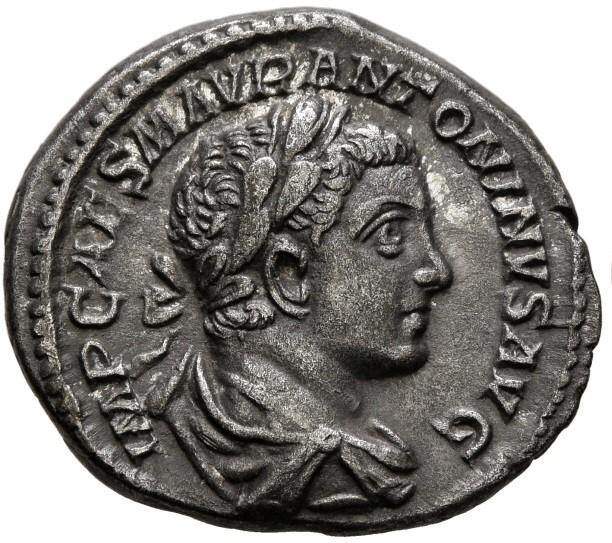
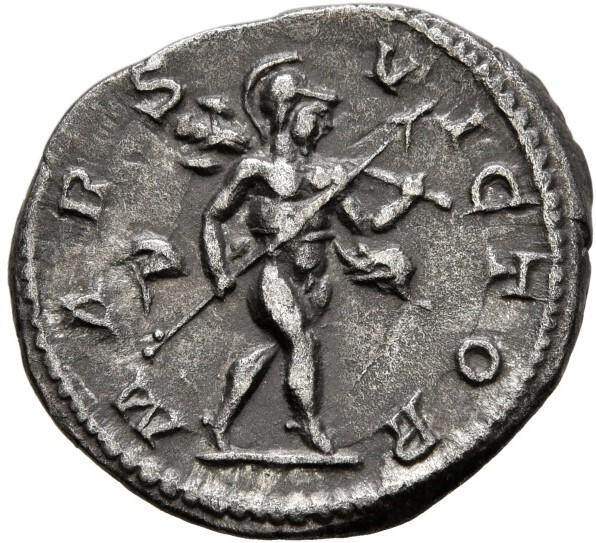
The Elagabalus “Mars the Victor” Denarius (RIC IV 122) serves as a fascinating silver window into one of the most bizarre and tumultuous chapters in Roman history. Struck around AD 218–219, this coin was minted during the earliest months of the teenage Emperor’s reign—a period when his powerful grandmother, Julia Maesa, was desperately trying to use traditional Roman imagery to mask the fact that the new ruler was actually a Syrian high priest of a sun god.
At Numiscurio, we often say that a coin’s “soul” is found in the “mask” it wears; while the reverse screams of Roman military tradition, the boy on the obverse was already planning to replace Jupiter with a black conical stone from Emesa.
1. The Historical Context: The Syrian Coup
In AD 218, the Roman world was stunned when a 14-year-old boy, claiming to be the illegitimate son of Caracalla, overthrew the Emperor Macrinus. This denarius was the “victory lap” for that coup. The MARS VICTOR (Mars the Victor) theme was a calculated piece of propaganda designed to appease the restless legions. It told the soldiers: “Regardless of the Emperor’s strange Eastern habits, the Roman God of War still leads our armies.”
The attractive toning on this specimen acts as a “patina of time,” a rainbow-like oxidation that often develops on silver that has been stored in old velvet trays or specific soil conditions for decades. While the slight porosity hints at the environmental stresses the silver endured over eighteen centuries, it also gives the coin an honest, “circulated” character that places it right in the hands of a 3rd-century citizen.
2. The Reverse: Mars the Trophy-Bearer
The reverse features Mars, the god of war, advancing right in a dynamic, aggressive stride. He holds a vertical spear and carries a trophy slung over his left shoulder.
- The Spoils of Civil War: The trophy—consisting of a helmet, cuirass, and shields stripped from a defeated foe—was a grim reminder of Elagabalus’s victory over Macrinus.
- The Traditional Anchor: By using the “Mars Victor” type, the Imperial mint was reaching back to a design favored by the great emperors of the past (like Septimius Severus), trying to anchor the radical new regime in familiar military glory.
- The Legend: MARS VICTOR.
3. The Obverse: The Priest-King
The obverse features the laureate and draped bust of Elagabalus, facing right and seen from behind.
- The “Rear View” Perspective: This “seen from behind” (heroic) perspective was a stylistic choice that emphasized the Emperor’s physical presence and military rank. Despite being a teenager who preferred dancing to drilling, the coin depicts him as a stoic, armored commander.
- The Antonine Claim: The legend IMP CAES M AVR ANTONINVS AVG is a masterpiece of political fiction. Elagabalus’s real name was Varius Avitus充分, but he took the name Marcus Aurelius Antoninus to link himself to the beloved Caracalla and the “Golden Age” of the Antonines.
- The Legend: IMP CAES M AVR ANTONINVS AVG.
4. Technical Details: The Severan Silver Standard
- RIC IV 122: Cataloged in the fourth volume of Roman Imperial Coinage, which covers the fascinating and often chaotic Severan dynasty.
- The Mint: Struck in Rome. During the early years of Elagabalus, the Rome mint maintained a high level of artistic detail, particularly in the fine “feathering” of the trophy and the individual laurel leaves in the Emperor’s crown.
- The Silver Quality: While the silver purity was beginning to decline during this era, these denarii still possess a heavy, substantial feel. The toning on your piece suggests a high silver content that has reacted beautifully with its environment over the last 1,800 years.
