
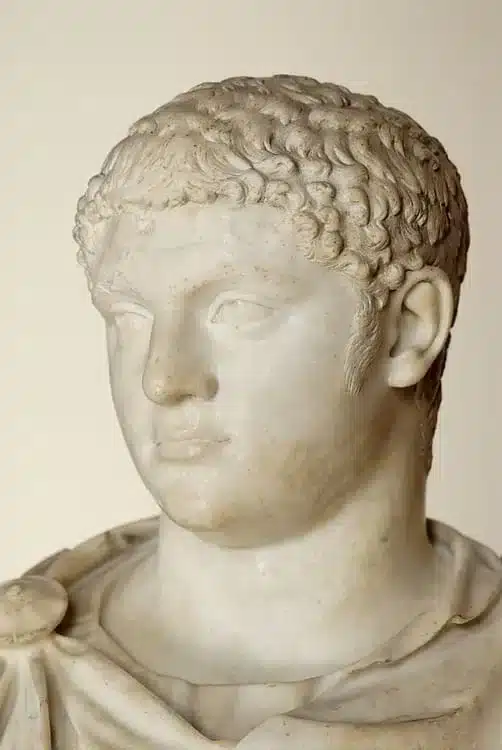
To a collector of the Severan dynasty, there is no task more bittersweet than searching for a clear, untouched portrait of Publius Septimius Geta. While his father, Septimius Severus, and his brother, Caracalla, dominate the numismatic record of the early 3rd century, Geta remains a phantom. To hold a denarius of Geta is to hold a survivor of one of the most thorough campaigns of hatred in human history. His life was a slow-motion collision with his brother’s ambition, and his coinage is the primary witness to his systematic erasure from the Roman world.
The Syrian Prince and the Rivalry of Brothers
Geta was born on March 7, 189 AD, into a family that would soon seize the world. His father was the North African general Septimius Severus, and his mother was the formidable Julia Domna, daughter of the high priest of the Sun in Emesa, Syria.
From the beginning, the Severan household was a house divided. While Geta was reportedly the more intellectual and refined of the two brothers, showing an interest in literature and the nuances of bureaucracy, his older brother Caracalla was a creature of the camps, aggressive and pathologically ambitious.
In 198 AD, their father began the process of “dynastic minting.” Caracalla was raised to Augustus, while Geta was given the title of Caesar, or junior emperor. For the numismatist, the coins of Geta as Caesar are some of the most beautiful of the era. They depict a young boy with soft, curly hair and the idealized features of a prince in waiting. The reverses often celebrate the Juventas (Youth) or the Spei Perpetuae (Everlasting Hope) of the dynasty.
The Triumvirate and the British Campaign
For over a decade, the Roman world was ruled by a trinity of Severans. However, the “concord” celebrated on their coins—often featuring the legend CONCORDIA AVGVSTORVM with the brothers shaking hands—was a thin silver wash over a base metal of loathing. Geta handled the civil administration while his brother and father campaigned, but he was constantly fighting to step out from Caracalla’s shadow.
In 209 AD, Geta was finally elevated to the rank of Augustus, making him legally equal to his brother. The family traveled to Britain to suppress the northern tribes, a brutal campaign that saw the construction of massive fortifications. In 211 AD, Septimius Severus died at Eboracum (York). On his deathbed, he famously told his sons: “Be harmonious, enrich the soldiers, and scorn all others.” It was advice they ignored before the body was even cold.
A House Divided: The Palace of Shadows
The brothers returned to Rome as co-emperors, but the city was effectively split in two. They lived in separate wings of the Palatine Hill, barricaded behind private guards. They even discussed partitioning the Empire, with Geta taking the West and Africa, while Caracalla took the East.
During this brief, tense period of 211 AD, the mints were in a frenzy. Coins were struck for both emperors, but the iconography began to diverge. Geta’s coins often emphasized his role as a bringer of peace and stability, featuring Liberalitas (Generosity) and Felicitas (Happiness). But for a collector, these late coins of Geta are a rarity. They represent the final months of a man whose world was closing in on him.
The Murder in the Mother’s Arms
The end came on December 26, 211 AD. Under the guise of a reconciliation meeting arranged by their mother, Julia Domna, Caracalla entered her private apartments. As the two brothers embraced, Caracalla’s centurions rushed in. Geta was stabbed to death, reportedly bleeding out in his mother’s arms as she tried to shield him.
Caracalla did not stop at murder. He launched a Damnatio Memoriae so severe it bordered on the psychotic. Roughly 20,000 of Geta’s supporters were slaughtered. But for us numismatists, the most striking evidence is in the metal and stone.
Collecting the Damned: The Erased Coinage
Caracalla ordered Geta’s statues to be melted, his name to be chiseled out of every arch (most famously the Arch of Septimius Severus in the Roman Forum), and his coins to be withdrawn and destroyed.
For a collector, the “Geta erasure” coins are a specialized and haunting category. You will occasionally find “family” coins where the faces of Severus, Domna, and Caracalla remain, but Geta’s face has been deliberately gouged out by a chisel or a sharp tool. In other cases, his name on the legend is scratched away, leaving only a scarred surface where a prince’s title once sat.
To find a pristine, un-defaced coin of Geta is to find a piece of history that escaped a tyrant’s reach. It is a reminder that while Caracalla could kill the man and chisel the stone, he could not stop the earth from swallowing and preserving these small silver discs for future generations to find.
Geta was the “Spare” who became a victim of the “Heir.” He left no grand monuments and no lasting reforms, but through the survival of his coins, we are reminded of the high cost of the Severan “harmony” and the brutal reality of Roman power.
