
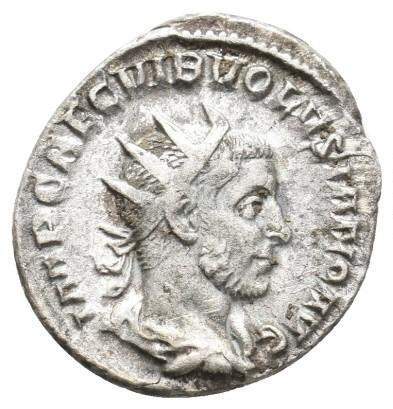
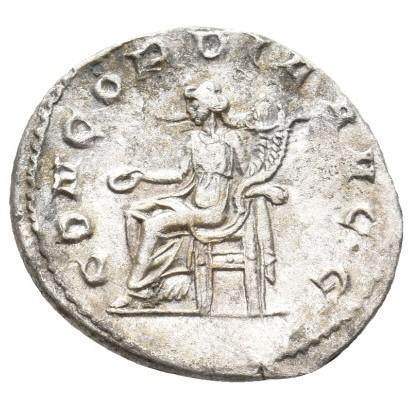
The Volusian “Concord of the Emperors” Antoninianus (RIC IV 168) serves as a poignant silver-washed window into a rare moment of familial unity during the chaotic “Crisis of the Third Century.” Struck between AD 251–253, this coin was minted to broadcast a message of stability that the Roman Empire desperately needed as it reeled from the first-ever death of an Emperor in battle against a foreign foe.
At Numiscurio, we often say that a coin’s “soul” is found in its ability to project a sense of “Concordia” (Harmony) even as the frontiers were burning and a plague was ravaging the heart of Rome.
1. The Historical Context: The Rise of the Treboniani
Volusian’s rise to power was born of catastrophe. After the Emperor Decius was killed by the Goths at the Battle of Abritus, Volusian’s father, Trebonianus Gallus, was proclaimed Emperor by the legions. In a savvy political move to prevent further civil war, Gallus initially adopted Decius’s surviving son, but after that boy’s death from the plague, Volusian was elevated to full Augustus.
This coin was the centerpiece of their joint propaganda. By invoking Concordia Augg (The Harmony of the two Augusti), the father-and-son duo was trying to reassure the Roman people that the leadership was unified, the succession was secure, and the “Year of the Six Emperors” would not be repeated. It was a visual shield against the looming threat of usurpers like Aemilian, who was already gathering strength on the Danube.
2. The Reverse: Concordia and the Double Abundance
The reverse features Concordia, the personification of agreement and harmony, draped and seated left on a throne. She holds a patera (sacrificial bowl) in her right hand and a double cornucopia in her left.
- The Patera of Piety: The patera indicates that this harmony is blessed by the gods. It suggests that the joint rule of Gallus and Volusian was a religious duty performed for the safety of the state.
- The Double Cornucopia: While a single horn of plenty is common, the double cornucopia is a specific “dynastic” symbol. It represents the dual prosperity brought by having two Emperors working in perfect unison.
- The Legend: CONCORDIA AVGG. The double ‘G’ at the end of AVGG is a crucial numismatic shorthand for “Augustorum,” plural, referring to the two co-rulers.
3. The Obverse: The Prince of the Plague Years
The obverse features the radiate, draped, and cuirassed bust of Volusian, facing right.
- The Severan Style: Volusian’s portraiture follows the rugged, soldier-emperor style of the mid-3rd century. Notice the short, “barracks” beard and the intense, often worried expression—a reflection of a reign dominated by the devastating Cyprian Plague and constant Gothic raids.
- The Imperial Titles: The legend IMP CAE C VIB VOLVSIANO AVG (Imperator Caesar Caius Vibius Volusianus Augustus) presents his full, formal name, anchoring his legitimacy in the Roman legal tradition.
- The Radiate Crown: The spikes of the crown identify this as an Antoninianus. By this time, the silver content was rapidly declining, but Volusian’s issues from the Rome mint often retain a surprisingly high-quality strike.
4. Technical Details: The Rome Mint Craft
- RIC IV 168: Cataloged in the fourth volume of Roman Imperial Coinage, covering the fast-paced transitions of the mid-200s.
- The Mint: Struck in Rome. The Rome mint during Volusian’s reign was known for its “full” portraits and clear, legible lettering.
- The Silvering: Like many coins of this era, it was issued with a thin silver wash over a billon (low-grade silver/copper) core. Finding a specimen where the silvering is still present in the deep recesses of the radiate crown or the folds of Concordia’s gown is a significant win for any collector of the Crisis years.
