
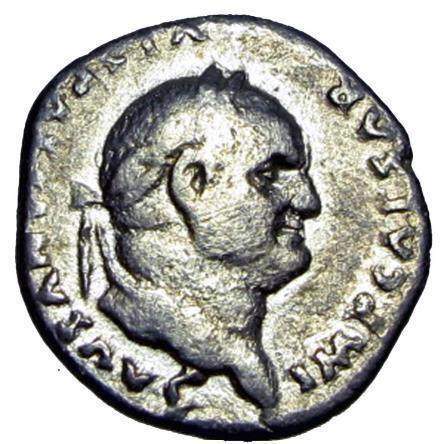
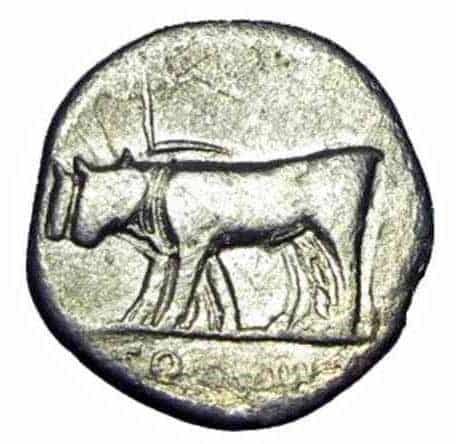
If you are searching for a coin that represents the “Healing of Rome” after its most chaotic year, the Vespasian “Oxen” Denarius (RIC II.1 944) is a masterclass in quiet, powerful propaganda. Struck in AD 77–78, this silver piece marks the moment the Roman world finally took a breath of relief after the suicidal civil wars of AD 69.
At Numiscurio, we often say that a coin’s “soul” is found in its ability to turn a simple agricultural image into a grand political statement.
1. The Historical Context: The Taxman Who Saved the Empire
Vespasian was the ultimate “anti-Nero.” While Nero was playing the lyre and burning through the treasury, Vespasian was a gritty, no-nonsense general from a middle-class background. When he took the throne after the “Year of the Four Emperors,” the Roman economy was in ruins.
Vespasian’s solution? He taxed everything (famously including public urinals) and focused on rebuilding the Italian countryside. By AD 77, the year this coin was minted, his “austerity program” had worked. The Empire was solvent, the Colosseum was under construction, and the scarred battlefields of Italy were being turned back into productive farms. This coin was the visual celebration of that recovery.
Because Vespasian’s coins were used heavily to rebuild the state, many are found with significant wear. Finding a RIC 944 in Choice VF or EF condition—where you can see the individual muscles on the oxen—is a major achievement
2. The Reverse: The Return to the Soil
The reverse features a pair of oxen (a yoke of oxen) pacing right.
- The Symbol of Peace: In the Roman mind, oxen were the engines of civilization. After a decade of soldiers trampling crops, the sight of a peaceful team of oxen on a coin signaled that the “Pax Romana” was back.
- The Colonization Message: Oxen were also used to plow the pomoerium (the sacred boundary) of new cities. This image told the veterans of the Jewish Wars and the Civil Wars that it was time to hang up their swords, take their retirement land, and start plowing.
- The Legend:
COS VIII. This identifies Vespasian’s eighth consulship, allowing us to date the coin precisely to the end of his reign.
3. The Obverse: The “Warts and All” Portrait
The obverse features the laureate head of Vespasian, facing right.
- The Flavian Realism: Notice the deep wrinkles on his forehead and the strained expression around his eyes. Unlike the idealized, god-like portraits of the Julio-Claudians, Vespasian wanted to look like a man who had worked hard his entire life. He wanted to look like a “CEO Emperor.”
- The Legend:
IMP CAESAR VESPASIANVS AVG.
4. Technical Details: The “Ephesus” Style
- RIC II.1 944: Cataloged in the updated Roman Imperial Coinage, Volume II, Part 1.
- The Mint: While many of these were struck in Rome, Vespasian also operated active mints in the East (like Ephesus and Antioch). The “Oxen” type is a classic of the Rome mint, known for its thick, chunky silver flans and high-relief striking.
- Silver Purity: Vespasian was the last emperor for a long time to maintain a very high silver standard. This was “honest money” for an honest reign.
