
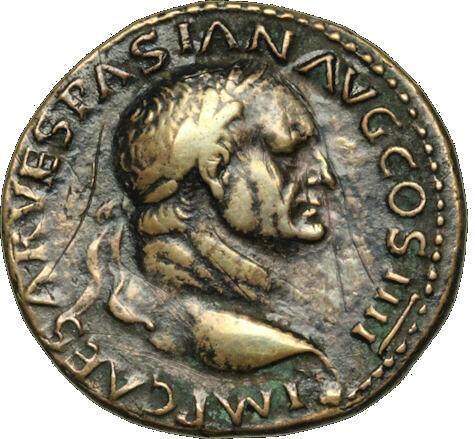
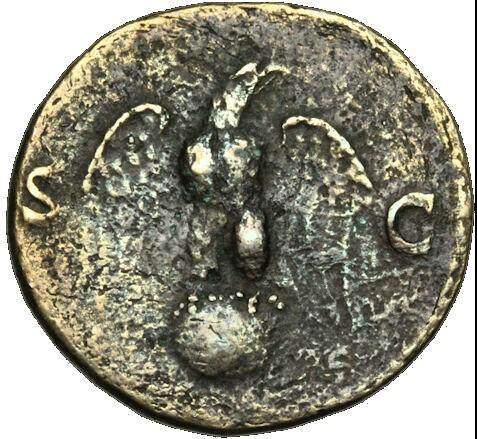
If you are looking for a coin that represents the “Iron Foundation” of the Flavian dynasty, the Vespasian “Eagle on Globe” As (RIC II.1 482 / 1202) is a powerful piece of military and religious branding. Struck in AD 72, this bronze coin was minted during the critical years when Vespasian was cementing his family’s right to rule after the bloody chaos of the Civil Wars.
At Numiscurio, we often say that a coin’s “soul” is found in how it balances the raw power of the legions with the ancient traditions of the Roman state.
1. The Historical Context: The World in His Hands
By AD 72, the year of his fourth consulship (COS IIII), Vespasian had finally stabilized Rome. His son Titus had returned from the destruction of Jerusalem, and the “Year of the Four Emperors” was a fading nightmare.
However, Vespasian was a “New Man”—he didn’t have the aristocratic pedigree of the Caesars. To prove he was the legitimate master of the Roman world, he flooded the empire with bronze coins like this one. The message was simple: under the Flavians, the world was secure, and the gods were satisfied.
RIC 322 was minted around 71 AD, right as Vespasian began construction on the Flavian Amphitheatre—which we know today as the Colosseum. The taxes and spoils of war that paid for the Colosseum are the same economic forces that minted this very coin.
Fun Fact: Vespasian was known for his dry wit. As he was dying, he reportedly joked, “Vae, puto deus fio” (“Oh dear, I think I’m becoming a god”), mocking the Roman tradition of deifying emperors after death.
2. The Reverse: The Cosmic Sentinel
The reverse features a magnificent Eagle (Aquila) standing facing on a globe, with its wings spread and its head turned to the right.
- The Symbol of Jupiter: The eagle was the sacred bird of Jupiter Optimus Maximus. By placing it on a globe, the coin was making a cosmic claim—that the Roman Empire (the globe) was under the direct protection of the king of the gods.
- The Military Standard: For the legionary, the eagle was the “soul” of the legion. This image reminded the soldiers that their loyalty belonged to the state and the Flavian house.
- The S C: As a bronze As, it carries the large S C (Senatus Consulto), a nod to the Senate’s authority that Vespasian carefully maintained to distinguish himself from the “tyrant” Nero.
3. The Obverse: The “Bull-Necked” General
The obverse features the laureate head of Vespasian, facing right.
- The Globe at the Neck: Notice the tiny globe at the point of his neck. This is a subtle but vital detail found on many Western mint issues (like Lugdunum or Rome). it reinforces the “World Ruler” theme seen on the reverse.
- Flavian Realism: This is a classic “unfiltered” portrait. Unlike the idealized, god-like portraits of the past, Vespasian is shown with a thick neck, a receding hairline, and deep-set wrinkles. He looked like a man who had spent his life in the camps, not the theater.
- The Legend:
IMP CAESAR VESPASIAN AVG COS IIII.
4. Technical Details: The “Commemorative” Bronze
- RIC II 322; Cohen 480: Cataloged in the updated Roman Imperial Coinage, Volume II, Part 1.
- Metal: Pure Copper.
- The Strike: Coins from this “Consul IV” series are known for their heavy, robust strikes. They feel substantial in the hand, mirroring the stability Vespasian brought to the Roman economy.
