
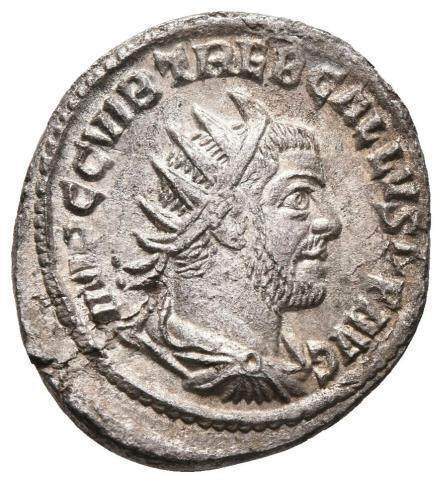
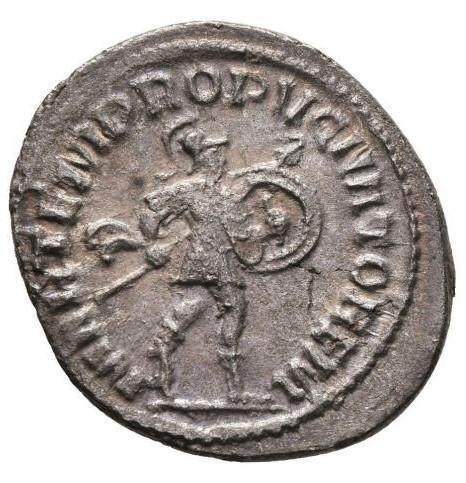
If you are searching for a coin that represents “Defiance in the Face of Disaster,” the Trebonianus Gallus Antoninianus (RIC IV 84) is a masterclass in desperate, martial propaganda. Struck between AD 251–253, this silver-washed radiate marks a moment when the Roman Empire was suffering from a triple-threat of plague, Persian invasion, and Gothic uprisings.
1. The Historical Context: The General of the Great Plague
Trebonianus Gallus didn’t inherit a golden age; he inherited a nightmare. He rose to power after the disastrous Battle of Abritus, where his predecessor, Decius, became the first Roman Emperor to be killed by barbarians in battle.
Gallus’s reign was defined by the Plague of Cyprian, a pandemic so lethal it reportedly killed 5,000 people a day in Rome alone. To make matters worse, the Sassanid Persians were carving through the East. This coin was minted during the height of these crises. It wasn’t just currency; it was a morale booster for the legions, promising them that despite the sickness and the defeats, Rome’s military spirit remained unbroken.
Because the “Crisis of the Third Century” caused massive inflation, these coins were minted rapidly with declining silver purity. Finding a RIC 84 with its original silvering intact—where you can see the sharp bristles of Mars’s crest, is a rare window into the frantic economy of the 250s.
2. The Reverse: Mars Propugnator
The reverse features Mars Propugnator (Mars the Champion/Defender), walking right, brandishing a spear and carrying a shield.
- The God of War as Bodyguard: By invoking Mars “The Defender,” Gallus was telling the Roman people that the gods hadn’t abandoned them. While the plague decimated the population, Mars was depicted as the shield standing between the citizens and the Gothic invaders.
- The Call to Arms: This specific “walking” pose of Mars suggests a god in action—not a statue in a temple, but a deity on the march. It was an appeal to the soldiers: Mars is fighting, and so must you.
- The Legend: MARTI PROPVGNATOREM. A direct dedication to the god in his role as the Empire’s frontline protector.
3. The Obverse: The Radiate Crown of Crisis
The obverse features the radiate, draped, and cuirassed bust of Trebonianus Gallus, facing right.
- The Radiate Crown: This crown, with its sun-like spikes, was the universal symbol for the “Antoninianus” (a double-denarius). It signaled the Emperor’s connection to Sol Invictus, the Unconquered Sun.
- The “Soldier-Emperor” Aesthetic: Notice the short-cropped hair and the heavy, somewhat weary features. Gallus wanted to look like the veteran commanders the soldiers trusted, emphasizing stability over the youthful beauty of the earlier dynasties.
- The Legend: IMP C C VIB TREB GALLVS P F AVG
4. Technical Details: The Antioch Mint
- RIC IV 84: Cataloged in the Roman Imperial Coinage, Volume IV, Part 3, covering the mid-3rd century.
- The Mint: Most examples of RIC 84 were struck in Antioch. This is significant because Antioch was the primary staging ground for the wars against Persia. These coins likely went straight from the mint into the palms of soldiers preparing for a desert campaign.
- The Debasement: By this period, the “silver” coin was actually mostly copper with a thin silver wash. The fact that the Rome and Antioch mints could still produce high-relief, artistic dies during a pandemic and a civil war is a testament to the resilience of Roman bureaucracy.
