
The Trajan Decius “Imperial Arrival” Antoninianus (RIC IV 11) serves as a striking silver-washed window into a moment of hard-won, yet fleeting, Roman stability. Struck in AD 249, this coin was a massive piece of political theater, designed to announce that a “New Trajan” had arrived in Rome to wash away the chaos of the past and restore the ancient virtues of the Empire.
At Numiscurio, we often say that a coin’s “soul” is found in the grit of its history—the roughness and faint scratches on this piece are the honest wear of a coin that likely sat in a soldier’s pouch while the Goths were crossing the Danube.
1. The Historical Context: The Restorer of Rome
Trajan Decius was a senator from the Balkans who was reluctantly propelled to the throne by his troops. After defeating Philip the Arab in a brutal civil war, Decius entered Rome as a conqueror who wanted to be seen as a traditionalist. He even added the name “Trajan” to his own to link himself to the “Best of Princes” from a century prior.
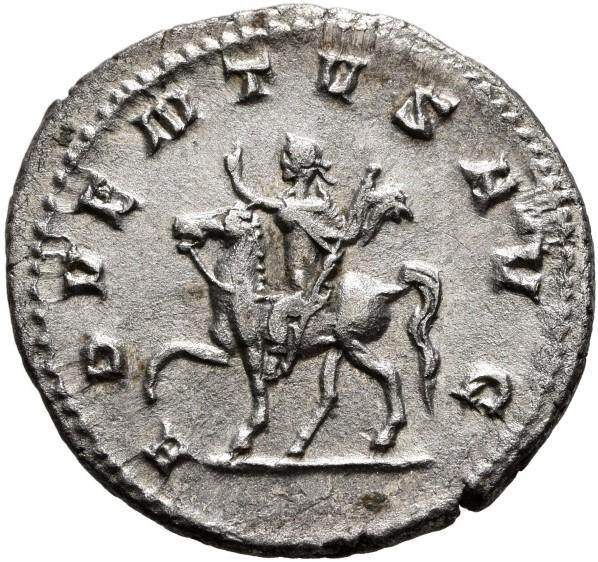
The ADVENTVS AVG (The Arrival of the Augustus) on the reverse is a literal “press release” in metal. It commemorates his formal, ceremonial entry into the city of Rome after his victory. It was meant to reassure the Senate and the people that a true Roman—a man of the old school—was finally back in control. Tragically, just two years later, Decius would become the first Roman Emperor to be killed in battle against a foreign enemy (the Goths at Abritus).
2. The Reverse: The Emperor on Horseback
The reverse features Trajan Decius in full military regalia, mounted on a horse pacing to the left. He raises his right hand in a gesture of greeting (adlocutio) and holds a long scepter.
- The Gesture of Peace: By raising his hand, Decius is showing he comes not as a tyrant, but as a protector. It is the classic pose of an Emperor acknowledging the cheers of the Roman crowd during a “Triumph.”
- The Pacing Horse: The horse’s movement suggests a grand, slow procession through the streets of Rome, likely heading toward the Temple of Jupiter on the Capitoline Hill.
- The Legend: ADVENTVS AVG. This specific type was a favorite for new Emperors, acting as an official “inauguration” coin.
3. The Obverse: The Stoic General
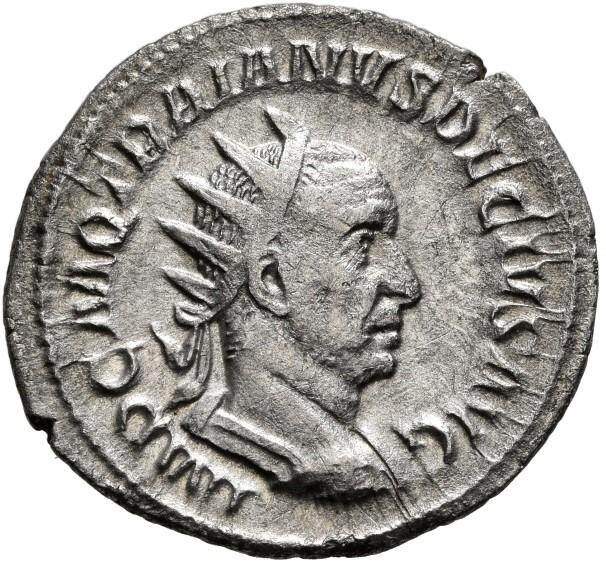
The obverse features the radiate and cuirassed bust of Trajan Decius, seen from behind.
- The “Rear View” Portrait: Notice how the bust is seen from the back, showing the detail of the cuirass (military armor). This “heroic” perspective was very popular in the mid-3rd century, emphasizing the Emperor’s role as the supreme commander of the legions.
- The Serious Profile: Decius’s portraits are famous for their “Veristic” realism. He is shown as a weathered, older man with deep lines of worry and experience—a stark contrast to the youthful, idealized portraits of earlier eras.
- The Legend: IMP C M Q TRAIANVS DECIVS AVG.
4. Technical Details: The Rome Mint Excellence
- RIC IV 11: Cataloged in the fourth volume of Roman Imperial Coinage, which documents the rapid-fire succession of the “Soldier-Emperors.”
- The Mint: Struck in Rome. Despite the “Crisis of the Third Century,” the Rome mint under Decius produced some of the most artistically refined dies of the era. The lettering is typically bold and centered.
- The Metal: This is an Antoninianus, which by AD 249 still contained a decent amount of silver (roughly 35–40%) compared to the nearly pure copper coins that would follow just twenty years later. The roughness on the surface is often the result of the “pickling” process used at the mint to bring silver to the surface, which reacts over time with the soil.
