
he Theophilus Follis (Sear 1667) is a striking bronze monument from the mid-9th century. Struck between AD 829–842 in Constantinople, this coin represents the final, fiery chapter of the Second Iconoclasm. Theophilus was a man of contradictions: a fierce opponent of religious icons, yet a lover of art, a builder of magnificent palaces, and a ruler who sought to restore the Roman Empire to its former military glory.
At Numiscurio, we often say that a Byzantine follis is “the people’s history”; while the gold coins were locked in the Great Palace, these heavy bronzes were the coins exchanged for bread and wine in the bustling markets of the Golden Horn.
1. The Historical Context: The Last Iconoclast
Theophilus was the second emperor of the Amorian dynasty. His reign was defined by his relentless wars against the Abbasid Caliphate and his strict adherence to Iconoclasm (the ban on religious images). However, he was also famous for his “Golden Tree” with mechanical singing birds and his legendary sense of justice—he was known to ride through the streets of the capital alone to hear the grievances of common citizens.
This coin was a centerpiece of his monetary reform. Theophilus moved away from the smaller, cruder bronzes of his predecessors, issuing these large, well-struck folles to signal a new era of stability and imperial strength.
2. The Obverse: The Imperial Presence
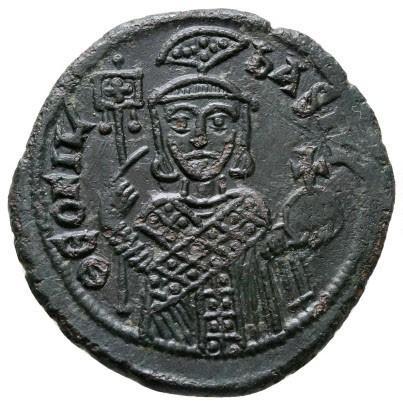
The obverse features a three-quarter length bust of Theophilus, facing forward.
- The Loros and Labarum: He wears the loros, a heavily jeweled, gold-embroidered consular scarf that symbolized the shroud of Christ. In his hands, he holds the labarum (a military standard with a Christian symbol) and a globus cruciger (an orb topped with a cross), asserting his role as the divinely appointed protector of the world.
- The Tufa: Look closely at the crown; it is topped with a tufa, an exotic, fan-like ornament made of feathers or metal pellets. This was a rare and highly prestigious piece of imperial regalia, emphasizing his majesty and his connection to the triumph of the Roman tradition.
- The Legend: ΘEOFIL bASIL (Theophilos Basileus — Theophilus, King).
3. The Reverse: The Proclamation of Victory
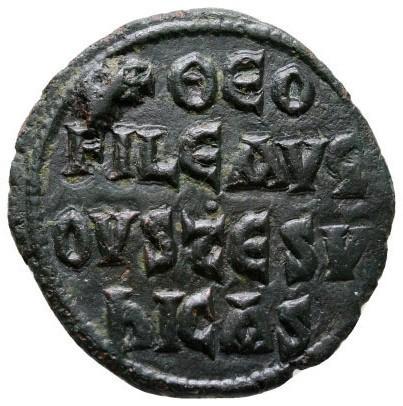
The reverse breaks from the tradition of large numerals (like the “M” for 40) and instead uses a powerful four-line inscription:
+ΘEO / FILE AVG / OVSTE SV / NICAS
- The Translation: “Theophilus Augustus, may you conquer!” (from the Greek Sy Nikas).
- The Victory Cry: This wasn’t just a polite wish; it was a rhythmic chant used by the factions in the Hippodrome and by the legions on parade. By placing this on the reverse of the currency, Theophilus was turning every coin into a tiny, bronze victory rally.
- The “N” Variation: Notice the backwards “И” in the last line; this was a common quirk of the Constantinople engravers during this period, adding a touch of authentic medieval character to the strike.
4. Technical Details: The Constantinople Standard
- Sear 1667: Cataloged in David Sear’s Byzantine Coins and Their Values.
- The Mint: Constantinople. During the 9th century, the central mint regained its reputation for high-quality strikes, producing coins with a thickness and weight that felt substantial in the hand.
- The Patina: These folles often develop a deep, “emerald” green or a rich “earthy” brown patina.
- The Collector’s “Tell”: Look for the detail in the pellets of the tufa and the streamers attached to the labarum. Finding a specimen where the jewels on the loros are distinct is a major highlight for any 9th-century collection.
