
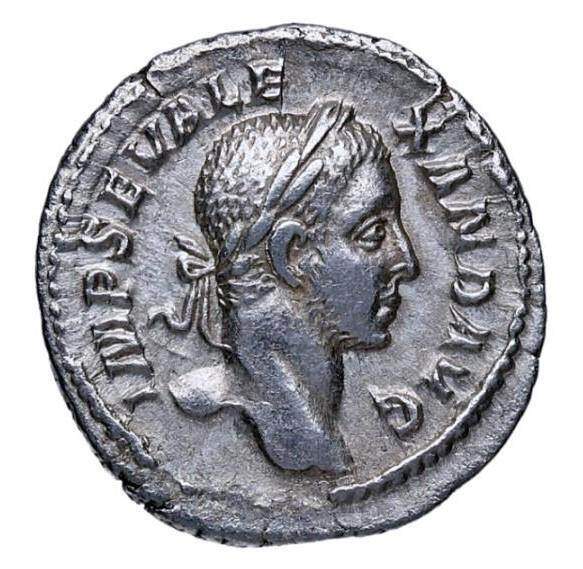
If you are looking for a coin that captures the “Last Sigh” of the high Roman Empire before it tumbled into the chaos of the 3rd-century crisis, the Severus Alexander Denarius (RIC 83a) is a fascinating piece of history. Struck in AD 228, this silver coin represents an Emperor who was perhaps too “good” for the violent times in which he lived.
Because his reign lasted 13 years (an eternity in the 3rd century), many of these coins were hoarded. Finding a RIC 83a in Choice EF condition—where you can still see the individual “studs” on Mars’s sandals—is a testament to it being a “survivor.
At Numiscurio, we often talk about the “Soul of the Coin”—and with Severus Alexander, that soul is one of tragic idealism.
1. The Historical Context: The Boy-King and His Mother
In AD 222, the Roman world was reeling from the scandalous reign of Elagabalus. When his cousin, the 13-year-old Severus Alexander, was raised to the throne, he was seen as a breath of fresh air. He was studious, respectful of the Senate, and deeply under the influence of his powerful mother, Julia Mamaea.
By AD 228, the year this coin was struck, the honeymoon period was ending. The military was becoming restless. They didn’t want a “philosopher-king” who listened to his mother; they wanted a warrior who would lead them to plunder. This denarius, featuring Mars, was a calculated attempt to “toughen up” the Emperor’s image in the eyes of the increasingly rebellious legions.
2. The Reverse: Mars the Peace-Bringer?
The reverse features Mars, the God of War, walking right. He carries a spear in his right hand and a trophy over his left shoulder.
- The Paradox: While Mars is the god of combat, on Severus Alexander’s coins, he often looks more like a protector than a conqueror. This “Mars Propugnator” (Mars the Defender) theme was a message to the soldiers: “The Emperor is with you, he honors your craft, and the gods grant us victory.”
- The Military Pressure: In AD 228, the Sassanid Persians were rising in the East, and the Germanic tribes were probing the Rhine. This coin was the silver used to pay the very soldiers who would eventually betray and murder Alexander just seven years later for being “too soft” on the barbarians.
- The Legend:
P M TR P VII COS II P P. These titles allow us to date the coin precisely to AD 228.
3. The Obverse: The Face of “Civilitas”
The obverse features the laureate and draped bust of Severus Alexander.
- The Portrait: Notice the difference between Alexander and his predecessor, Caracalla. There is no scowl here. Alexander is depicted with a calm, youthful, and clean-shaven face. It was the face of Civilitas—the return to civilian, constitutional rule.
- The Legend:
IMP SEV ALEXAND AVG.
4. Technical Details: The “Good” Silver
- RIC 83a: Cataloged in Roman Imperial Coinage, Volume IV, Part II.
- Silver Purity: Severus Alexander actually tried to increase the silver quality of the denarius during his reign, stabilizing it around 45-50%. He was the last emperor to make a serious effort to fix the Roman economy before the Great Debasement began.
- The Strike: Coins from the early years of his reign are known for their elegant, classical style. The hair and the folds of the toga are often rendered with a fine, artistic touch that was lost in the “soldier-emperor” era that followed.
