
The Scholarly Soldier: Severus Alexander and the Virtus of Peace
The Severus Alexander “Virtus” Denarius (RIC IV 226) is a fascinating study in imperial branding, struck between AD 231–235. This coin represents the final, steady years of the Pax Romana before the world descended into the “Crisis of the Third Century.” It is a physical manifestation of an Emperor trying to balance two identities: the gentle, law-giving civilian and the supreme commander of the legions.
1. The Historical Context: The Last of the Severans
Severus Alexander came to the throne at just 13 years old, following the chaotic reign of his cousin Elagabalus. Guided by his mother, Julia Mamaea, his reign was defined by a “Return to Order.” He famously surrounded himself with jurists and philosophers, earning a reputation for being the “Model Prince.”
However, by AD 231, the Sassanid Persian King Ardashir I was ravaging the Eastern frontiers. Alexander was forced to leave the libraries of Rome and lead his troops into battle. This coin was minted specifically to reassure the public—and more importantly, the soldiers—that the young Emperor possessed VIRTVS AVG (The Valor of the Augustus). It was a “PR blitz” in silver, designed to show a civilian Emperor as a conquering hero.
2. The Reverse: The Master of the World
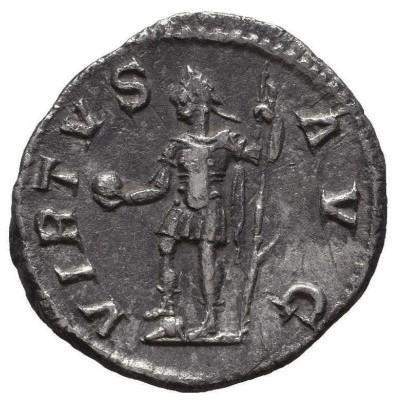
The reverse features Severus Alexander in full military dress, standing left. He holds a globe in his right hand and a reversed spear in his left, with his right foot resting firmly on a helmet.
- The Globe of Command: The globe represents the oikoumene (the civilized world). By holding it, Alexander is signaling that the safety of the entire Roman world rests in his hands.
- The Reversed Spear: This is a crucial detail. A spear held point-down is a symbol of “Peace through Victory.” It suggests that while the Emperor is armed, the fighting is over and the order has been restored.
- The Foot on the Helmet: Placing a foot on a helmet (the “triumph over war” pose) was a classic Roman shorthand for having subdued an enemy. It was a bold claim for an Emperor who often struggled to control his own mutinous troops.
3. The Obverse: The Intellectual Profile
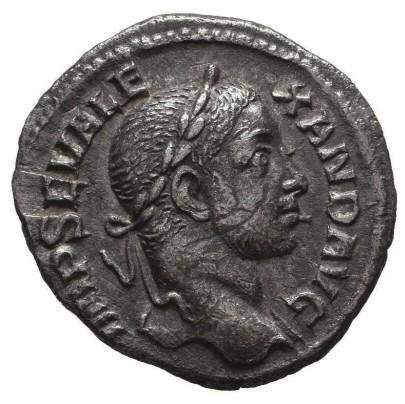
The obverse features the laureate head of Severus Alexander, facing right, with drapery visible over his left shoulder.
- The Portrait of a Philosopher: Notice the features; unlike the grizzled, scowling “Soldier-Emperors” who followed him, Alexander is depicted with a youthful, serene, and almost gentle expression. This was intentional—he wanted to be seen as the intellectual heir to Marcus Aurelius.
- The “Pius” Omission: On this specific issue, the legend is shortened to IMP SEV ALEXAND AVG, a compact and efficient title that emphasizes his military authority (Imperator) above all else.
- The High Relief: The Rome mint during the 230s AD was still producing exceptionally high-quality engraving. The individual laurel leaves in his crown and the fine folds of the drapery are often remarkably crisp.
4. Technical Details: The Final Silver of the Pax Romana
- RIC IV 226: Cataloged in the fourth volume of Roman Imperial Coinage, covering the end of the Severan Dynasty.
- The Mint: Struck in Rome. Despite the Emperor being on campaign in the East or on the Rhine, the central mint continued to produce these “morale-boosting” denarii for the Roman economy.
- The Silver Quality: Under Alexander, the silver purity remained relatively stable (around 45-50%), giving these coins a bright, “honest” luster that is much more appealing than the dark, debased billon of the later 3rd century.
- The Collector’s “Tell”: Look for the detail in the helmet under his foot. On a sharp, early strike, you can see the individual crest of the enemy’s helmet. Finding a specimen where the fingers holding the globe are distinct is a sign of a premier Severan collection.
