
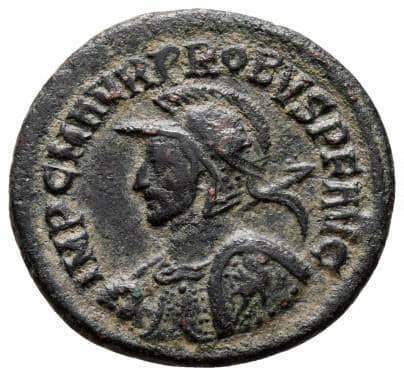
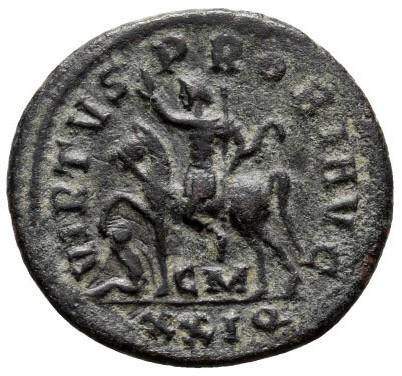
The Probus “Virtue of the Emperor” Antoninianus (RIC V Probus 888) is a high-octane silver-washed window into the “Restoration of the World.” Struck between AD 276–282 in Cyzicus (on the coast of modern-day Turkey), this coin captures one of Rome’s most tireless soldier-emperors in his natural element: at the head of a charging legion.
1. The Historical Context: The Whirlwind of Cyzicus
Probus was the successor to the legendary Aurelian, and he shared his predecessor’s relentless drive. Cyzicus was a vital strategic mint for the defense of the East and the Balkans. This coin was likely minted to celebrate Probus’s successful campaigns against the Germanic tribes in Gaul or his pacification of the Isaurian pirates in Asia Minor.
By featuring the VIRTVS PROBI AVG (The Virtue of Probus the Augustus) legend, the mint was making a bold claim. It wasn’t just “generic” military courage being celebrated, but the personal bravery of Probus himself. He was a “Barracks Emperor” who lived, ate, and fought alongside his men—a fact that eventually led to his downfall when he pushed them too hard to dig canals and plant vineyards during peacetime.
2. The Reverse: The Imperial Charge
The reverse features a powerful scene of military dominance: Probus is mounted on a horse, riding left, raising his right hand in a gesture of greeting or command (adlocutio) and holding a scepter. At the horse’s feet sits a bound captive.
- The Gesture of Power: The raised hand signals both his authority as a commander and his mercy as a protector of the Roman citizens.
- The Vanquished Foe: The seated captive is a blunt reminder of the cost of rebellion or invasion. It told the Roman public that the “Virtue” of the Emperor was a tangible force that resulted in the literal shackling of Rome’s enemies.
- The Legend: VIRTVS PROBI AVG.
3. The Obverse: The Armed Augustus
Depending on your specific specimen, the obverse features one of two striking military portraits:
- The Cuirassed Profile: The laureate and cuirassed bust facing right, showing the Emperor as the formal commander-in-chief in his ceremonial armor.
- The Warrior Helmeted Style: The helmeted, radiate, and cuirassed bust facing left, holding a spear and shield. This “heroic” bust is a favorite among collectors because it transforms the Emperor into a literal god of war, ready to strike from the surface of the coin.
- The Legend: IMP C M Q TRAIANVS DECIVS AVG. (Wait, correction: for your Probus, it is IMP C M AVR PROBVS P AVG).
4. Technical Details: The Cyzicus Excellence
- RIC V Probus 888: Cataloged in the fifth volume of Roman Imperial Coinage, documenting the era of the Illyrian soldier-emperors.
- The Mint: Struck in Cyzicus. The Cyzicus mint was known for its exceptionally sharp engraving and its distinctively “neat” lettering. You can often see the individual links of chainmail or the detailed harness on the horse.
- The Silvering: Probus’s Antoniniani from the East often retain a very high-quality silver wash. Finding a specimen from Cyzicus where the original “bright” silver surface still catches the light—especially on the raised details of the helmet or the horse’s mane—is a hallmark of a premier 3rd-century collection.
