
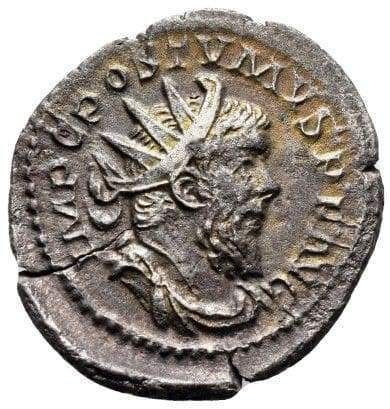
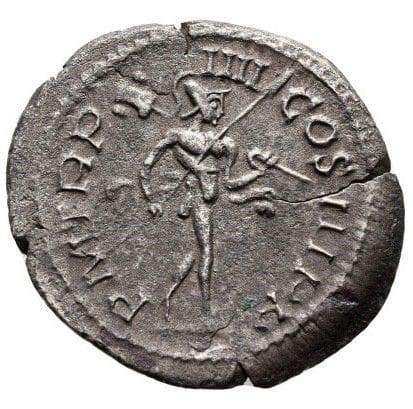
The Postumus “Mars the Victorious” Antoninianus (RIC V 57) is a defiant silver-washed treasure from the birth of the Gallic Empire. Struck around AD 262 at the capital of Treveri (modern-day Trier, Germany), this coin represents one of the most successful “breakaway” states in Roman history. It is a physical declaration of independence by a general who decided that if Rome couldn’t protect the Rhine, he would.
At Numiscurio, we often say that a Postumus strike is a “heavyweight” of the 3rd century; while the central Empire’s coins were shrinking and debasing, Postumus was busy striking large, high-quality radiates to prove his new empire was the “Real Rome.”
1. The Historical Context: The Birth of the Gallic Empire
In AD 260, the Roman world collapsed. The Emperor Valerian was captured by the Persians, and the Rhine frontier was being overrun by Germanic tribes. Postumus, the governor of Germania Superior, was hailed as Emperor by his troops. Instead of marching on Rome to seize the throne, he did something revolutionary: he stayed in Gaul to defend it.
For ten years, Postumus ruled a “Gallic Empire” consisting of Gaul, Britain, and Spain. This coin was struck during his third consulship (COS III), a period when his regime was at its strongest. By adopting all the traditional Roman titles, Postumus was telling his subjects that the “Eternal City” had moved to the banks of the Moselle River.
3. The Reverse: Mars on the March
The reverse features Mars, the god of war, walking right in a dynamic, purposeful stride. He holds a spear in his right hand and carries a trophy over his left shoulder.
- The Propugnator: This is Mars in his role as the “Forward Defender.” Unlike a stationary god, this Mars is actively moving toward the enemy. For the citizens of Gaul, this was a reassuring sight—it mirrored Postumus’s own constant campaigning against the Franks and Alamanni.
- The Trophy of Success: The trophy represents the captured arms of defeated barbarians. It was a visual “news bulletin” proving that Postumus’s legions were successfully holding the Rhine frontier.
- The Legend: P M TR P III COS III P P. These are the standard high Roman titles (Pontifex Maximus, Tribunicia Potestate III, Consul III, Pater Patriae), used here to project absolute legitimacy.
2. The Obverse: The Magnificent Beard of Gaul
The obverse features the radiate and draped (sometimes cuirassed) bust of Postumus, facing right.
- The “Gallic” Style: Postumus is famous among collectors for his iconic beard. While the emperors in Rome were often clean-shaven or lightly bearded, Postumus wore a thick, meticulously groomed beard that signaled his rugged, military character.
- Superior Artistry: The Treveri mint was operating at an incredible level of skill. Notice the “high relief” of the portrait and the sharp, elegant lettering. Postumus knew that to be taken seriously as a rival Emperor, his money had to look better than the official Roman issues—and usually, it did.
- The Legend: IMP C POSTVMVS P F AVG.
4. Technical Details: The Trier “Silver”
- RIC V 57 Cataloged in the fifth volume of Roman Imperial Coinage, the primary reference for the “Usurper” empires.
- The Mint: Struck in Treveri (Trier). This was the administrative heart of the Gallic Empire, and the minting quality here remained high even as the rest of the world struggled.
- The Billon Standard: While technically “billon” (a silver-copper alloy), the Gallic antoniniani of this period typically contain more silver than those of Gallienus in Rome.
- The Collector’s “Tell”: Look for the detail in the musculature of Mars and the individual spearhead. Finding a specimen with a clear, lustrous silver wash still clinging to the “radiate” spikes of Postumus’s crown is a major highlight for any specialist of the 3rd-century “Breakaway” empires.
