
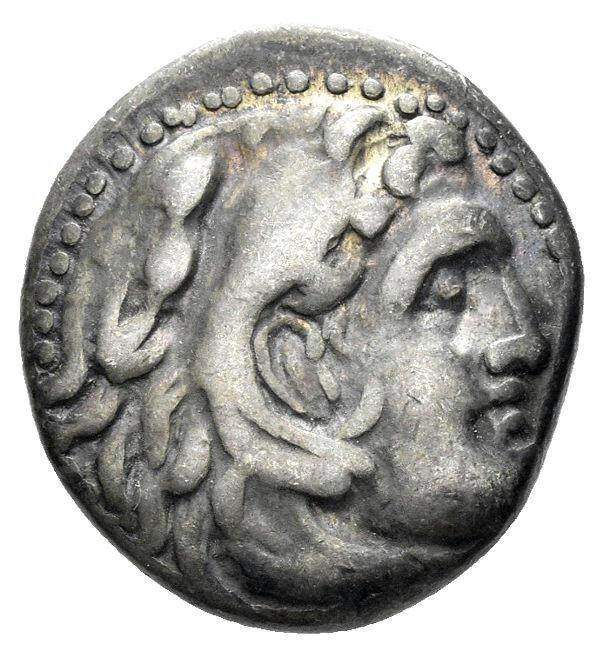
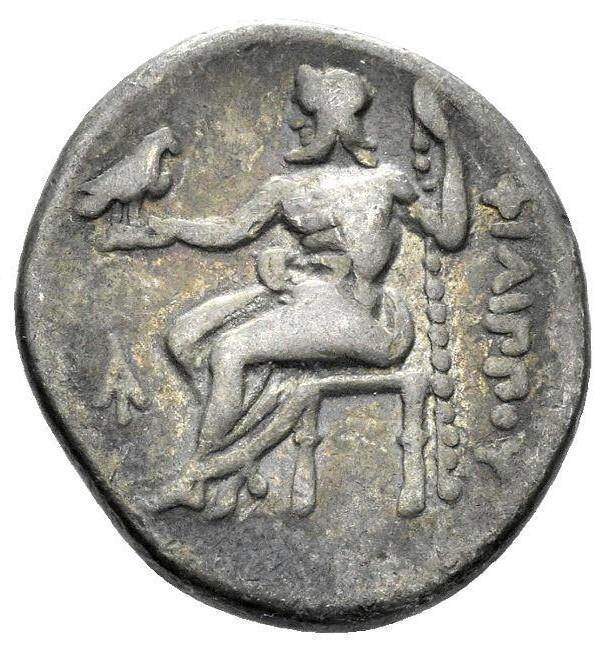
The Philip III Arrhidaios “Royal Shadow” Drachm (Price P56) is a poignant silver artifact from the chaotic decade following the death of Alexander the Great. Struck between 323–319 BC at the prestigious mint of Sardeis (modern-day Turkey), this coin represents one of the most fragile moments in Hellenistic history—the attempt to keep a crumbling empire together under the name of a king who could not rule.
At Numiscurio, we often say that a coin’s “soul” is found in its name; while the face on this coin is the same as Alexander’s, the legend tells the story of his half-brother, a man caught in the crossfire of the Diadochi (the Successors).
1. The Historical Context: The King Who Was Not There
When Alexander the Great died in Babylon in 323 BC, he left no clear heir. The Macedonian army proclaimed his half-brother, Philip III Arrhidaios, as king. However, Philip III was reported to be mentally disabled, making him a perpetual pawn in the hands of Alexander’s ambitious generals.
This drachm was struck at Sardeis, the ancient Lydian capital and a strategic powerhouse in Asia Minor. During these four years, the city was under the control of Menander (and later Kleitos the White), who struck these coins in Philip’s name to pay the Macedonian veterans. It was a visual lie of stability: using the famous “Alexander-style” imagery to validate a king who was effectively a royal prisoner.
2. The Obverse: Herakles and the Argead Claim
The obverse features the Head of Herakles, facing right, wearing the Leonté (Nemean lion skin).
- The Bloodline: Like his father Philip II and his brother Alexander, Philip III used Herakles to assert his divine right to rule. Even as the empire was being carved up by generals like Ptolemy and Seleucus, the coinage insisted that the Argead bloodline remained supreme.
- The High Relief of Sardeis: The Sardeis mint was renowned for its artistic heritage (going back to Croesus). The engravers here treated the lion’s mane and the facial features of Herakles with a sculptural depth that is often superior to the more “mass-produced” coins of Babylon.
3. The Reverse: Zeus and the Royal Name
The reverse features Zeus Aëtophoros (the Eagle-Bearer) seated left on a high-backed throne, holding an eagle in his outstretched right hand and a long scepter in his left.
- The Legend: The Greek inscription reads ΦIΛIΠΠOY (Philippou — “Of Philip”). This is the key identifier for collectors. While the design is identical to Alexander’s coinage, the change in name marks the official shift in power after June 323 BC.
- The Sardeis Monogram: In the left field, there is a specific monogram (a combination of Greek letters). In Price’s catalog (P56), these marks help us identify the specific magistrate or workshop in Sardeis responsible for the purity and weight of the silver.
- The Throne Detail: Notice the legs of the throne; on well-preserved Sardeis strikes, you can see intricate carvings, a hallmark of the city’s luxury traditions.
4. Technical Details: The Post-Alexander Silver
- Price P56: Cataloged in Martin Price’s definitive work, The Coinage in the Name of Alexander the Great and Philip Arrhidaios.
- The Mint: Sardeis. As one of the primary treasuries of the Persian Empire before Alexander conquered it, Sardeis remained a critical hub for the Diadochi wars.
- The Metal: Silver Drachm. This was the “daily wage” for a high-ranking soldier or a skilled artisan in the Hellenistic world.
- The Patina: These silver coins often develop a beautiful, iridescent “horn silver” or a dark, “cabinet” toning over centuries. Finding a specimen where the eagle’s wings or the letters of Philip’s name are still sharp is a major highlight for any specialist of the Successor period.
