
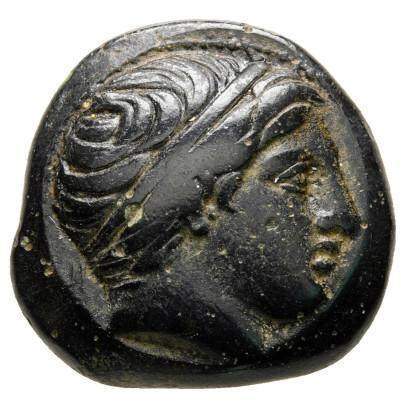
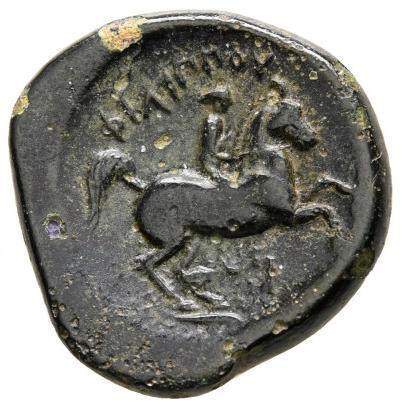
The Philip II “Olympic Youth” Bronze (SNG Copenhagen 585) is a masterclass in ancient political branding. Struck between 359–336 BC at the royal Macedonian capital of Pella, this coin represents the moment the “Backwater Kingdom” of Macedon transformed into the superpower of the Greek world. While Philip’s gold and silver funded his phalanx, these bronzes (likely chalkoi or dichalkoi) were the coins that circulated in the markets of Pella, carrying the King’s personal glory into the hands of every citizen.
1. The Historical Context: The Rise of the Argead Star
When Philip II took the throne in 359 BC, Macedon was surrounded by enemies and fractured by internal strife. Through a combination of military innovation and diplomatic brilliance, he unified the kingdom and eventually brought all of Greece under his hegemony.
But Philip wasn’t just a warlord; he was a statesman who understood the power of prestige. In 356 BC, his horse won the race at the Olympic Games. In a world where only Greeks were allowed to compete, this victory was Philip’s “passport” into civilized society. He was so proud of this win that he featured the horse and rider on his coinage for the rest of his life, ensuring everyone knew that the King of Macedon was a true, Hellenic victor.
2. The Obverse: The Radiant Apollo
The obverse features the Diademed Head of Apollo, facing right.
- The God of Order: Apollo was the patron of the Pythian Games and the god of music, prophecy, and light. By placing Apollo on his bronze coinage, Philip was aligning himself with the most “civilized” of the Greek gods.
- The Pella Style: The mint at Pella was the artistic heart of the kingdom. Notice the fine, youthful features of Apollo—often rendered with a sharp, classical profile that rivals the work of the best engravers in Athens or Corinth.
- The Diadem: The simple headband (diadem) signifies Apollo’s divine status, but it also subtly mirrors the headbands worn by victorious athletes.
3. The Reverse: The Olympic Victor
The reverse features a youth on horseback, galloping to the right. Above or below the horse is the Greek legend ΦIΛIΠΠOY (Philippou — “Of Philip”).
- The Olympic Connection: The youth is often identified as the jockey who rode Philip’s horse to victory at Olympia. In the 4th century BC, it was the owner of the horse, not the rider, who received the crown. This coin is Philip’s permanent trophy.
- The Macedonian Cavalry: Beyond the Olympics, the image celebrates the “Hetairoi” (the Companion Cavalry), the elite noble horsemen who were the decisive “hammer” in Philip’s military tactics.
- The Legend: The name ΦIΛIΠΠOY was a bold statement. It was the first time a Macedonian king’s name appeared so prominently on such a massive scale of bronze currency.
4. Technical Details: The Pella Bronze
- SNG Copenhagen 585: Cataloged in the Sylloge Nummorum Graecorum, the standard reference for Greek bronze issues.
- The Mint: Pella. As the birthplace of Alexander the Great and the administrative center of the kingdom, Pella produced some of the most high-quality bronze strikes of the era.
- The Metal: Bronze (AE). These were the essential “low-denomination” coins used for daily transactions.
- The Patina: Macedonian bronzes from Pella often develop a stunning, dark “forest green” or “chocolate brown” patina. Finding a specimen where the jockey’s arm or the horse’s individual muscles are still visible is a sign of a premier Philip II collection.
