
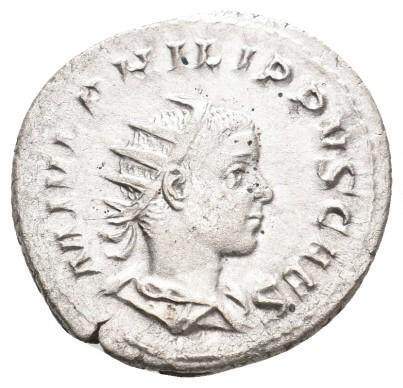
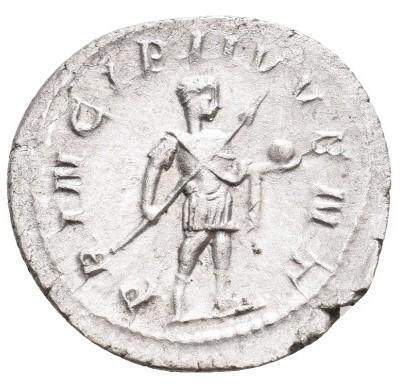
The Philip II “Prince of Youth” Antoninianus (RIC IV 216) serves as a poignant silver-washed window into the dynastic ambitions of a father and the tragic brevity of a son’s life. Struck between AD 244–246, this coin captures the young Marcus Julius Philippus at the precise moment he was being groomed to inherit the Roman world, a world that was rapidly fracturing under the weight of the “Crisis of the Third Century.”
At Numiscurio, we often say that a coin’s “soul” is found in the contrast between its grand imperial titles and the actual vulnerability of the child depicted on the obverse.
1. The Historical Context: The Heir of the “Arab”
Philip II was only seven years old when his father, Philip the Arab, ascended to the throne after the mysterious death of Gordian III on the Persian frontier. To secure his new dynasty, the elder Philip immediately elevated his son to the rank of Caesar. This coin was part of a massive propaganda campaign to legitimize the new family in the eyes of the Roman Senate and the legions.
This piece was minted as the Empire prepared for its most significant anniversary: the 1,000th year of the founding of Rome (the Saeculum Novum). By featuring the young Philip as the “Prince of Youth,” the administration was promising a new millennium of stability. Sadly, the promise was hollow; just a few years later, in AD 249, both father and son would be cut down by the troops of the usurper Decius.
2. The Reverse: The Prince of Youth
The reverse features Philip II, dressed in full military attire, standing right. He holds a globe in his right hand and a transverse scepter in his left.
- The Globe of Command: Even as a young boy, Philip is shown holding the world in his hand. This is the ultimate symbol of Cosmic Governance—the idea that the Roman Emperor was the divinely appointed caretaker of the entire earth.
- The Transverse Scepter: Unlike a vertical scepter of stationary rule, the transverse (diagonal) scepter is a more “active” military symbol, reflecting the Princeps Iuventutis (Prince of Youth) as the honorary leader of the Roman equestrian order and the future commander of the legions.
- The Legend: PRINCIPI IVVENT. This traditional title was given to the designated heir of the throne, marking him as the first among the Roman youth.
3. The Obverse: The Child Caesar
The obverse features the radiate, draped, and cuirassed bust of Philip II, facing right.
- The Adolescent Portrait: On RIC 216, Philip is still depicted with the soft, rounded features of a child. Notice the short-cropped “military” hairstyle, which was meant to make him look disciplined and ready for the barracks, despite his age.
- The Caesar Title: The legend M IVL PHILIPPVS CAES is key. At this stage, he had not yet been raised to the full rank of Augustus. The title “Caesar” identified him specifically as the junior partner and heir.
- The Legend: M IVL PHILIPPVS CAES.
4. Technical Details: The Last “High-Quality” Billon
- RIC IV 216: Cataloged in the fourth volume of Roman Imperial Coinage, representing the mid-point of the 3rd-century crisis.
- The Mint: Struck in Rome. The Philip era is known for having some of the most consistent and aesthetically pleasing strikes of the mid-200s. The engraving is often very clear, particularly in the details of the cuirass (armor) on the shoulder.
- The Silvering: Like most Antoniniani of this period, the coin was made of “billon” (a low-grade silver alloy) and given a bright silver wash. Finding a specimen where the silvering is still intact across the “radiate crown” is a great way to see the coin as it looked when it was first paid out to a Roman soldier.
