
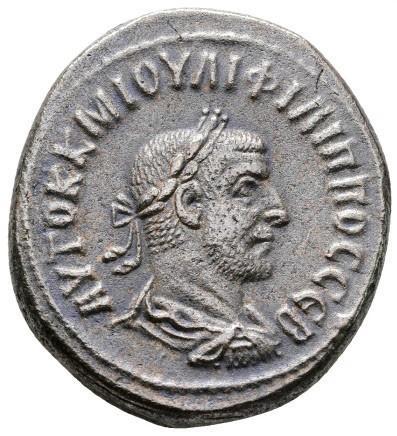
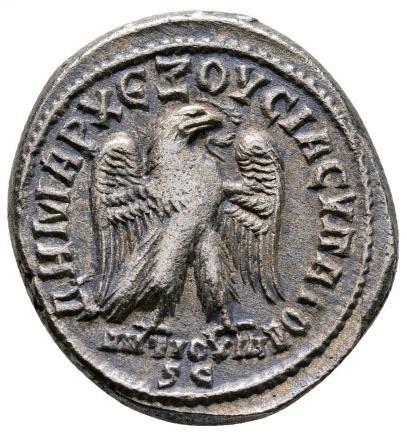
The Philip I “Arab” Billon Tetradrachm (Prieur 329) is a massive, silver-washed monument to one of the most improbable rises in Roman history. Struck between AD 247–249, this coin represents the high-stakes propaganda of the mid-3rd Century Crisis. Philip was a man from the edges of the empire who found himself at the helm during Rome’s most symbolic moment: its 1,000th Anniversary.
At Numiscurio, we often say that a provincial tetradrachm is a “cultural hybrid”; it carries the weight and language of the Greek East, but the iron-fisted authority of the Roman Emperor.
1. The Historical Context: From the Desert to the Throne
Marcus Julius Philippus, known to history as Philip the Arab, was born in the Roman province of Arabia (modern-day Syria). A career soldier and Praetorian Prefect, he rose to power after the death of the young Gordian III during a campaign against the Persians.
Philip’s reign was defined by the Saeculum Novum—the “New Age.” In AD 248, he presided over the Ludi Saeculares, the spectacular games celebrating the millennium of Rome’s founding. To fund these celebrations and pay the Eastern legions, the mint at Antioch (his regional power base) went into overdrive, producing these thick, impressive tetradrachms that dominated the economy of the Levant.
2. The Obverse: The Soldier from the East
The obverse features the laureate, draped, and cuirassed bust of Philip I, facing right.
- The Military Portrait: Notice the short, cropped hair and the “stubble” beard. This was the look of a soldier-emperor, designed to show he was a man of the camps, not the palace.
- The High Relief: The Antioch mint was famous for its bold, expressive portraiture. The engravers captured Philip’s heavy features with a realism that reflects the rugged nature of 3rd-century politics.
- The Legend: ΑΥΤΟΚ Κ Μ ΙΟΥΛΙ ΦΙΛΙΠΠΟC CЄΒ. This is the Greek translation of the standard Roman titles: Imperator Caesar Marcus Iulius Philippus Augustus.
3. The Reverse: The Eagle of the Legions
The reverse features the iconic Eagle, standing right with wings spread, holding a wreath in its beak.
- The Symbol of Zeus and Rome: The eagle was both the bird of Zeus (honoring Antioch’s Greek heritage) and the Aquila of the Roman legions. It represented the “watchful eye” of the state over the Eastern provinces.
- The S C (Senatus Consulto): Beneath the eagle, the letters S C appear. While usually found on bronze coins in Rome, on these Eastern silver issues, they served as a mark of official Senatorial authority, legitimizing Philip’s rule in the eyes of the Greek-speaking world.
- The Legend: ΔHMAPX ΕΞOYXIAX YΠA TOΓ (Demarchikes Exousias Hypatos To Gamma). This translates to “Tribunician Power, Consul for the Third Time.”
- The Mint Signature: The word ANTIOXIA in the exergue leaves no doubt about this coin’s origin as the “silver heart” of Roman Syria.
4. Technical Details: The “Billon” Era
- The Denomination: The Tetradrachm was a four-drachma coin. By Philip’s time, these were made of billon—a mixture of silver and copper. When fresh, it would have been silver-washed and brilliant; today, they often have a rich, greyish-toning.
- The Mint: Antioch. As one of the largest cities in the empire, its mint was a logistical marvel, supplying currency for the entire Persian frontier.
- The Collector’s “Tell”: Look for the detail in the eagle’s feathers and the individual leaves of Philip’s laurel wreath. Finding a specimen where the “S C” is sharp and the “ANTIOXIA” is fully legible is a sign of a premier 3rd-century collection.
