
The Nero “Victory” As (RIC I 312) serves as a striking silver-screened window into the golden facade of an Emperor whose reign was as theatrical as it was tumultuous. Struck around AD 65, this bronze piece was minted during the high-drama years following the Great Fire of Rome—a period when Nero was doubling down on his public image as the divinely favored protector of the Roman people.
At Numiscurio, we often say that a coin’s “soul” is found in its ability to project a sense of triumph even as the actual political ground is shifting beneath the Emperor’s feet.
1. The Historical Context: The Artist-Emperor’s Propaganda
By AD 65, Nero had moved away from the sobering influence of his advisors, Seneca and Burrus, leaning fully into his own vision of a “cultural” Empire. While the Senate whispered about his extravagances and his stage performances, the common people—the ones using this bronze As in the markets—were being treated to a relentless marketing campaign of Roman success.
This coin was minted shortly after the Roman general Corbulo had secured a massive diplomatic victory over the Parthians in Armenia. Nero, never one to miss a moment for self-promotion, used this “Victory” type to claim the glory for himself. It acted as a visual shield, protecting his reputation from the mounting Pisonian conspiracies and the astronomical costs of rebuilding Rome after the fire.
Because Nero was a dedicated patron of the arts, the die-engravers of his reign reached a level of realism and beauty that many numismatists argue was never surpassed in Roman bronze. Finding a RIC 312 in “Choice VF” where the individual feathers of Victory’s wings are distinct is a major addition to any collection of the Julio-Claudian dynasty.
2. The Reverse: Victory and the Sacred Shield
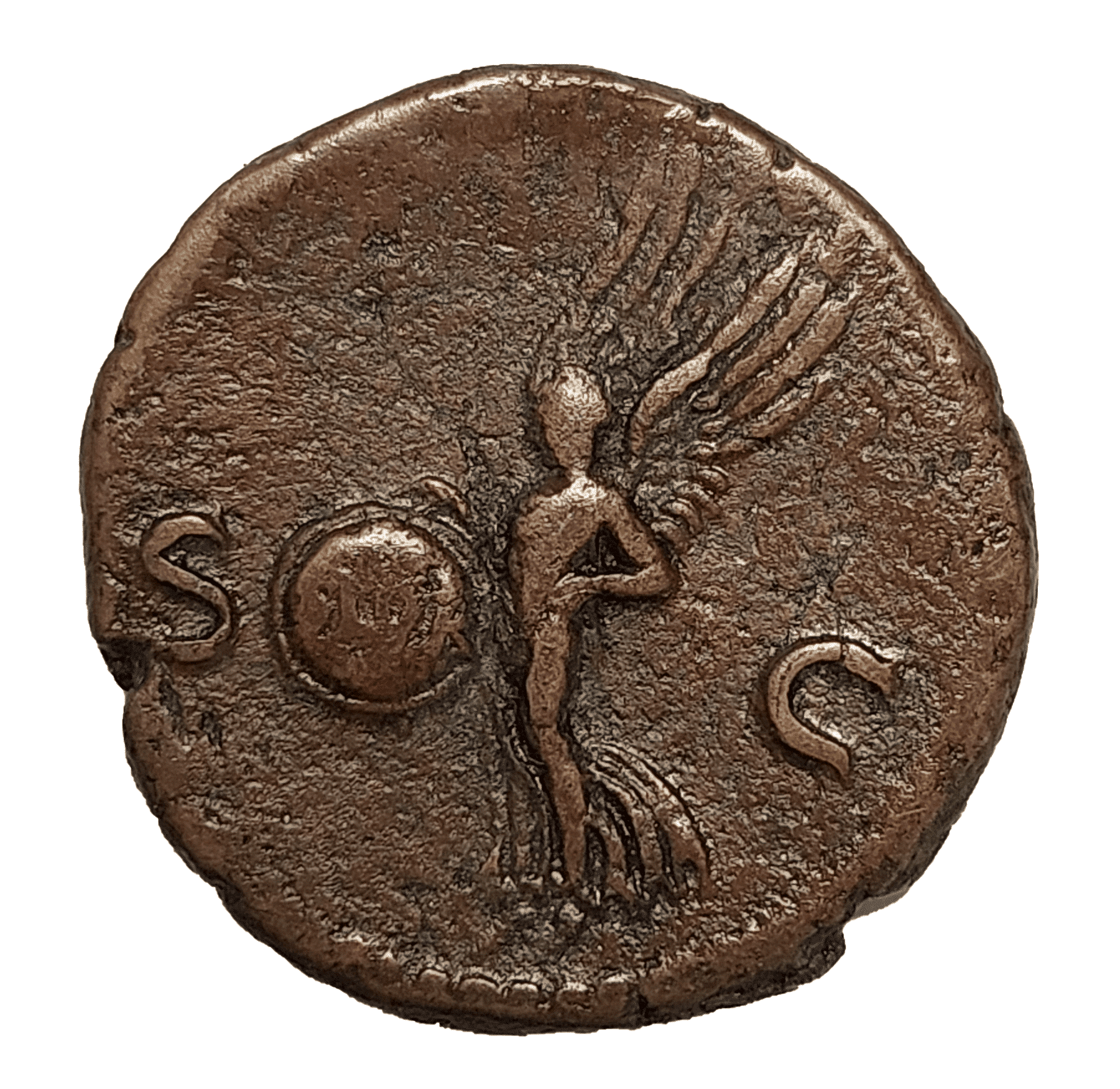
The reverse features Victory (Victoria), winged and draped, moving left, holding a shield inscribed S P Q R.
- The Shield of the State: The inscription S P Q R (Senatus Populusque Romanus) on the shield is a masterstroke of political branding. It suggests that Nero’s victories were not just his own, but were won for the Senate and the People of Rome—a vital message when his relationship with the aristocracy was at its breaking point.
- The Motion of Triumph: Unlike the static Victory poses of earlier emperors, Nero’s Victory is often depicted with a sense of fluid movement. She is actively carrying the news of success into the heart of the city.
- The Legend: S – C. This stands for Senatus Consulto (By Decree of the Senate), the standard mark on bronze coins reminding the user that this currency was legally backed by the Roman government.
3. The Obverse: The Julio-Claudian Portrait
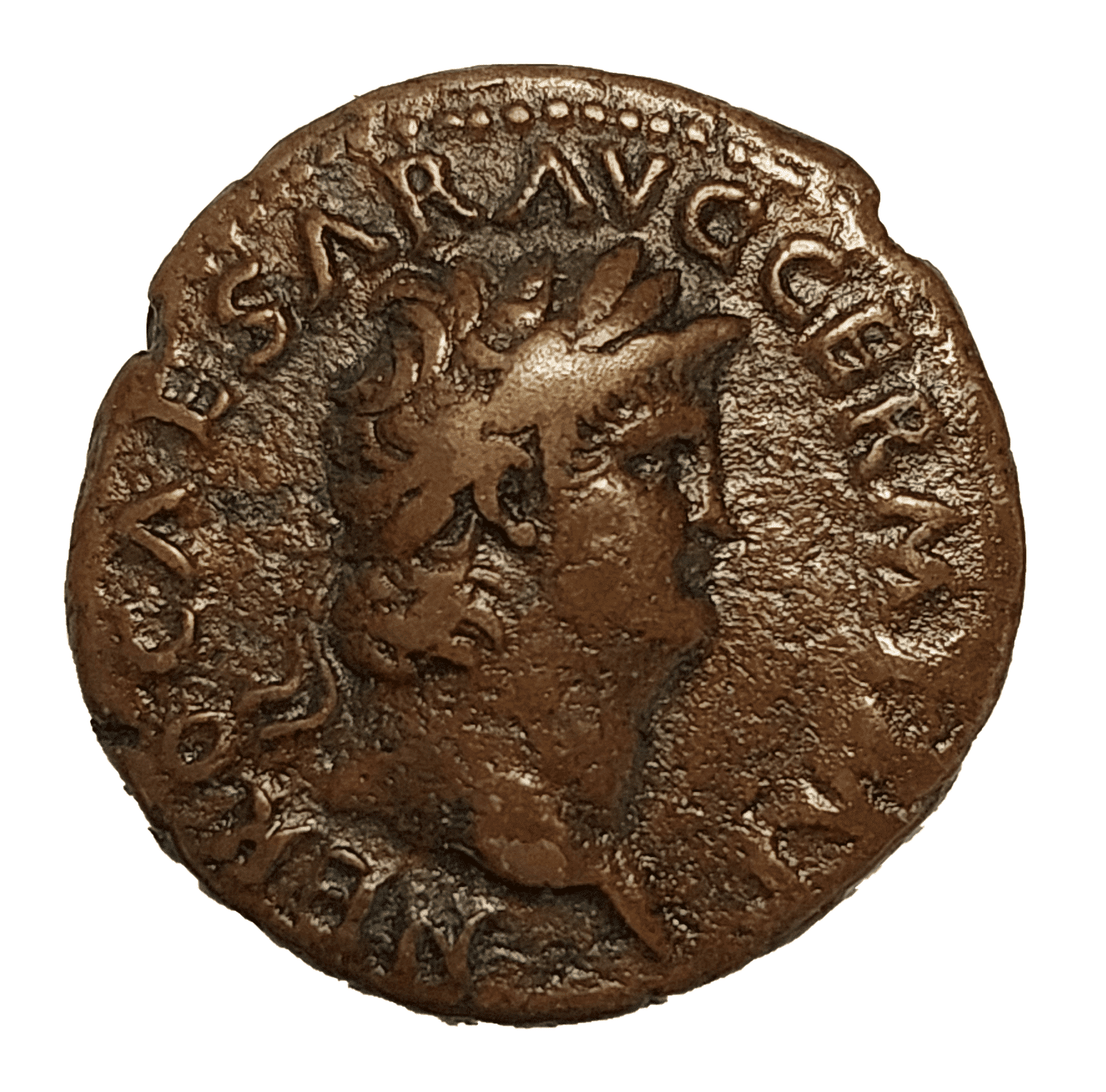
The obverse features the laureate head of Nero, facing right.
- The Late-Reign Look: Note the “heavy” features of the portrait. Nero is depicted with a fleshy neck and a distinctively styled, almost “stepped” hairstyle across his forehead. This was the “New Nero”—an Emperor who was well-fed, prosperous, and far removed from the slender, boyish youth who had first taken the throne.
- The Imperial Titles: The legend includes GERM (Germanicus), honoring his family’s ancestral victories in Germany, and IMP, marking him as the supreme commander.
- The Legend: NERO CAESAR AVG GERM IMP.
4. Technical Details: The Orichalcum Standard
- RIC I 312: Cataloged in the revised Roman Imperial Coinage, Volume I.
- The Mint: Struck in Rome (though some variants were produced in Lugdunum). Nero’s Rome mint was known for using high-quality copper and orichalcum. When these coins were brand new, they shone like gold, making them an incredibly impressive piece of propaganda in the hands of a common citizen.
- The Artistic Relief: Nero’s bronze coinage is famous for its high relief and “medallic” style. The engravers clearly put extra effort into the portraiture, capturing the Emperor’s likeness with a level of detail that feels remarkably modern.
