
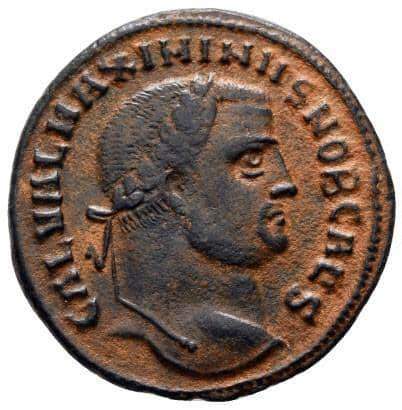
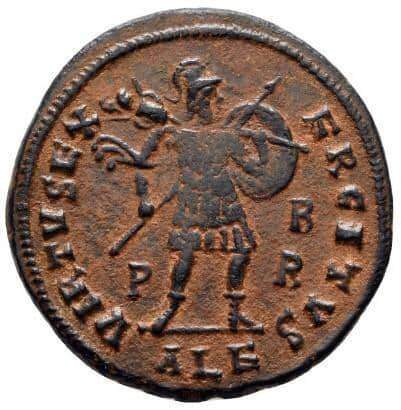
The Maximinus II Daia “Virtue of the Army” Follis (RIC VI Alexandria 83) serves as a striking bronze window into the final, defiant years of the Roman Tetrarchy. Struck around AD 308, this piece captures Maximinus Daia—the nephew of the Emperor Galerius—at a moment when he was a “Caesar” in title but a warlord in practice, fighting to hold the wealthy Eastern provinces against a sea of rivals.
1. The Historical Context: The Shepherd-Soldier of the East
Maximinus Daia’s rise was the ultimate Roman success story. Born a humble shepherd in Illyria, he was plucked from obscurity by his uncle and thrust into the highest levels of power. By the time this coin was minted in Alexandria, the “Rule of Four” (the Tetrarchy) was collapsing into civil war.
Maximinus was a staunch traditionalist. While his western rivals were beginning to flirt with new religious ideas, Daia doubled down on the old gods and the cult of the soldier. This coin was his manifesto: by celebrating Virtuti Exercitus (The Virtue of the Army), he was telling the elite legions of Egypt and Syria that their strength was the only true law of the Empire.
2. The Reverse: Mars the Trophy-Bearer
The reverse features Mars, the god of war, in full military dress, advancing or standing right. He carries a vertical spear and a shield, but the most important detail is the trophy slung over his shoulder.
- The Captured Spoils: The trophy represents the armor and weapons of a defeated enemy stripped from the battlefield. It was a visual promise of plunder and victory for the soldiers who carried this follis in their pouches.
- The Active God: Unlike the static, peaceful depictions of gods seen in earlier centuries, this Mars is “on the march.” It reflects the restless, high-stakes military atmosphere of the early 4th century.
- The Legend: VIRTVTI EXERCITVS. A direct dedication to the “Virtue (or Valor) of the Army.” In an age of usurpers, the Emperor’s survival depended entirely on the virtus of his men.
3. The Obverse: The Tetrarchic “Block” Style
The obverse features the laureate head of Maximinus Daia, facing right.
- The Iron-Jawed Portrait: Notice the specific “Tetrarchic” style of the portrait—the thick neck, the square jaw, and the close-cropped military beard. This wasn’t meant to be a delicate likeness; it was intended to convey an image of indestructible, granite-like authority.
- The Noble Caesar: The legend GAL VAL MAXIMINVS NOB C (Galerius Valerius Maximinus Nobilissimus Caesar) identifies him as the “Most Noble Caesar.” Even though he felt he deserved the higher rank of Augustus, he used this title to maintain a veneer of legality within the imperial system.
- The Legend: GAL VAL MAXIMINVS NOB C.
4. Technical Details: The Alexandria Workshop
- RIC VI Alexandria 83: Cataloged in the sixth volume of Roman Imperial Coinage, which documents the complex era of Diocletian and his successors.
- The Mint: Struck in Alexandria, Egypt. The Alexandria mint was famous for its heavy, well-struck coins and its use of specific workshop marks (like A, B, Γ, or Δ) in the fields. You can identify the mint by the ALE mark in the exergue.
- The Follis Standard: These coins were originally issued with a thin silver wash (billon). Because Egypt’s climate is so dry, many Alexandrian folles survive today with incredible detail and “desert patinas”—sand-colored deposits that highlight the deep engraving of the die.
