
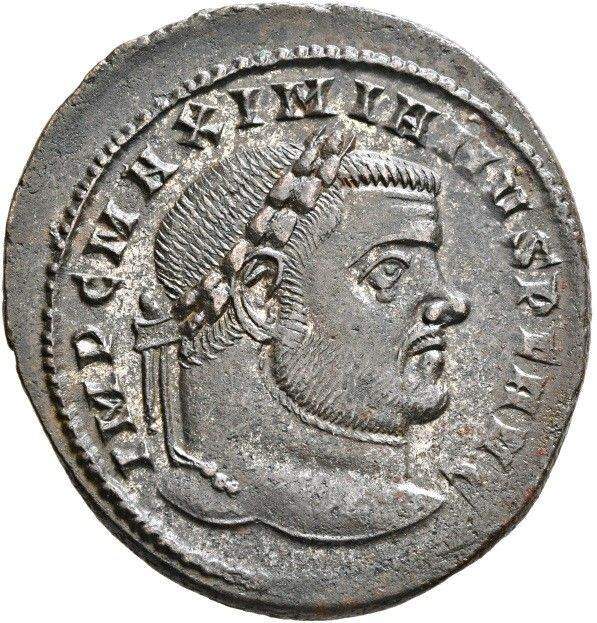
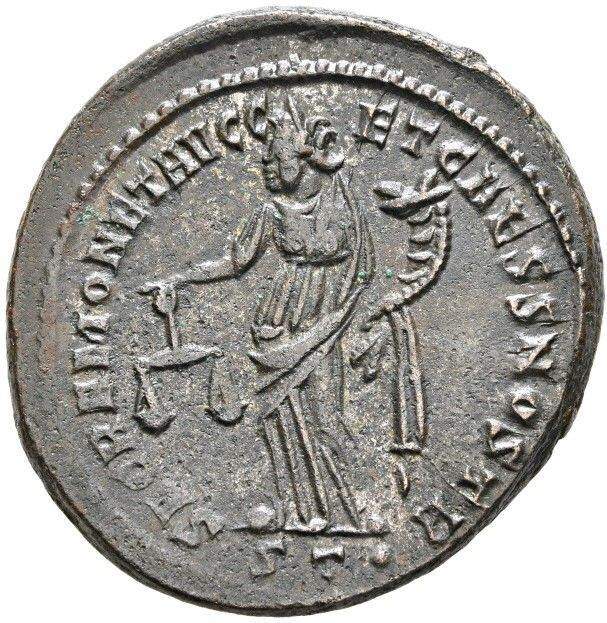
The Maximianus “Sacred Money” Follis (RIC VI Ticinum 463) is a heavy, commanding bronze struck around AD 300–303. This coin is a survivor of the Tetrarchy—the “Rule of Four”—a period when the Roman Empire was reorganized into a military machine of unprecedented scale. But what makes this specific piece truly special for any collector isn’t just the history of the Emperor; it’s the provenance of the soil from which it emerged.
At Numiscurio, we often say that a coin’s “soul” is found in its journey; to hold a piece from the Rauceby Hoard is to touch a hidden moment of 4th-century British history.
1. The Historical Context: The Rauceby Hoard
This coin was part of the spectacular Rauceby Hoard, discovered in Lincolnshire in July 2017. Consisting of over 3,000 copper-alloy coins, it is one of the largest Roman hoards ever found in the UK.
Finding a coin from the Ticinum (Pavia, Italy) mint in a British hoard tells us a great deal about the Roman economy. It shows that even in the remote reaches of Lincolnshire, the “Sacred Money” of the central Italian mints was flowing freely, paying the salaries of the bureaucrats and soldiers who kept the province of Britannia firmly within the Imperial fold. The light corrosion on this piece is a “badge of honor”—a physical reminder of the seventeen centuries it spent buried in the English earth.
2. The Reverse: The Goddess of the Mint
The reverse features Moneta, the personification of the Mint and the goddess of sound finance. She stands facing left, holding scales in her right hand and a cornucopia in her left.
- The Scales of Integrity: Under the Tetrarchy, the currency had been drastically reformed by Diocletian. The scales represented the “Sacred Weight” of the coin, a promise from the government that the money was honest and backed by the state.
- The Cornucopia of Plenty: This symbolized the prosperity that a stable currency was supposed to bring to the Empire after the chaos of the 3rd century.
- The Legend: SACRA MONET AVGG ET CAESS NOSTR. This translates to “The Sacred Money of our Augusti and Caesars,” acknowledging all four rulers of the Tetrarchy simultaneously.
3. The Obverse: The “Hercules” of the West
The obverse features the laureate head of Maximianus Herculius, facing right.
- The Tetrarchic Style: Notice the blocky, powerful, and almost “brutalist” style of the portrait. The Tetrarchs moved away from individual likenesses; they wanted to look identical—stern, square-jawed, and invincible—to project a sense of unified, unbreakable power.
- The Name of a Hero: Maximianus took the name Herculius to signal that he was the “earthly muscle” to Diocletian’s “Jupiter.” He was the warrior-emperor who held the West while Diocletian managed the East.
- The Legend: IMP C MAXIMIANVS P F AVG.
4. Technical Details: The Ticinum Strike
- RIC VI Ticinum 43b: Cataloged in the sixth volume of Roman Imperial Coinage, the definitive guide to the Great Reform.
- The Mint Mark: Look in the exergue for ST•. The T stands for Ticinum, and the S (Secunda) indicates it was struck in the 2nd Workshop of the mint. The dot (•) is a series mark used for internal inventory.
- The Silver Wash: These large folles were originally issued with a 3-4% silver wash (argentiferous bronze). While the Lincolnshire soil may have weathered the surface, traces of that original silvering often remain in the deep recesses of Maximianus’s laurel wreath.
