
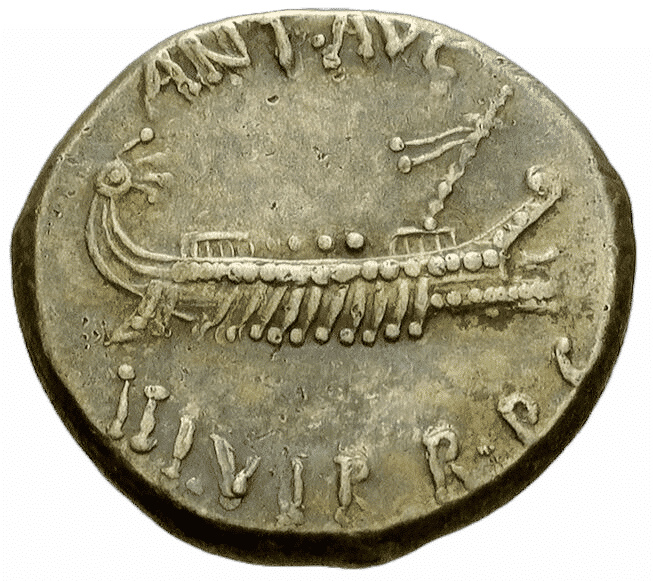
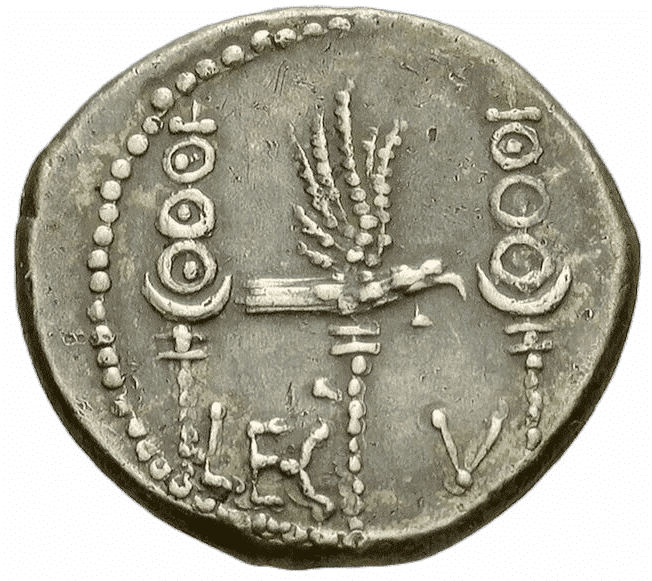
The Mark Antony Legionary Denarius (Crawford 544/18) is one of the most famous “military” coins in history. Struck in 32–31 BC, these coins were minted not in a city, but in a moving military camp as Antony prepared for the final, cataclysmic showdown of the Roman Republic: the Battle of Actium.
While most Roman coins were intended for the general public, this was a “soldier’s coin,” designed to buy the loyalty of the men who would decide the fate of the Mediterranean.
1. The Historical Context: The War of the Propaganda
By 32 BC, the alliance between Mark Antony and Octavian (the future Augustus) had shattered. Antony was in the East with Cleopatra, and Octavian was in Rome, portraying Antony as a man who had “gone Egyptian” and betrayed his Roman roots.
To counter this, Antony issued a massive series of silver denarii. These coins were a brilliant piece of counter-propaganda. They didn’t feature his face or Cleopatra’s; instead, they honored the Roman Legions. The message was clear: “I am still a Roman general, and these are the men who stand with me.”
2. The Obverse: The Praetorian Galley
The obverse features a Roman Praetorian Galley (a warship) moving right, with a row of twenty oars and a mast with banners.
- The Symbolism: Antony’s strength lay in his massive fleet and his control of the Eastern Mediterranean. The galley represented his ability to strike anywhere and his command of the seas.
- The Legend:
ANT AVG III VIR R P C.- ANT AVG: Antonius Augur (referring to his religious office).
- III VIR R P C: Triumvir Rei Publicae Constituendae (One of three men for the restoration of the Republic).
3. The Reverse: The Legio V Alaudae
The reverse of Crawford 544/18 specifically honors LEG V (Legion Five). Between two Signa (military standards) stands a Legionary Eagle (Aquila).
- The “Larks”: Legio V was known as Alaudae (The Larks). Originally raised by Julius Caesar in Gaul, they were famous for their bravery and for being the first legion composed of non-citizens (Gauls) who were later granted full Roman citizenship.
- Veterans of the East: By the time of Actium, the 5th was a veteran unit that had fought with Antony in his Parthian campaigns. By naming them on the coin, Antony was giving them a public “shout-out,” boosting morale before the fight against Octavian.
4. Technical Details & The “Antony” Silver
- Crawford 544/18: This refers to Michael Crawford’s Roman Republican Coinage, the definitive catalog for this era.
- Debasement: Because Antony had to pay roughly 200,000 soldiers and sailors, he had to stretch his silver. These denarii are notoriously “base”—meaning they have a lower silver content than Octavian’s coins.
- The “Banker’s Marks”: You will often see tiny “crescent” or “letter” punches on these coins. These are Banker’s Marks, made by ancient money-changers to test if the coin was solid silver or just silver-plated copper (fourrée).
