

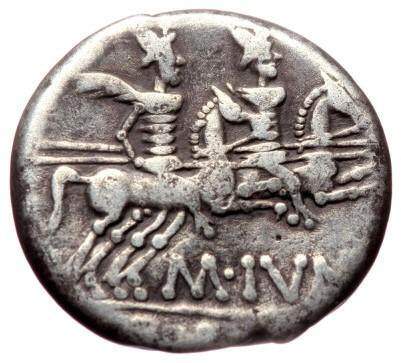
The M. Junius Silanus Denarius (RRC 228/1) serves as a striking silver window into the competitive, high-stakes world of the Roman Republic. Struck around 145 BC, this piece captures a moment when Rome was transitioning from a regional power to a global hegemon—and when the great aristocratic families, like the Junii, were beginning to use the Republic’s coinage as a personal family billboard.
1. The Historical Context: The Rise of the Junii
By 145 BC, Rome had just finished dismantling Carthage and Corinth. The city was flooded with silver, and the office of the Moneyer (Triumvir Monetalis) became the ultimate stepping stone for ambitious young politicians. Marcus Junius Silanus, the man behind this coin, was no exception.
While the obverse and reverse look like “standard” Roman currency, Silanus added a clever, punning “signature” behind the head of Roma. This was a era of “talking coins” (armes parlantes), where a symbol was worth a thousand words of political lineage. It marks the precise era when the Roman Denarius stopped just being money and started being a campaign poster for the next generation of Senators.
2. The Reverse: The Dioscuri on the Charge
The reverse features the Dioscuri (the twin brothers Castor and Pollux), galloping right with spears couched and stars above their caps.
- The Saviors of Rome: The Dioscuri were the patron saints of the Roman cavalry. Legend claimed they miraculously appeared at the Battle of Lake Regillus to lead the Romans to victory. By 145 BC, they were the “old guard” symbol of Republican strength.
- The Family Signature: Below the galloping hooves, you see the legend M IVNI, and in the exergue, ROMA. This was Silanus’s way of tethering his family name to the eternal protection of the Twin Gods.
- The Motion of Empire: Notice the wind-swept cloaks of the twins. The Republican engravers of the mid-2nd century BC were masters of depicting action on a tiny silver canvas.
3. The Obverse: Roma and the Secret Symbol
The obverse features the helmeted head of Roma, facing right, wearing a winged Attic helmet.
- The Head of an Ass: Tucked behind Roma’s neck is a small, curious symbol—the head of an ass (asinus). This is a classic Roman “pun” on the moneyer’s name, Silanus. In mythology, Silenus (the companion of Bacchus) was famously depicted riding an ass. By placing this symbol here, Marcus Junius Silanus was making sure that every Roman who spent this coin knew exactly which family had provided it.
- The Mark of Value: Below Roma’s chin is the X, indicating the coin’s value of 10 Asses. This was the classic weight standard before the “re-tariffing” of the denarius later in the century.
- The Heritage of the Junii: The Junii were one of Rome’s most storied families (claiming descent from Brutus, the man who drove out the kings). This coin is an early chapter in a family history that would eventually lead all the way to the assassination of Julius Caesar.
4. Technical Details: The Republican Silver Standard
- RRC 228/1: Cataloged in Crawford’s Roman Republican Coinage, the definitive guide to the era.
- The Mint: Struck in Rome. During this period, the mint was likely located on the Capitoline Hill, near the Temple of Juno Moneta.
- The Silver Quality: These mid-Republic denarii are famous for their exceptionally high silver purity (nearly .950 fine). They have a “heavy,” honest feel in the hand that reflects the stern, unyielding character of the Romans of the Punic War era.
